Aave at $132.29: $306.2M OI Reveals a Positioning Split
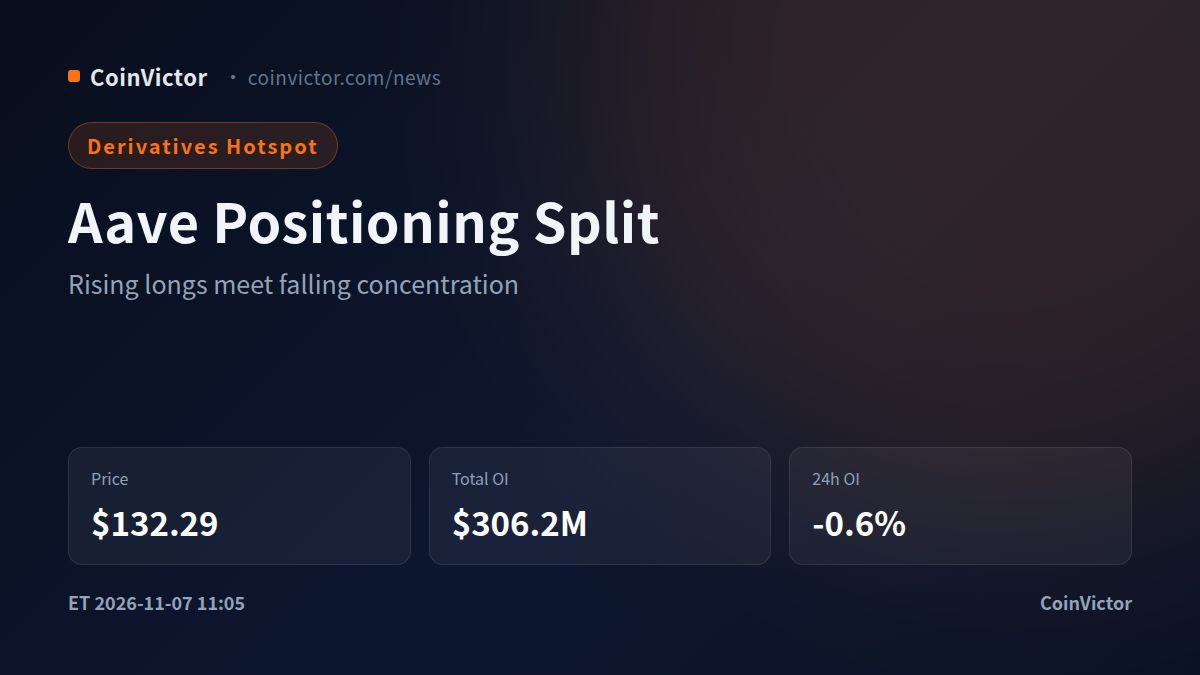
Aave is trading at $132.29, but its derivatives market is sending a divided message: total open interest is $306.2M after falling 0.6% in 24 hours, while the largest venue exposure is shrinking sharply. Recent coverage has highlighted Aave’s product rollout and uneven price momentum, framing the market as a potential breakout setup rather than a confirmed trend. The more useful signal now is positioning divergence, not the headline bounce.
Gate is the pressure point
Gate accounts for 20.1% of tracked AAVE OI, or $62.0M, making it the biggest single venue in the snapshot. Yet its exposure dropped 7.2% over 24 hours and 0.3% over the last 4 hours. That is a meaningful contrast with Binance, where $52.0M represents 17.0% of OI and increased 0.2% over 24 hours and 0.5% over 4 hours. Bybit carries another $48.3M, or 15.8%, with gains of 1.0% over 24 hours and 0.9% over 4 hours.
OKX is smaller at $14.7M and 4.8% of OI. Its daily change is negative at 0.9%, but its 4-hour change is positive at 2.2%. The split suggests that fresh leverage is appearing on selected major venues while the largest concentration is being unwound. That combination can support price temporarily, but it also leaves the market dependent on whether the rebuilding flow broadens beyond Binance and Bybit.
Funding confirms uneven conviction
Current funding rates are positive on Binance at 0.0053%, Bybit at 0.0017%, and Gate at 0.0020%, but negative on OKX at -0.0017% and KuCoin at -0.0053%. The range is wide: Aster is at 0.0100%, while the positive rate on Binance is more than three times the Bybit reading. This is not a uniform market-wide long premium. It is a venue-specific premium, strongest where directional demand is most aggressive.
The account-versus-taker split sharpens that conclusion. Across the ticker aggregate, 64.1% of accounts are long, while 80.2% of taker flow is long. On Binance, accounts are 60.2% long, but takers are 63.9% long. Gate is the extreme case: 58.0% of accounts are long, while 89.7% of active takers are long. Passive positioning is therefore only moderately bullish, whereas immediate market orders are heavily one-sided. That raises the risk that the latest buying is chasing rather than building a balanced base.
Liquidations favor a fragile rebound
The liquidation structure also diverges by window. Over 24 hours, long liquidations reached $185.4K against $34.5K for shorts, showing that earlier downside pressure forced out more bullish positioning. The largest event was a $145.7K long liquidation at $127.62. However, the 12-hour window flipped toward shorts, with $13.2K of short liquidations versus $1.3K of longs. In the latest 4-hour window, only $425.16 of shorts were liquidated and no longs were recorded.
That progression is consistent with a rebound from a long-clearing event, but it has not yet become a broad squeeze. The $18.8K largest short liquidation at $134.40 is also notable: it marks an overhead level where a move higher began to pressure short exposure, without producing the scale of liquidation seen on the downside.
Verdict: AAVE’s near-term setup is cautiously constructive but structurally divergent. The key downside reference is $127.62, where the largest long liquidation occurred; the key upside reference is $134.40, where the largest short liquidation occurred. With total OI at $306.2M and Gate’s $62.0M position contracting, the bullish view requires price to reclaim and hold $134.40 while OI rebuilds from $306.2M. A failure below $127.62, especially alongside renewed OI contraction, would invalidate the rebound thesis; conversely, a sustained move above $134.40 with broader OI expansion would invalidate the view that buying is mainly concentrated taker chasing.
Data as of 00:05 Beijing time on Nov 8, covering Binance, OKX, Bybit and other major venues.