Aave OI Climbs 7.1% as Funding Turns Negative at -0.0063%
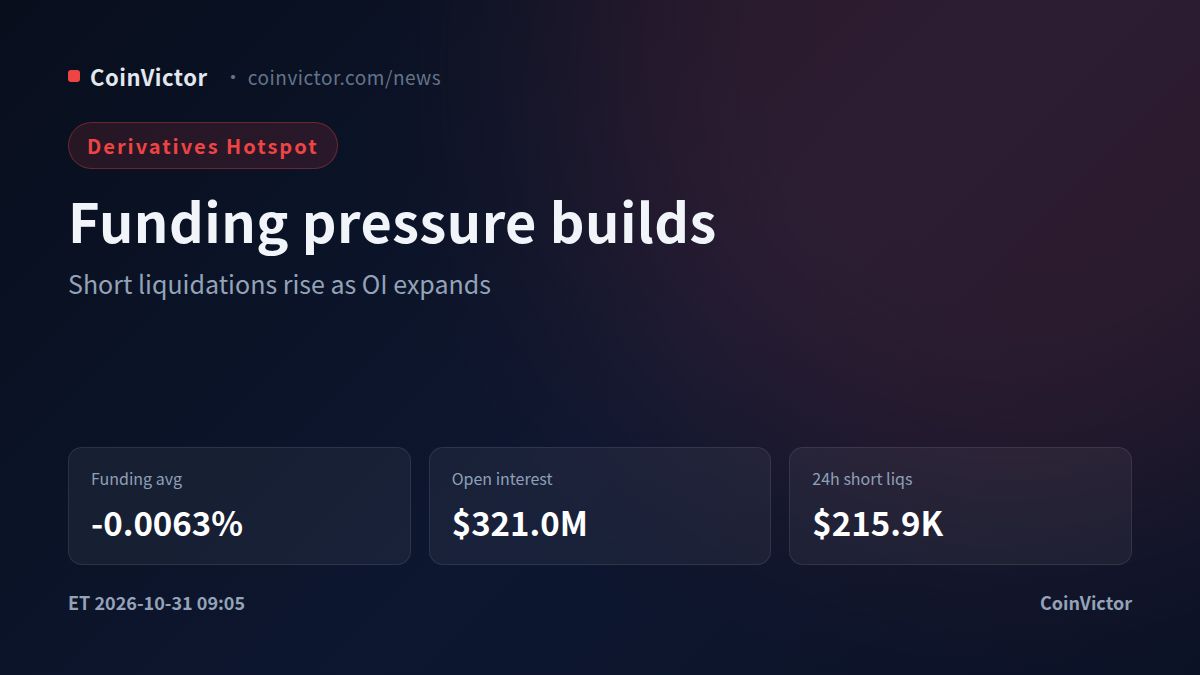
Aave is trading at $134.44 with open interest near $321.0M, up 7.1% over twenty-four hours, while its average eight-hour funding rate is -0.0063%. That combination is the central warning in the current derivatives setup: leverage is rebuilding into a market where shorts are receiving payments, yet the price has already gained 7.2%. Recent market coverage has described AAVE as facing technical pressure, with near-term moving averages overhead.
OI is expanding across the largest venues
The concentration of open interest is broad rather than isolated. Gate holds the largest reported share at 18.2%, equal to about $58.3M, although its twenty-four-hour increase is the slowest among the leading venues at 3.8%. Bybit accounts for 17.4%, or about $55.7M, after adding 8.3% in twenty-four hours and 5.3% over four hours. Binance contributes 17.1%, around $54.7M, with OI up 7.3% in twenty-four hours. Bitget adds another 7.5%, or about $24.1M, after a 5.7% daily increase.
OKX is smaller at 4.6%, but its positioning is more aggressive: OI has climbed 12.1% over twenty-four hours and 7.2% over four hours. Across the reported venues, total OI is about $321.0M and has risen 7.1%. The four-hour changes show that leverage is not merely a stale daily carryover; Bybit and OKX are building particularly quickly.
Funding is negative, but unevenly so
The funding map confirms a strong short-side incentive, though the pressure varies considerably by venue. Bybit shows -0.0252%, Bitfinex -0.0281%, and KuCoin -0.0358%, the deepest negative reading in the supplied set. OKX is also negative at -0.0160%, while Binance is less extreme at -0.0050% and Gate is at -0.0026%. Bitget sits at -0.0179%.
This dispersion matters. The aggregate average is negative because several large venues are below zero, but the market is not uniformly crowded into the same trade. Positive readings remain visible at Crypto.com, 0.0074%, and Lighter, 0.0096%, while Backpack and Hyperliquid are both at 0.0013%. Negative funding normally means longs pay shorts, so the current structure can attract additional long exposure even as short sellers retain a carry advantage on the most negative venues. That creates fuel for a squeeze in either direction rather than a clean directional signal.
Liquidations favor shorts while traders disagree
The liquidation structure is decisively short-heavy. Over twenty-four hours, short liquidations reached $215.9K versus $62.2K for longs, for a total of $278.1K. The same pattern appears in every shorter window: shorts lost $72.5K against $17.5K for longs over twelve hours, $57.2K against $9.3K over four hours, and $45.2K against only $106.7 over one hour.
That imbalance suggests the recent price advance has already forced some bearish positions out, even while negative funding continues to reward holding them. The long/short ratio adds another layer of tension. Across the ticker data, 58.8% of accounts are long, compared with 46.8% of active taker flow. On Binance, accounts are 55.0% long, but takers are only 23.2% long; in other words, active execution is heavily short. Gate is less extreme, with accounts 56.1% long and takers 46.5% long. Passive account positioning is therefore bullish, while aggressive trading remains defensive or bearish.
Verdict: At $134.44 and roughly $321.0M in OI, the negative-funding setup is a squeeze-risk market, not a confirmed breakdown. The key bearish signal is continued OI expansion alongside deeply negative funding and short-heavy taker flow; the view is invalidated if funding turns positive while OI keeps rising and short liquidations fade, showing that the bearish crowd has been absorbed. Data as of 21:05 Beijing time on Oct 31, covering Binance, OKX, Bybit and other major venues.