Aptos Basis Hits -17.4% Annualized as $81.2M OI Leans Bearish
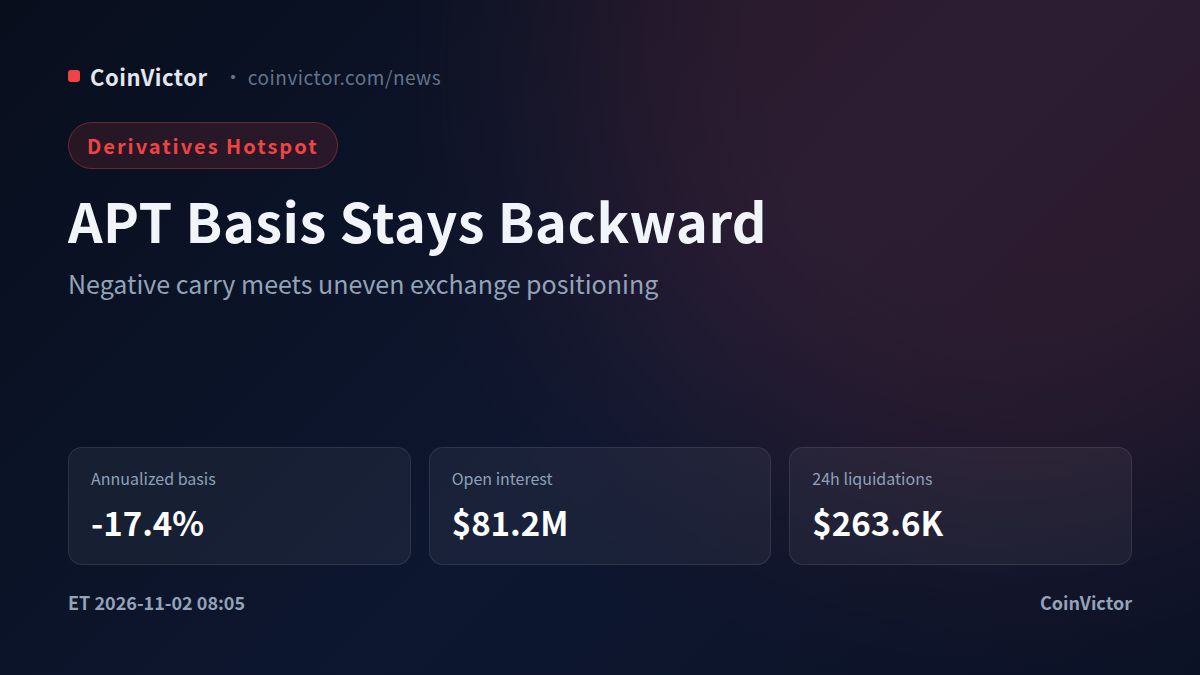
Aptos derivatives are pricing a clear defensive tilt: the basis is negative and annualized carry has fallen to -17.4%, while aggregate open interest is $81.2M after declining 0.7% over 24 hours. The combination matters more than the spot move alone. Traders are paying to maintain bearish futures exposure, but the shrinking OI suggests some leverage is being removed rather than aggressively added. Market commentary has also focused on persistent selling pressure and weak price structure, a backdrop that fits the negative carry signal.
Positioning is concentrated but not uniform
The exchange split shows why the headline OI number needs a venue-level read. Bybit holds the largest disclosed share at 20.6%, with $16.7M of OI and a 1.6% daily decline. Binance follows with 19.1% and $15.5M, down 4.9%, making it the clearest source of contraction among the largest venues. Gate contributes 16.2%, or $13.2M, but its OI rose 1.4%. Bitget is smaller at 7.5% and $6.1M, yet expanded 3.8%. OKX holds 5.5% and increased 3.0%.
This is a fragmented adjustment rather than a uniform unwind. The two largest reported venues are losing exposure while Gate, Bitget and OKX are adding it. That mix can keep the basis below zero: fresh positioning is appearing where liquidity is thinner, while larger books are reducing risk. The 4-hour changes sharpen the split, with Bitget up 2.4%, OKX up 1.8%, Binance up 0.5%, and Bybit down 0.5%.
Funding confirms a venue-level short bias
The funding rate map is predominantly negative across the venues carrying meaningful OI. Bitget, OKX, Bybit and Gate show negative readings, as do Bitfinex, Lighter, Backpack, Crypto.com and Hyperliquid. By contrast, Aster, KuCoin and WhiteBIT are positive, while Binance, Bitunix, Kraken, LBank and MEXC are also on the positive side. dYdX is flat.
That dispersion is important. A single exchange can show positive funding even while the broader futures curve remains backwardated. Here, the negative cluster includes several major venues, and the ticker-level average is also negative. The result is a carry signal that leans bearish without proving that every participant is short. Binance’s long/short account ratio is 1.1, with 52.3% of accounts long, a mild long majority that conflicts with the negative funding backdrop. No taker long/short reading is supplied, so the account data cannot be treated as evidence of aggressive buying.
Liquidations leave support under pressure
The liquidation structure is more damaging to longs. Over 24 hours, total liquidations reached $263.6K, including $190.0K in long liquidations against $73.6K in shorts. The 12-hour window shows the same imbalance: $22.0K in longs versus $73.6K in shorts, suggesting the latest flush hit shorts more heavily even though the full-day damage remains concentrated on long positions.
The largest recorded long liquidation occurred at $0.6099 and was worth $58.3K. Other long liquidations appeared at $0.6178 and $0.6152, while the largest short liquidation was at $0.6397 and totaled $47.2K. These levels define a practical stress band. A move toward $0.6099 would reopen the long-liquidation pocket, while a recovery through $0.6397 would challenge the current short-carry structure.
Verdict: The dominant signal remains bearish backwardation: negative funding, -17.4% annualized basis, and $81.2M OI with the largest books contracting. The key downside level is $0.6099, while $0.6397 is the first price level that can invalidate the bearish view if Aptos reclaims it as OI rebuilds from $81.2M and funding turns broadly positive. Until that combination appears, the uneven venue expansion looks more like short-side repositioning than a durable reversal. Data as of 21:05 Beijing time on Nov 2, covering Binance, OKX, Bybit and other major venues.