Arbitrum Derivatives: 20.7% OI Share Meets 66.8% Long Accounts
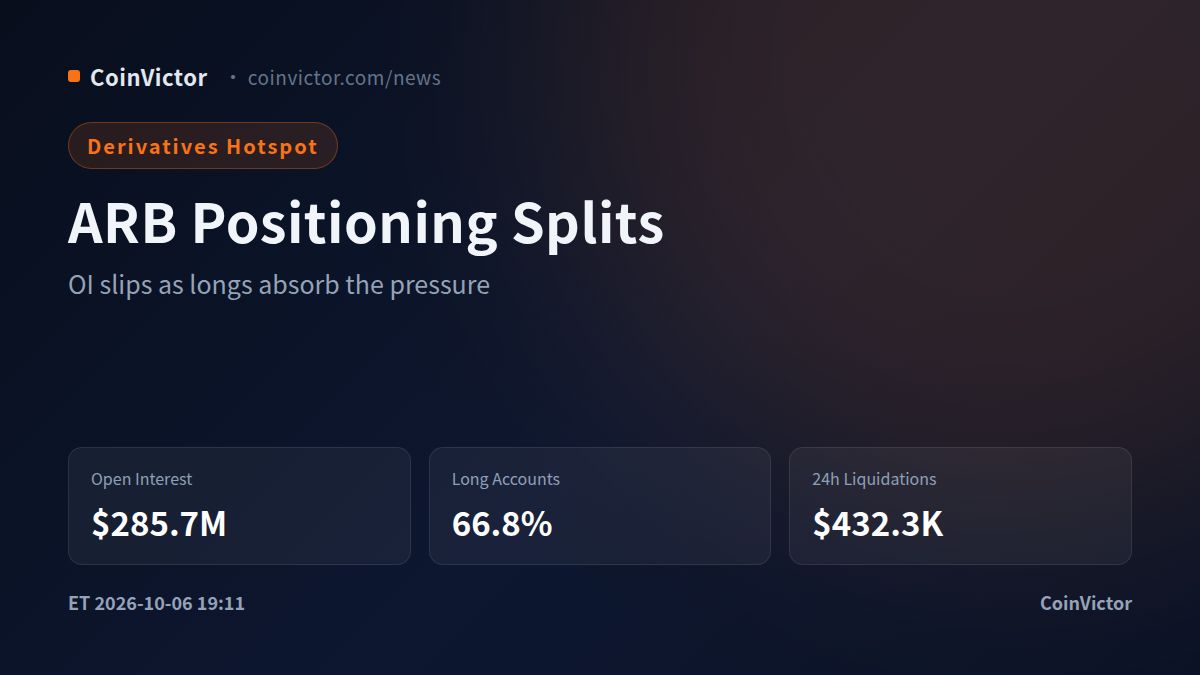
Arbitrum derivatives are showing a sharp positioning divergence: 66.8% of accounts are long, yet aggregate open interest is down 0.1% over 24 hours and the token is trading near $0.2011 after a 3.5% decline. The mismatch matters because long exposure is still dominant at the account level, while leverage is being reduced and forced selling is concentrated on that same side. News flow has recently highlighted Arbitrum’s growing role in dollar-focused stablecoin infrastructure and broader ecosystem adoption.
OI is concentrated, but not uniformly defensive
The market carries $285.7M in total OI across 17 venues. Binance is the largest book at $59.2M, or 20.7% of the total, but its OI has fallen 1.4% over 24 hours and 1.5% over four hours. Gate holds the second-largest share at 14.6%, with $41.6M; its daily OI rose 1.1%, although its four-hour reading still declined 1.9%.
Bybit accounts for 12.3%, or $35.2M, and shows the clearest contraction among the major venues: OI is down 6.4% over 24 hours and 4.3% over four hours. OKX represents 7.5%, or $21.6M, with declines of 2.5% and 1.9% across the same windows. This distribution suggests that the largest books are not adding broad conviction into the move. Gate’s daily increase is an exception, but its shorter-term decline keeps the overall picture defensive rather than accumulative.
Funding is positive on major books, but stress is uneven
The current funding rate landscape is mildly positive across several liquid venues: Bybit is at 0.0%, Gate at 0.0%, Binance at 0.0%, and OKX at 0.0% when rounded to one decimal place. That does not signal an extreme premium for longs, but it does confirm that the account imbalance is not being fully neutralized by negative carry on the main venues. The sharper exceptions are CoinEx at -0.4% and Coinbase at -0.0%, while Bitfinex is also negative.
The more useful read is the difference between account positioning and active flow. Binance has 55.5% long accounts, but its taker flow is only 52.7% long. Gate shows the opposite tension: 62.3% of accounts are long, while takers are 67.0% long. Across the reported aggregate, 66.8% of accounts are long versus 59.4% for active taker positioning. Passive accounts therefore remain more bullish than the traders currently hitting the market, a setup consistent with longs being gradually unwound rather than aggressively replaced.
Liquidations confirm a long-side flush
The liquidation structure is heavily asymmetric. Over 24 hours, long liquidations reached $421.8K, compared with only $10.6K for shorts, out of a $432.3K total. The imbalance is even clearer over four hours: $129.2K in longs were liquidated against just $7.5 in shorts. The 12-hour window shows the same pattern, with $197.1K in long liquidations versus $7.6K in short liquidations.
The largest recorded event was a $78.4K Bybit long liquidation at $0.1991. Binance contributed a $35.5K liquidation at $0.1986, while another Binance event reached $33.4K at $0.2018. These prints place the immediate liquidation pressure around the current market rather than far below it. With shorts barely being forced out, the tape is not yet showing a squeeze-driven recovery.
Verdict
ARB’s near-term signal is bearish-to-neutral: long accounts remain crowded, active taker flow is less bullish, major-venue OI is falling, and liquidations are overwhelmingly long. The key downside levels are $0.1991 and $0.1986, where recent forced selling was recorded. A decisive move above $0.2049 accompanied by OI rebuilding above $285.7M would invalidate this view by showing that demand is returning with leverage rather than merely covering. Until that combination appears, the positioning divergence favors continued pressure on longs.
Data as of 07:11 Beijing time on Oct 7, covering Binance, OKX, Bybit and other major venues.