Arbitrum OI Falls 3.9% as $241.0M Positioning Gets Purged
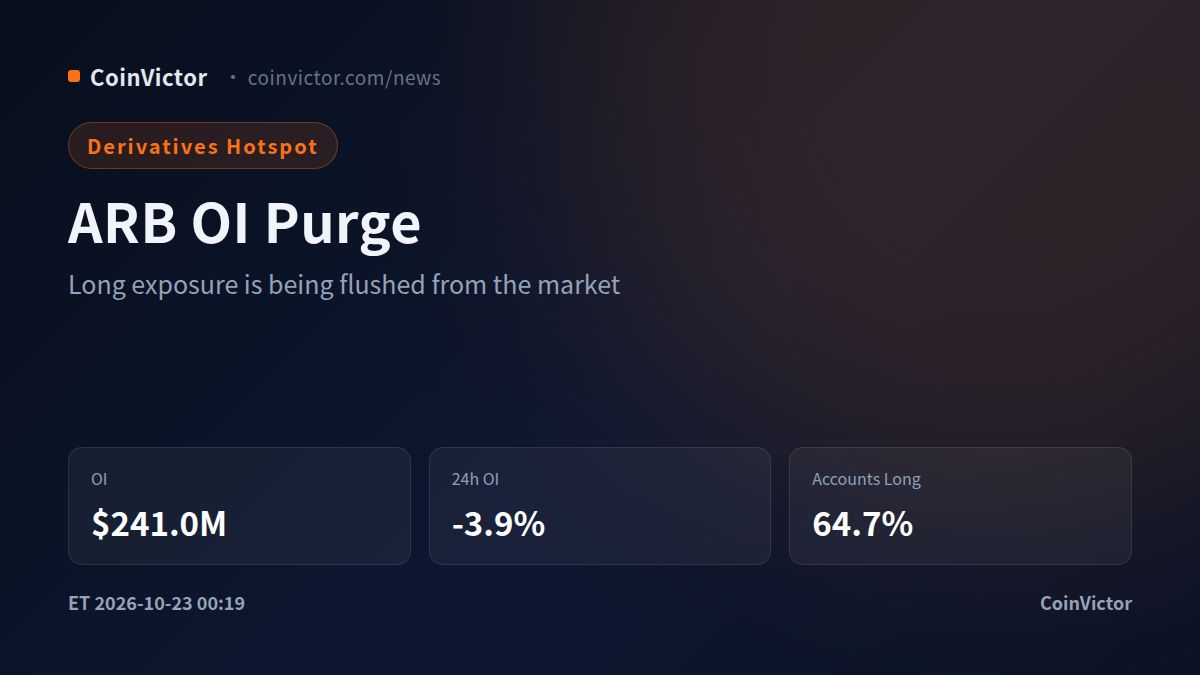
At $0.18352, Arbitrum is sitting in a clear derivatives cleanup: aggregate open interest is about $241.0M, down 3.9% over 24 hours, while 24-hour liquidations have reached $555.3K. Market context is mixed, with technical selling pressure and a retreat in network activity competing with broader ecosystem-expansion narratives. The key question is whether this is a controlled reduction in leverage or the first leg of a deeper long-position purge.
OI contraction is concentrated, not uniform
Binance remains the largest reported venue at $51.5M, representing 21.4% of total OI, but its exposure is only down 1.0% over 24 hours and has risen 2.8% over the latest four-hour window. Bybit holds $31.1M, or 12.9%, and has suffered a sharper 5.0% daily decline. Gate is the clearest source of stress among major venues: its $30.4M position base, equal to 12.6% of the total, has contracted 21.5% in 24 hours. OKX is the counterexample, adding 6.3% to reach $20.2M, or 8.4% of aggregate OI.
That split matters. The market is not seeing every venue simultaneously abandon ARB; instead, leverage is being removed aggressively from selected books while other venues absorb some repositioning. The one-hour ticker reading shows OI up 0.5%, and each of the major venue snapshots posted a positive four-hour change. This suggests the purge has slowed at the margin, but the daily damage remains unresolved.
Funding and positioning disagree
The funding rate map reinforces the uneven structure. Binance and OKX are negative, while Bybit, Bitget, BitMEX, and several other venues are positive. CoinEx is the strongest negative outlier, whereas BitMEX, Aster, Bitget, Bybit, and KuCoin sit on the positive side. The aggregate eight-hour funding average is also negative, indicating that the market-wide carry burden is leaning toward shorts rather than longs even as account positioning remains long-heavy.
The account-versus-trader split is more revealing. Across the ticker snapshot, 64.7% of accounts are long, but only 35.2% of active taker flow is long. On Binance, accounts are 57.2% long while takers are 41.1% long; on Gate, the gap is wider, with accounts at 62.7% long and takers at just 31.7% long. The long/short ratio therefore describes a crowded passive bullish base confronting active sellers. That is a classic setup for further OI reduction if price fails to stabilize.
Liquidations show the long side is paying
The liquidation windows confirm that the recent flush has been asymmetric. In the latest 24 hours, long liquidations total $514.4K against $41.0K for shorts, meaning most forced exits came from bullish positions. The twelve-hour window is similar: $160.0K of longs were liquidated versus $9.8K of shorts. Even the shorter windows show short liquidations, but their absolute size is small: the latest four hours recorded $7.1K in shorts against only $115.4 in longs, while the latest hour produced $5.3K in shorts against $38.9 in longs.
The largest identified event was a $49.9K long liquidation at $0.18086834 on Hyperliquid. That level is now the most useful downside reference because it marks where leveraged demand has already failed once. A break below it would risk turning the current deleveraging into a renewed liquidation cascade, especially while account positioning remains crowded to the long side.
Verdict
ARB remains in an OI-purge regime, not a confirmed trend reversal. The decisive levels are $0.18086834 on price and roughly $241.0M on total OI: losing the liquidation level while OI continues to contract would favor another long flush, while reclaiming $0.18352 with OI rebuilding above $241.0M would invalidate the bearish purge view. Until that reclaim appears, the combination of negative aggregate funding, long-heavy accounts, seller-led taker flow, and $514.4K of daily long liquidations keeps downside risk dominant. Data as of 12:19 Beijing time on Oct 23, covering Binance, OKX, Bybit and other major venues.