Arbitrum OI Holds at $255.4M as Negative Funding Splits Venues
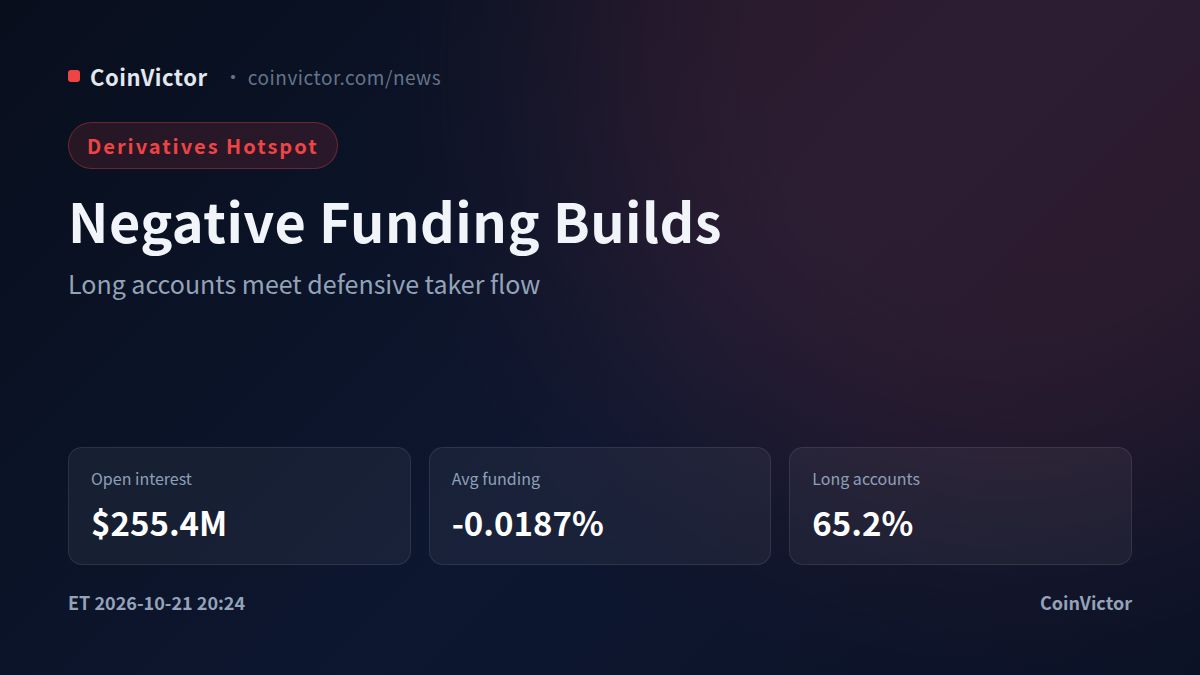
Arbitrum trades at $0.18909 with aggregate open interest at $255.4M, while its average 8-hour funding rate is negative at -0.0187%. That combination points to a crowded derivatives market where longs still dominate account balances, but the cost of holding exposure is being pushed against them. The signal is not a clean bearish unwind: OI is up 1.1% over 24 hours, while spot-linked trading volume is down 29.8%.
News flow has continued to highlight Arbitrum’s network activity, lending growth and new technology integrations, but the derivatives tape is sending a more conflicted message.
OI is concentrated, but not uniformly bullish
The OI distribution shows Binance leading with $54.0M, or 21.2% of tracked positions, followed by Gate at $39.9M and 15.7%, and Bybit at $33.9M and 13.3%. OKX contributes $19.2M, or 7.6%, giving these four venues the clearest read on positioning.
However, their changes diverge. Gate’s OI jumped 14.2% over 24 hours, while OKX rose 0.7%. Binance declined 0.8% and Bybit slipped 0.2%. Across the latest 4-hour window, every one of these major venues contracted: Binance fell 3.5%, OKX 5.2%, Bybit 2.4% and Gate 1.6%. This looks less like broad fresh conviction and more like leverage being trimmed after an earlier buildup. Aggregate OI across the tracked venues is $254.7M, up 1.1% in 24 hours.
Funding splits the market
The funding rate is not uniformly negative across exchanges. Bybit is at -0.006443%, while Binance is positive at 0.006653% and OKX at 0.005655%. Gate and Aster are both at 0.01%, while Bitget is at 0.0046%. The most extreme negative reading is CoinEx at -0.43145%, though its venue-level OI is not among the leading allocations in the supplied snapshot.
This dispersion matters. The aggregate average is negative because the market is not paying longs consistently across venues, even as account ratios remain tilted toward long exposure. The cross-venue gap also raises the possibility that some traders are using short positions as a hedge rather than expressing a uniform directional view. Basis remains modestly positive at 1.9% annualized, so the funding signal is more important than the basis signal for immediate leverage stress.
Liquidations and positioning disagree
Liquidations show that the recent pressure has mostly hit longs. In the latest 1-hour window, $93.6K of long positions were liquidated and no shorts were reported. Over 4 hours, long liquidations reached $214.7K, again with no short liquidations. The 12-hour total was $536.3K, split between $303.0K longs and $233.3K shorts, while the 24-hour total reached $654.0K, with $354.9K in longs versus $299.0K in shorts.
The account-versus-taker split reinforces the warning. Across the ticker snapshot, 65.2% of accounts are long, but only 44.1% of taker flow is long. Binance accounts are 61.1% long, while Bybit accounts are 73.5% long; yet Gate takers are only 24.4% long and 75.6% short. In other words, passive account positioning is long-heavy, while active execution can lean short.
Two notable short-liquidation prints occurred around $0.19642 on OKX and $0.19667 on Binance, showing that upside squeezes remain possible above the current market. Still, the prevailing liquidation damage is concentrated on longs, which is consistent with negative average funding and a fragile long bias.
Verdict: The negative-funding bias remains valid while ARB holds near $0.18909 with OI around $254.7M-$255.4M and funding stays below zero. A move back toward the $0.19642-$0.19667 liquidation zone could trigger a short squeeze, but the view is invalidated if funding turns positive while active takers remain short and OI expands rather than contracts. Data as of 08:24 Beijing time on Oct 22, covering Binance, OKX, Bybit and other major venues.