Avalanche Basis Hits -22.3% Annualized as OI Falls 2.6%
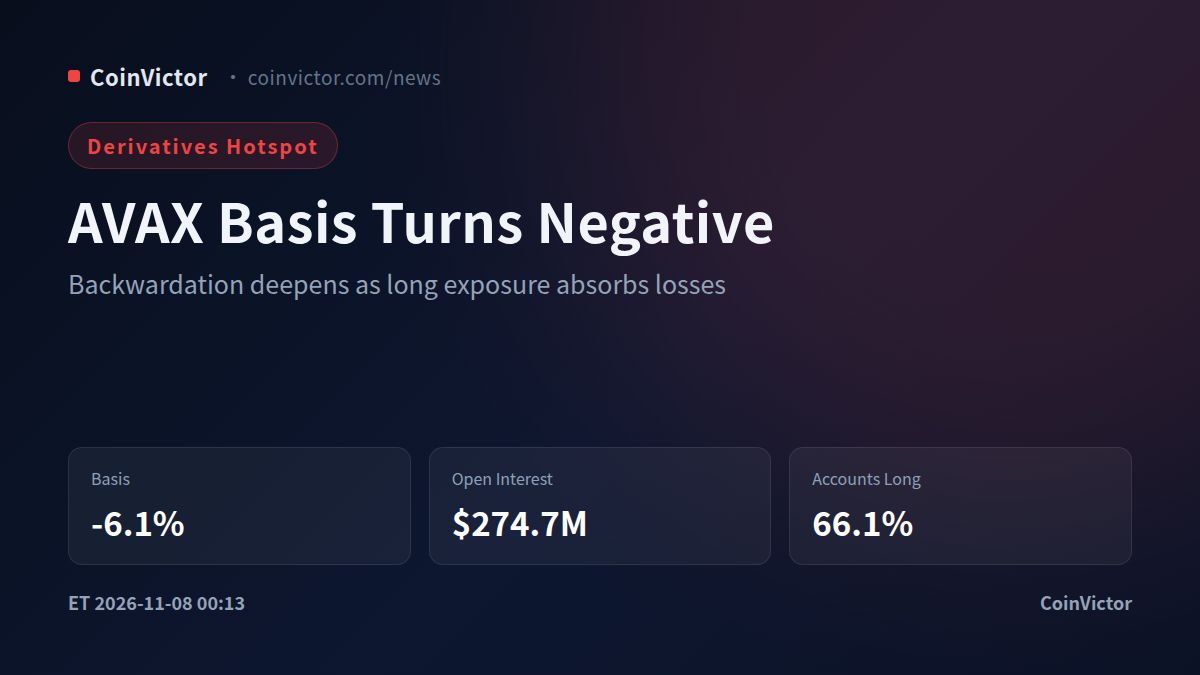
Avalanche is showing a clear derivatives stress signal at $8.172: its basis is -6.1%, or -22.3% on an annualized basis, while aggregate open interest has fallen 2.6% in 24 hours to $274.7M. That combination points to futures trading below spot rather than investors paying a premium for leverage. Recent market commentary has also characterized AVAX momentum as restrained and warned that its consolidation could deteriorate further.
The key question is whether this backwardation reflects a healthy clearing of leverage or the early stage of a more persistent bearish cycle. Current positioning and venue-level funding suggest the market is deleveraging, but not yet uniformly positioned for a clean rebound.
OI is retreating, but concentration remains high
Binance carries the largest share of AVAX open interest at $66.2M, or 24.1%, after a 1.3% daily decline. Bybit follows with $55.9M and a 20.4% share, while its OI is almost unchanged on the day, down just 0.0%. Gate holds $47.9M, or 17.4%, after a 0.3% decline, and Bitget accounts for $21.7M, or 7.9%, after a 2.5% drop.
This distribution matters for the basis signal. Binance and Bitget are reducing exposure, while Bybit is comparatively stable and Gate is only marginally lower. OKX has a smaller $11.5M position, representing 4.2%, but its 5.1% daily contraction is the sharpest decline among the larger venues. The overall 2.6% OI contraction therefore looks like a broad but uneven reduction in risk, not a single-exchange liquidation event.
Funding is positive in some books, deeply negative in others
The headline funding picture is deceptively mild. The average 8-hour funding rate is 0.000928%, but venue rates diverge sharply. Binance is positive at 0.0031%, OKX at 0.0013%, and Bybit is negative at -0.0030%. Bitget is more negative at -0.0053%, while Gate is positive at 0.0100%. The most bearish readings appear on Crypto.com at -0.0148% and KuCoin at -0.0110%.
This split is consistent with basis backwardation: some venues still charge longs, but other books are paying shorts because traders are willing to hold downside exposure. A negative funding rate alone would not prove a bottom, yet the spread between Gate and Crypto.com shows that AVAX leverage is being priced very differently across venues. Until the negative rates narrow and the aggregate basis improves, any spot bounce remains vulnerable to renewed futures selling.
Longs are being liquidated despite a long-heavy crowd
The liquidation structure is decisively one-sided. Over 24 hours, long liquidations reached $86.8K against only $1.4K in shorts. The imbalance was already visible over 12 hours, with $60.1K of longs liquidated versus $1.4K of shorts; during the latest hour, $2.6K of long positions were closed and no short liquidations were recorded.
The largest reported events were long liquidations at $8.129 and $8.144, worth $21.7K and $9.9K respectively. Those levels sit close to the current market and create an important short-term reference zone: a break back below them could trigger another wave of forced long exits, while sustained trade above them would reduce immediate liquidation pressure.
Positioning adds a second layer of caution. The overall account split is 66.1% long, while the active taker split is 54.5% long. On Binance, accounts are 62.3% long, but takers are 70.0% long; on Gate, accounts are 62.9% long while takers flip to 37.3% long. This divergence suggests passive accounts remain crowded on the long side even as aggressive traders are more selective or, on Gate, actively selling into the market.
Verdict: AVAX remains in a bearish derivatives regime while the basis is -6.1% and OI is $274.7M. The key downside markers are $8.144 and $8.129; a break below them would favor another long-liquidation leg. This view is invalidated if AVAX holds above $8.172 while OI rebuilds above $274.7M and the negative funding spread closes. Data as of 13:13 Beijing time on Nov 8, covering Binance, OKX, Bybit and other major venues.