Bitcoin Derivatives: $42.0B OI and 72.1% Long Accounts Shape Max Pain
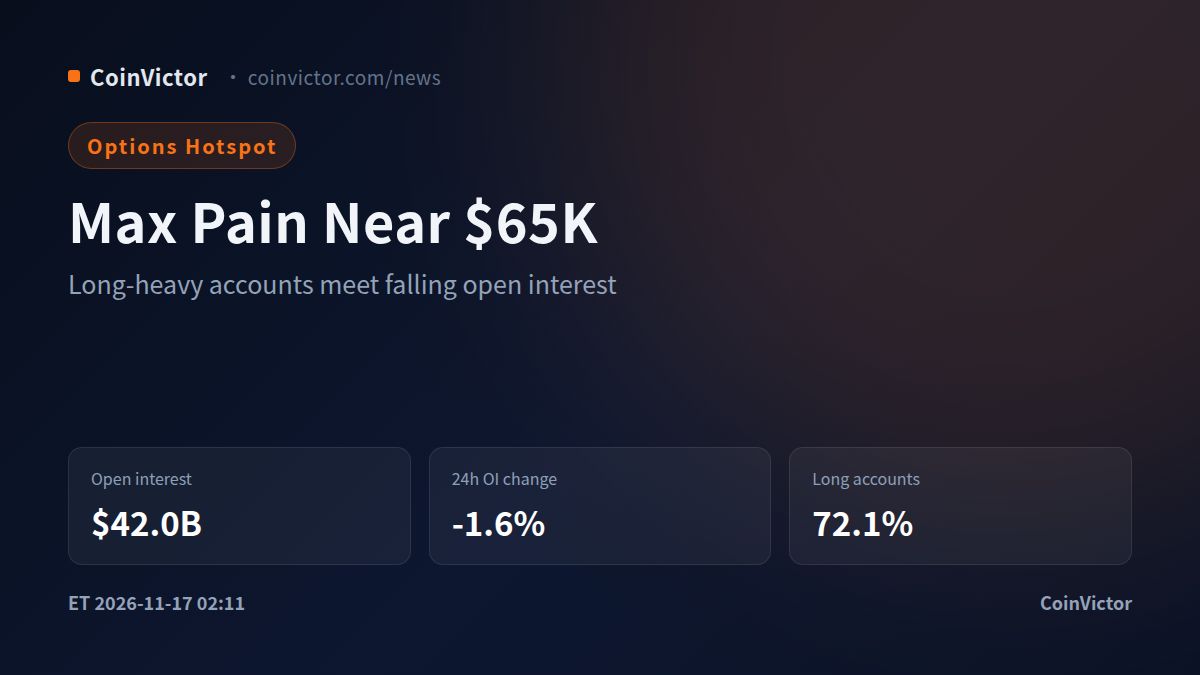
The Bitcoin derivatives tape is caught between a $42.0B open interest base and a heavily long account population: 72.1% of tracked accounts are long, yet total OI has declined 1.6% over 24 hours. Using an options-max-pain lens, that combination points less to clean bullish continuation than to a market seeking liquidity around the $65,000 area. Recent market coverage has framed Bitcoin as rebounding while macro risks are limiting follow-through.
OI concentration keeps the pressure local
Binance remains the largest OI venue at $8.7B, or 20.7% of the tracked total, with its OI down 1.2% over 24 hours. Bybit holds $5.3B, or 12.6%, after a 1.4% decline, while Gate carries $3.6B, or 8.5%, after a sharper 3.2% contraction. OKX contributes $2.9B, or 6.9%, and has seen OI fall 4.3%, the deepest retreat among these major venues.
The exception is Deribit, where OI has increased 1.6% to $1.5B. That divergence matters for a max-pain framework: leverage is being reduced across the largest perpetual venues, but derivatives positioning is not disappearing uniformly. Gate's four-hour OI change is positive at 0.5%, while Binance is down 0.3% and Bybit is down 0.8%. The result is a compressed setup in which a move through nearby liquidation levels could draw fresh positioning even without a broad OI expansion.
Funding is positive, but the long bias is uneven
The funding-rate picture is broadly positive, though the venue spread is meaningful. Binance is at 0.00184%, OKX at 0.00259%, Bybit at 0.003293%, and Bitfinex at 0.007666%. HTX is also elevated at 0.006476%, while Kraken is negative at -0.000425% and Paradex is lower still at -0.002903%. The market is therefore paying to maintain longs on several large venues, but the cost is not synchronized across the complex.
That funding signal aligns with account positioning but not with aggressive taker flow. Binance accounts are 74.1% long, while its takers are only 61.0% long. Bybit shows a similar gap, with 72.1% long accounts against 53.3% long takers. OKX has 73.7% long accounts, but its takers are nearly balanced at 51.3% long. Gate is the sharpest contradiction: accounts are 63.2% long, while takers are 39.2% long. In other words, passive account positioning is long-heavy, but active traders are less willing to chase upward.
Liquidation map favors a squeeze before a breakdown
Near-term liquidation flow is mixed by horizon. In the latest hour, long liquidations reached $4.1M versus $0.3M for shorts. Across four hours, longs lost $4.7M and shorts $2.3M. The 12-hour window is almost balanced, with $10.5M in long liquidations against $10.1M in shorts. Over 24 hours, however, shorts dominate at $62.9M versus $37.4M for longs.
The largest recorded short liquidations cluster above the current $64,622.6 price: $3.1M at $64,977.3, $4.2M at $65,251.8, and $1.2M at $65,387.2. That ladder makes the $64,977.3-$65,387.2 zone the most important nearby pressure pocket. A push through it could force short covering into a market where OI has already fallen, while failure below it would leave the long-heavy account base exposed to another liquidation wave.
Verdict: The immediate max-pain map is neutral-to-bearish below $65,251.8, with $64,622.6 and $42.0B OI as the key spot and positioning anchors. A reclaim and hold above $65,387.2, accompanied by OI rebuilding above $42.0B, would invalidate this squeeze-then-fade view and confirm stronger upside participation. Data as of 15:11 Beijing time on Nov 17, covering Binance, OKX, Bybit and other major venues.