Bitcoin Derivatives: $43.4B OI Meets a 64.3% Long-Account Bias
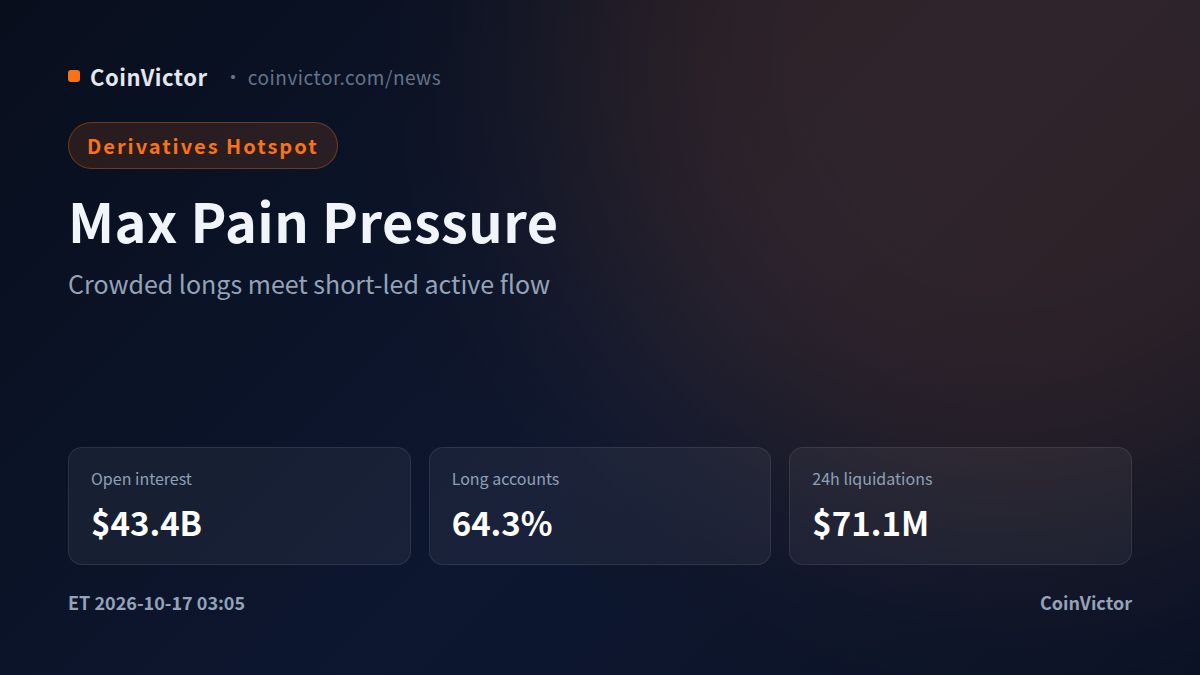
Bitcoin derivatives are setting up for a classic max-pain-style contest, even though the supplied snapshot does not include an options chain or a direct max-pain strike. The most useful proxy is the concentration of futures risk: total open interest is $43.4B, up 0.6% over 24 hours, while the market price is $81,602.9. At the same time, 64.3% of accounts are long, but only 31.7% of active taker positioning is long. That split suggests passive positioning is crowded on the upside while aggressive traders are still selling into the market.
Recent market coverage has focused on Bitcoin’s retreat from higher expectations, broader liquidation pressure and the possibility that bullish positioning has moved ahead of price.
OI is concentrated, but not uniformly bullish
Binance remains the largest listed venue with $7.7B of BTC open interest and a 17.7% share, yet its OI is down 0.7% over 24 hours. Bybit carries $4.8B, or 11.2% of the total, and has added 1.1%. Gate follows with $4.2B and a 9.7% share after a 1.3% increase, while Bitget holds $2.8B, or 6.6%, after adding 1.4%.
This distribution matters for a max-pain framework. The largest venue is shedding exposure while several secondary venues are adding it, so the aggregate 0.6% rise does not represent a single coordinated bullish bet. It looks more like risk migration across venues. Deribit, the venue most relevant to options context in the supplied exchange table, has only $841.1M of futures OI and is down 2.5%, limiting the evidence for a clean options-led upside squeeze.
Funding stays positive while positioning disagrees
Current funding is positive across most major venues, but the spread is meaningful. Binance is at 0.0047%, OKX at 0.0067%, Bybit at 0.0058%, Bitget at 0.0062% and Gate at 0.0045%. Bitfinex is higher at 0.0122%, while Deribit is much lower at 0.0014%. The ticker’s average eight-hour funding rate is negative at -0.0104%, showing that venue-level readings are not translating into a uniformly expensive long position.
The account data reinforces that contradiction. Long accounts represent 63.3% on Binance, 64.3% on OKX, 63.4% on Bybit, 68.2% on Bitget and 62.4% on Gate. Yet takers are net short on Binance at 47.4% long, OKX at 43.8% and Gate at just 3.8%. In other words, the crowd is long by account count, but the traders crossing the spread are predominantly selling. That is the kind of imbalance that can pull price toward a liquidation-heavy equilibrium before a decisive trend emerges.
Liquidation map favors a two-sided squeeze
The 24-hour liquidation total is $71.1M, split between $45.0M of longs and $26.1M of shorts. The shorter windows are more revealing: over four hours, $78.6K of shorts were liquidated against $5.6K of longs; over twelve hours, shorts accounted for $3.1M versus $1.7M for longs. The latest flow therefore shows short-side stress, despite the larger full-day loss suffered by longs.
The largest recorded long liquidation was $6.5M at $81,319.9 on Bybit. The largest short liquidation was $6.2M at $83,408.3 on Binance, with another $821.8K short liquidation at $83,164.0 on Bitget. These prices form the clearest pressure boundaries in the available data: below the lower level, long liquidation risk can reopen; above the upper level, short covering can accelerate.
Verdict: The current max-pain proxy is neutral-to-down while price remains below $83,408.3: crowded account longs, negative average funding and $43.4B of OI leave the market vulnerable to another move toward $81,319.9. The view is invalidated if price reclaims $83,408.3 while OI expands beyond $43.4B and active taker flow turns decisively long-led; that would signal genuine demand rather than passive crowding. Data as of 15:05 Beijing time on Oct 17, covering Binance, OKX, Bybit and other major venues.