Bitcoin Derivatives: $44.7B OI Sets an Options Max-Pain Map
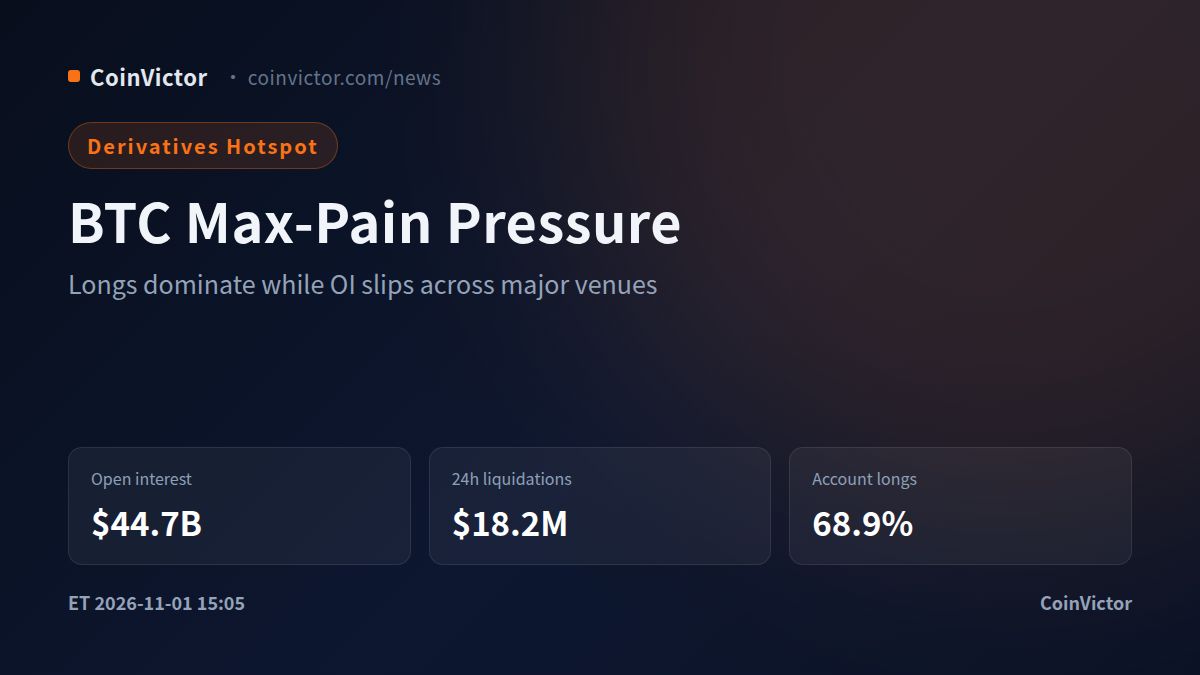
Bitcoin derivatives are presenting a classic options-max-pain style tension: open interest is still large at $44.7B, but it fell 0.7% over 24 hours while most major venues reduced exposure. With no strike-by-strike options ladder in the supplied data, the best proxy for a near-term pin is the interaction between crowded positioning, funding, open-interest concentration and liquidation levels. That proxy points to a market vulnerable below $77,287.5, yet still capable of a squeeze toward $78,408 if short liquidity is reached.
Recent market coverage has focused on Bitcoin’s recovery meeting heavier derivatives exposure and reported ETF outflows, adding to the debate over whether the rebound has enough participation behind it.
OI is large, but the complex is de-risking
The open-interest distribution is led by Binance at $7.5B, equal to 16.7% of the tracked total, with its position down 1.3% in 24 hours and 1.9% over four hours. Bybit holds $5.3B, or 11.9%, after a 0.5% daily decline, while Gate carries $4.7B, or 10.4%, after falling 1.3%. OKX adds $2.6B, or 5.9%, with only a 0.1% daily reduction but a sharper 1.5% four-hour decline.
The message is not broad risk accumulation. The total has contracted from the previous day, and the one-hour change is also negative at 0.7%. Bitfinex is the outlier among the listed venues, with OI up 0.6% over 24 hours, but its $719.8M position represents only 1.6% of the total. For a max-pain framework, that makes the current market more dependent on liquidation magnets than on fresh, balanced positioning.
Funding stays positive, but venue differences matter
Funding remains a cost for longs, with the aggregate eight-hour rate equivalent to 0.006611%. Binance, Bybit, Aster, Bitunix, LBank, MEXC and several other venues quote 0.01%, while OKX is lower at 0.008715% and Bitget at 0.0069%. Gate is softer at 0.0038%, and Deribit is lower again at 0.002138%.
That spread matters because the largest OI venues are not carrying identical pressure. Binance and Bybit combine meaningful exposure with the highest listed funding tier, whereas OKX carries a lower rate despite a heavily long account book. A positive rate across venues supports the idea that longs are paying to hold risk, but the falling OI says that cost is not yet producing a fresh leverage build. This is more consistent with a fragile upside bias than with a clean bullish expansion.
Liquidations reveal the immediate pain zone
The liquidation structure is decisively long-heavy in the short windows. One-hour liquidations totaled $3.4M, including $3.4M of longs and only $7.0K of shorts. Over four hours, longs accounted for $3.5M versus $78.6K for shorts. The imbalance narrows over 12 hours, with $6.2M of longs and $5.2M of shorts, before reversing over 24 hours: $6.8M of longs against $11.3M of shorts, for a total of $18.2M.
The largest recorded event was a $1.5M short liquidation at $78,408 on Aster. On the downside, Binance logged a $794,438 long liquidation at $77,287.5, while Gate recorded a $497,779 long liquidation near $77,733. These levels form a practical two-sided map: a break below the lower level would likely test long leverage first, while a push through the upper level could force shorts to cover.
Verdict: The current options-max-pain proxy favors a downside-to-neutral pin around the $77,287.5-$78,408 liquidation band while OI remains near $44.7B and daily OI change stays negative. A sustained move above $78,408 accompanied by renewed OI expansion would invalidate that view by showing that fresh risk is overpowering the existing long crowd; otherwise, a loss of $77,287.5 keeps long-side liquidation pressure in control. Data as of 04:05 Beijing time on Nov 2, covering Binance, OKX, Bybit and other major venues.