Bitcoin Derivatives: $44.8B OI Meets 58.2% Long Account Exposure
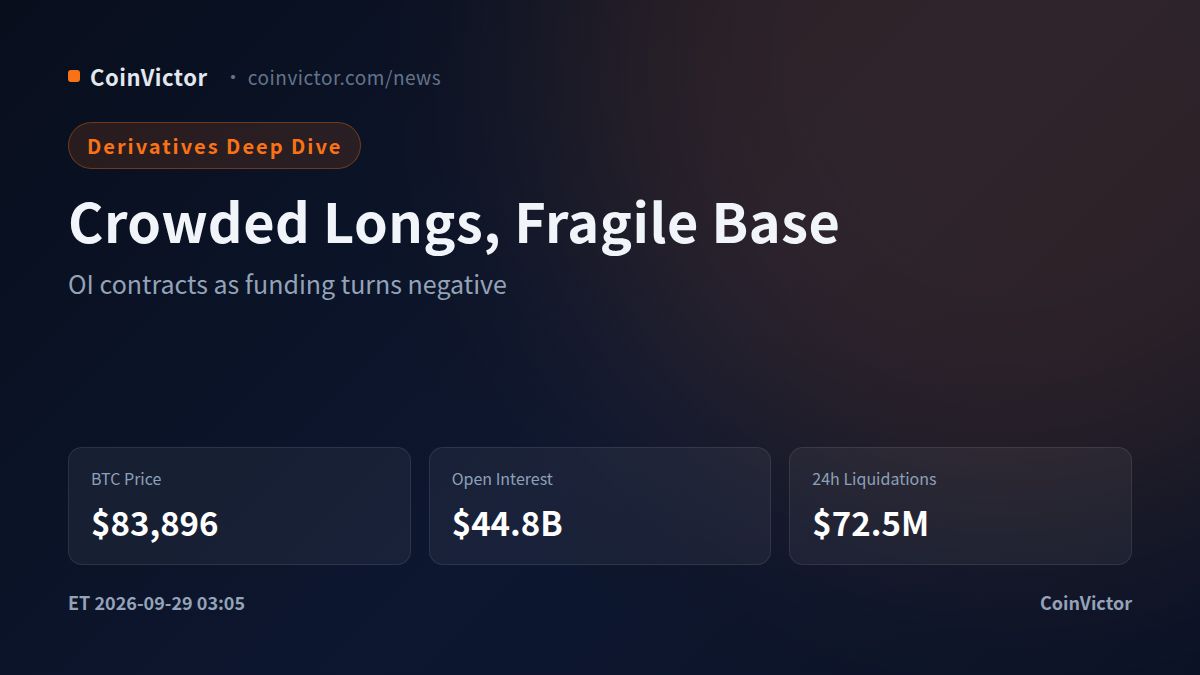
Bitcoin is trading at $83,896 after a 0.8% move, but the more important signal is underneath the price: total open interest stands near $44.8B and has fallen 1.8% over 24 hours. At the same time, 58.2% of tracked accounts are long, takers are 66.8% long, and average funding is negative. This is not a clean risk-on expansion. It is a market where leverage has been reduced, directional optimism remains visible, and both sides have identifiable liquidation pressure.
Broader market coverage is also highlighting Bitcoin’s recovery while some altcoins have recently outpaced it, adding a relative-performance layer to the derivatives picture.
OI is contracting, but not evenly
The aggregate OI series shows a modest deleveraging phase rather than a wholesale exit. The ticker reading is $44.8B, while the venue summary is $44.7B across 21 exchanges, with the total down 1.8% in 24 hours. Binance carries $7.8B, or 17.5% of the reported total; Bybit has $4.7B, or 10.5%; Gate holds $4.4B, or 9.9%; and OKX has $2.4B, or 5.3%. Their daily changes are all negative, ranging from a 0.5% decline at Bitget to a 3.4% decline at Gate.
The shorter-term signal is more constructive for leverage re-entry. OI has risen 0.6% over the latest hour, while Binance, OKX, Bybit, Bitget and Gate all show positive four-hour changes. Gate’s four-hour increase is 4.2%, Bybit’s is 1.3%, and Binance’s is 1.1%. That combination—daily contraction followed by shorter-term rebuilding—usually means the market is attempting to form a new position cluster rather than simply trending with established leverage. The risk is that fresh positions are entering before direction has been confirmed.
Funding and positioning favor a crowded-long test
The funding signal is unusually important because the positioning data is not neutral. The average eight-hour funding rate is negative, while individual readings are mixed: Binance is positive, OKX is positive, Bybit is flat, and Bitget is positive. The broad message is that funding has not validated the long bias even though account counts do. Traders are willing to hold long exposure, but the aggregate carry is not rewarding that exposure.
Account positioning shows longs ahead on every listed major venue. Binance is 57.1% long, OKX 57.6%, Bybit 58.0%, Bitget 61.5%, and Gate 55.7%. Taker flow is less uniform but still leans long: Binance is 52.6% long, OKX 57.3%, and Gate 63.9%. The difference between account positioning and taker behavior matters. It suggests that some long exposure is passive or already established, while aggressive traders are still buying into weakness or attempting to defend the current range.
That makes the long side more vulnerable if price loses the recent liquidation zone. The largest recorded long liquidations were clustered at $82,362 on Bybit and $82,219 on Binance, with another $1.5M long liquidation at $82,731 on Hyperliquid. Across 24 hours, long liquidations reached $42.6M versus $30.0M for shorts. Yet the latest window is different: shorts absorbed $3.5M in one hour and $4.5M in four hours, compared with only $20,039 and $463,539 of longs. The market has already punished longs over the broader window, but the immediate tape is beginning to squeeze shorts above the current price.
Basis confirms defensive leverage conditions
The basis is negative at 0.1%, with the annualized basis at negative 19.3%. This is a strong confirmation that futures are not carrying a bullish premium. Spot and derivatives are therefore telling different stories: price is holding near $83,896, takers lean long, and short liquidations have appeared, but futures pricing remains defensive.
This divergence creates a two-stage risk map. Above $84,329, where a Binance short liquidation was recorded, and then $84,568, another Binance short liquidation level, a continued climb could force more short covering. Such a move would be more credible if OI expanded alongside price while funding stayed contained rather than becoming aggressively positive. In that case, the market would be adding exposure without immediately recreating an expensive long carry.
Below $82,731, $82,362 and $82,219, the structure becomes more fragile. Those levels are tied to observed long-liquidation events, so a break could turn passive long exposure into forced selling. If OI rises while price falls through that band, it would indicate that new shorts are pressing the market and that the long side is absorbing losses rather than reducing risk. If OI falls sharply instead, the move would look more like a liquidation flush and could set up a faster rebound.
Verdict
The medium-term structure is cautiously bearish-to-neutral: longs are the more vulnerable side because account positioning and taker flow lean long, while basis remains negative and average funding does not confirm a healthy bullish trend. The key defense zone is $82,219-$82,731; the first upside squeeze zone is $84,329-$84,568. My base case is a range test with downside vulnerability before a sustainable continuation higher. This view is invalidated if Bitcoin holds above $84,568 while OI expands from $44.8B, funding remains restrained, and short liquidations continue to dominate; conversely, a break below $82,219 with rising OI would confirm that the crowded-long structure is unwinding rather than resetting.
Data as of 15:05 Beijing time on Sep 29, covering Binance, OKX, Bybit and other major venues.