Bitcoin OI Hits $45.2B as -18.4% Basis Tests Market Weakness
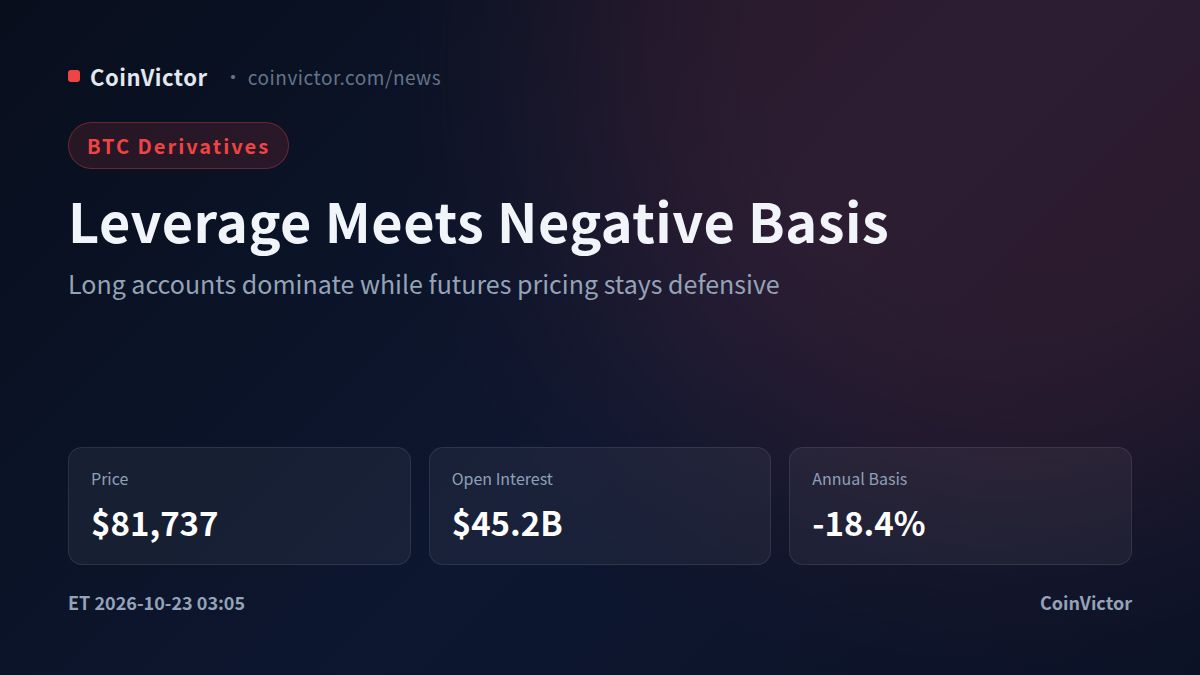
Bitcoin is trading at $81,737.2 while aggregate futures open interest sits near $45.2B, up 1.8% over 24 hours. That combination would normally suggest fresh risk entering the market, but the more important signal is that the annualized basis is -18.4%, with the spot-to-futures spread itself at -0.1%. At the same time, the average eight-hour funding rate is -0.0091%. The market is therefore adding contracts while pricing futures defensively, a structure that points to crowded positioning rather than clean bullish conviction.
The day’s news flow spans a proposed Bitcoin fork snapshot, enforcement messaging around overseas crypto scams, and filings related to tokenized-stock trading.
OI is rising, but the structure is not bullish
Total open interest is measured at $45.2B in the cross-venue summary, while the ticker aggregate is $45.2B, confirming that leverage remains substantial across the major derivatives complex. The 24-hour increase is 1.8% in the venue summary and 2.9% in the ticker view, while one-hour OI is slightly lower by 0.0% when rounded to one decimal place. That contrast matters: exposure has accumulated across the broader day, yet the immediate impulse is no longer expanding.
Exchange dispersion also shows where the leverage is concentrated. Binance holds $7.7B, or 17.2% of tracked OI, and Bybit holds $5.1B, or 11.4%. Gate carries $4.6B, or 10.2%, while Bitget has $3.0B, or 6.6%. OKX contributes $2.6B, or 5.7%. OI rose 5.7% on OKX and 2.9% on Bybit over 24 hours, but Binance’s four-hour change was -1.2% and Gate’s was -2.9%. The largest venues are not moving in lockstep, which raises the risk that a price break could trigger exchange-specific deleveraging rather than a stable trend.
Volume has fallen 22.6% over 24 hours to $48.8B. Rising OI alongside contracting volume is a weak quality signal: more positions are being carried, but less trading activity is validating them. Unless volume expands with price, the increase in OI is better read as stored liquidation risk than as evidence of durable demand.
Long accounts are crowded, while aggressive flow leans short
Account positioning is the clearest asymmetry. The overall long share is 68.5%, meaning long accounts outnumber short accounts by a wide margin. Binance shows 68.9% long, OKX 69.3%, Bybit 67.0%, Bitget 71.7%, and Gate 65.4%. The corresponding account ratios range from 1.9 on Gate to 2.5 on Bitget. This is not a balanced market: a large portion of participants is positioned to benefit from a rebound, leaving the long side vulnerable if support fails.
Taker positioning tells a different story. Binance takers are 44.2% long and 55.8% short, while OKX is nearly even at 49.6% long and 50.4% short. Gate is much more defensive, with only 21.6% long takers against 78.4% short takers. The gap between account positioning and executed aggressive flow implies that existing accounts remain long, but new market orders are increasingly willing to sell into the tape. That is a classic late-support configuration: passive or already-held longs dominate the snapshot, while active traders are pressing the opposite direction.
Funding reinforces the warning. Several major venues are charging positive funding, including Binance at 0.0091%, OKX at 0.0086%, Bybit at 0.0058%, Bitget at 0.0100% and Gate at 0.0066%. Yet the ticker’s average funding is -0.0091%, indicating that cross-venue conditions are uneven and that the aggregate reading is being pulled lower by isolated extremes. The result is not a simple bullish or bearish funding signal; it is a fragmented market where longs pay on many liquid venues while short pressure remains visible in broader positioning.
Liquidation map defines the immediate danger zone
Liquidations make the downside vulnerability more concrete. The latest 24-hour total is $105.5M, of which $98.6M came from long liquidations and $6.9M from shorts. That is a heavily one-sided flush against long positions. The shorter windows are less extreme: four-hour liquidations total $1.1M, with $660.5K from longs and $398.2K from shorts, while the one-hour total is $153.0K. This suggests the major long purge has already happened over the wider window, but it does not prove that the pressure is finished.
The largest recorded forced exits cluster around the current market. A Hyperliquid long liquidation was valued at $7.9M near $81,653, and an OKX long liquidation reached $3.9M near $81,207. Other large long events were recorded near $81,796, $81,644 and $81,728. These prices create a practical downside band around the current quote: a sustained move below roughly $81,200-$81,650 would reopen the liquidation mechanism and could force more crowded longs to reduce exposure.
On the upside, the market needs to reclaim the area around $81,800, where another large long liquidation was recorded, and then show that OI is not rising purely through new fragile longs. A recovery with falling OI would indicate deleveraging and healthier spot-led demand; a recovery with rising OI, weak volume and renewed positive funding would instead look like another crowded setup.
Verdict: The medium-term structure is bearish-to-defensive, with longs more fragile than shorts because account positioning is 68.5% long, 24-hour long liquidations are $98.6M, and the annualized basis is -18.4%. The key downside zone is $81,200-$81,650; a decisive break there with OI holding above $45.2B would favor another leverage unwind. The first recovery threshold is $81,800, but the view is invalidated only if Bitcoin reclaims and holds above that area while OI contracts, volume recovers from $48.8B, and the basis improves materially from -18.4%; a price bounce alone is not enough. Data as of 15:05 Beijing time on Oct 23, covering Binance, OKX, Bybit and other major venues.