Bitcoin at $78,162: Why the $44.5B OI Structure Still Looks Fragile
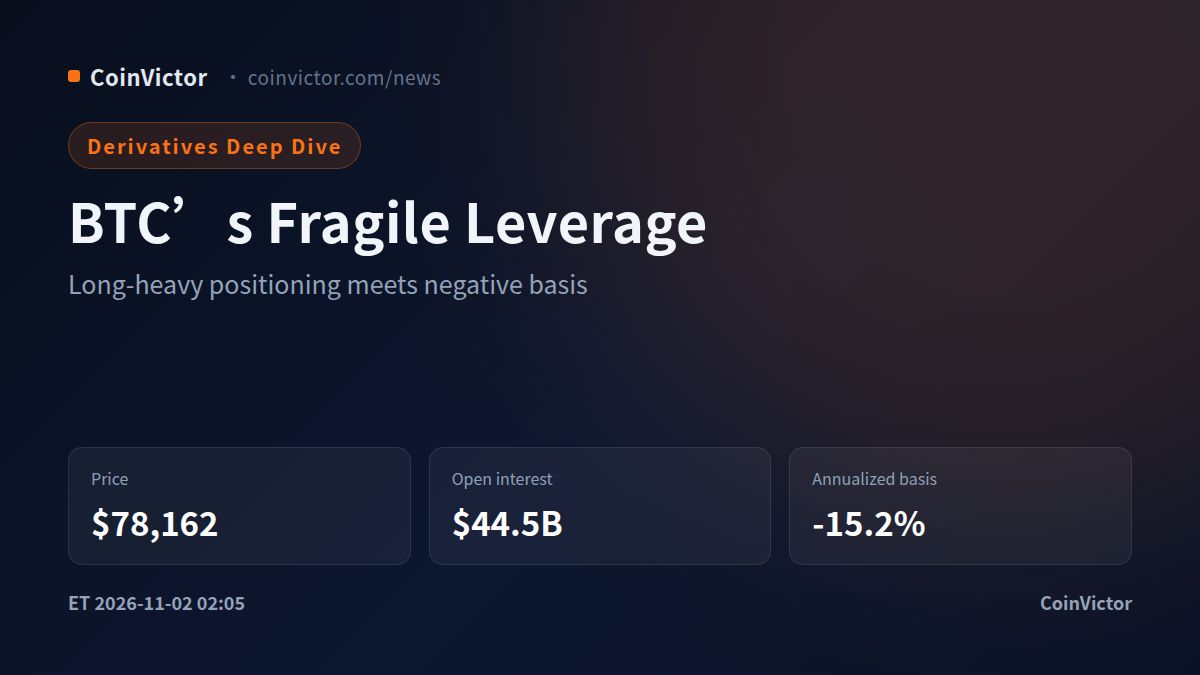
Bitcoin is trading at $78,162 while aggregate open interest sits near $44.5B, down 1.1% over 24 hours. That combination is the central clue: leverage has been trimmed even as price remains close to $78,000, but the remaining book is still tilted heavily toward longs. Average funding is positive at roughly 0.005% per 8 hours, whereas the futures basis is -0.04%, equivalent to an annualized -15.2%. This is not a clean risk-on structure. It is a crowded, uneven market in which long positioning pays funding while the term structure prices a discount.
Recent market coverage has focused on whether Bitcoin can extend its recovery, with attention also on rising derivatives exposure and pressure from exchange-traded-fund flows.
Open interest is falling, but not enough to reset risk
The total open interest reading is $44.5B across 19 venues, compared with $44.5B on the broader ticker aggregate, and the daily change is approximately -1.1%. The decline is widespread rather than isolated. Binance, which holds 16.8% of tracked interest, is down 1.8% over 24 hours. OKX has fallen 3.2%, Bybit 1.1%, Bitget 2.9% and Gate 2.9%. Their respective shares are 5.9%, 11.9%, 6.3% and 10.2%.
The one-hour change in the headline aggregate is only -0.1%, so deleveraging is gradual rather than a forced liquidation cascade. The key implication is that the market has not fully cleared its leverage. Falling OI alongside a 72.2% increase in volume suggests active repositioning, but not necessarily a decisive transfer of control to bears. If price remains stable while OI continues to contract, that would be constructive from a medium-term perspective: weaker positions would be leaving without a corresponding collapse in spot. If price falls while OI stabilizes or rebuilds, the structure becomes more dangerous because fresh leverage would be arriving into weakness.
Longs dominate accounts, while takers disagree
The account-level long/short ratio is the clearest vulnerability. Long accounts represent 67.2% of the aggregate reading. Binance shows 67.3% long, OKX 68.8%, Bybit 67.2%, Bitget 71.9% and Gate 60.8%. The corresponding account ratios range from 1.5 on Gate to 2.6 on Bitget. This is a broad directional bias, not a single-venue anomaly.
However, taker flow is less uniform. Binance takers are 69.4% long, but OKX takers are 54.9% short, while Gate takers are 66.7% long. That split matters. Passive account positioning says many traders are still holding long exposure, while aggressive execution is already willing to sell on at least one major venue. The result is a fragile long side rather than an outright bearish consensus. Longs are more exposed to a downside air pocket because they are numerous, but shorts can still be squeezed if buyers regain control above the recent liquidation cluster.
Funding reinforces this interpretation. Current rates are positive on Binance at 0.007%, OKX at 0.007%, Bybit at 0.003% and Deribit at 0.006%. Several venues are near 0.010%, while one listed venue is slightly negative at -0.000%. The dispersion is not extreme enough to signal universal euphoria, yet it confirms that longs are generally paying to maintain exposure. With the basis already negative, traders are paying periodic funding inside a market that does not reward them with a positive futures premium. That carry profile is a warning against treating every rebound as a durable trend reversal.
Liquidations define the near-term price map
Twenty-four-hour liquidations total $41.4M, including $33.3M of shorts and $8.1M of longs. The imbalance shows that the latest upward push has already punished bearish leverage. Over 12 hours, short liquidations reach $28.1M against $5.3M for longs; over 4 hours, shorts account for $11.9M versus $1.1M for longs. In the last hour, however, the total drops to $0.4M, with $0.4M from longs and almost no short damage. Momentum has therefore cooled after a short squeeze, rather than continuing in a one-way fashion.
The largest recorded forced exit was a $4.0M short liquidation near $78,725, followed by a $1.9M short near $78,946 and a $1.2M short near $78,752. These levels create a practical upside test around the upper-$78,000 area: a sustained break through it could force residual shorts to cover, especially if OI rises only modestly. On the downside, a $0.8M long liquidation occurred near $77,288, marking a visible stress point below the current market. A move through that zone would challenge the idea that longs can absorb weakness without another round of forced selling.
The medium-term structure is therefore asymmetric. The vulnerable side is the long side because account positioning is heavily long, funding is positive and the basis is negative. Yet the immediate liquidation data favor shorts already, so a fresh decline is not automatically the higher-probability path. A market that holds above $77,288 while reclaiming $78,725-$78,946 can still build a squeeze. A market that loses $77,288 with OI refusing to fall would instead indicate that leverage is being added into weakness.
Verdict: The key range is $77,288 to $78,946, with $78,725 as the first upside trigger and $77,288 as the downside line. Medium-term risk remains skewed toward a long flush unless price can reclaim and hold the upper-$78,000 area while OI stays below roughly $44.5B; this view is invalidated by a sustained break above $78,946 accompanied by expanding price and orderly OI growth, or by a sharp loss below $77,288 with OI contracting rapidly. Data as of 15:05 Beijing time on Nov 2, covering Binance, OKX, Bybit and other major venues.