Bitway OI at $201.1M as Price Gains 2.0% but Positioning Splits
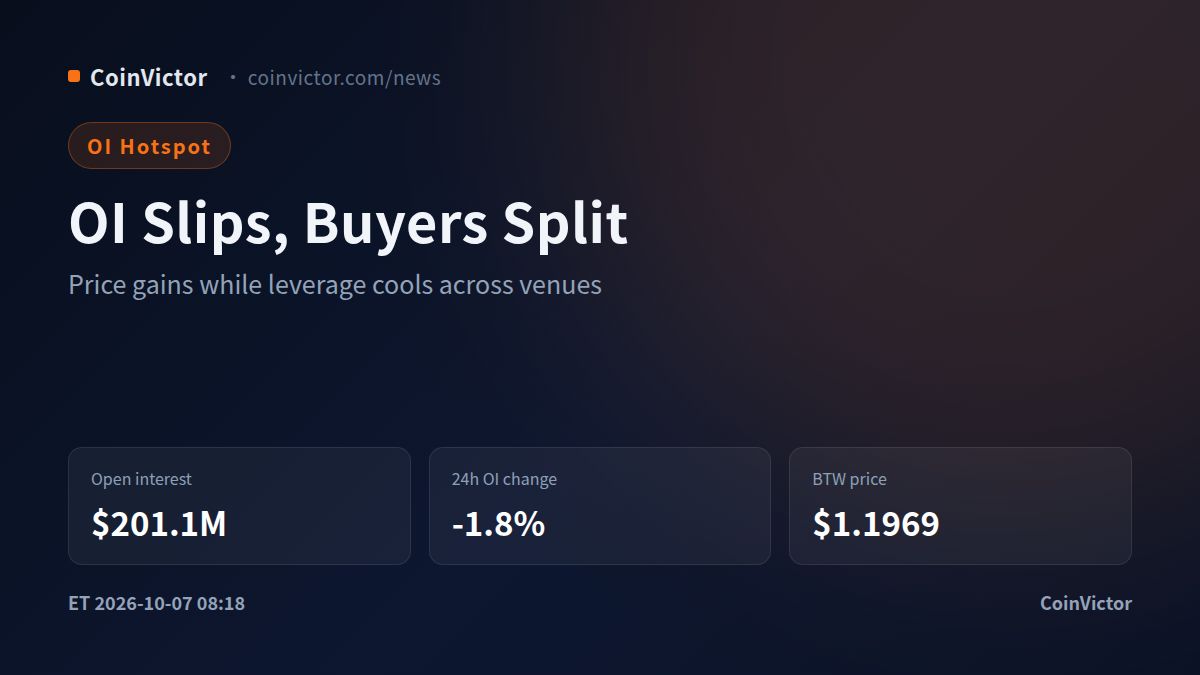
Bitway is showing a classic price-versus-positioning split: price is at $1.1969 after a 2.0% gain, while aggregated open interest is down 1.8% over 24 hours to $201.1M. The move is therefore not being confirmed by broad leverage expansion. Market context is also favorable to smaller altcoins, with traders rotating beyond the largest market leaders.
Binance still anchors the structure
The exchange breakdown shows a concentrated but uneven OI map. Binance carries $98.4M, or 48.9% of the total, and its OI is up 1.9% over 24 hours but down 4.8% over four hours. Bitget holds $35.1M, equal to 17.5%, with a 2.4% daily increase and a 4.8% four-hour decline. Gate contributes $28.3M, or 14.1%, after a 0.7% daily rise and a 4.8% four-hour drop. Bybit is smaller at $22.9M and 11.4% share, with OI down 3.2% daily and 6.0% over four hours.
This makes the latest structure more defensive than the headline price suggests. The largest venues have added some exposure on the daily view, but the synchronized four-hour contraction points to leverage being reduced into the recent advance. MEXC is the notable exception: its $10.8M OI, representing 5.4% share, rose 5.0% daily and 0.9% over four hours. That is constructive, but its weight is not large enough to reverse the broader short-term contraction.
Funding is calm, with one clear outlier
Current funding rates are almost uniform across the main venues. Aster, Binance, Bitget, Bitunix, Bybit, Gate, KuCoin and MEXC each show 0.0% when rounded to one decimal place, while LBank stands apart at 0.1%. The raw spread matters even though the rounded display compresses it: LBank's 0.0572% rate is materially above the 0.005% reading seen elsewhere.
That pattern does not indicate a broad crowded-long trade. Instead, it suggests localized demand for long exposure on LBank while the larger venues remain comparatively balanced. The ticker's average funding rate is 0.0108%, reinforcing that the aggregate carry burden is positive but not extreme. With OI falling, positive funding is more consistent with existing longs paying carry during a deleveraging phase than with a fresh, market-wide leverage build.
Liquidations favor the short-covering explanation
The liquidation windows add an important bullish detail. In the latest hour, long liquidations were $7.6K versus only $33.3 for shorts. Across four hours, longs reached $7.8K and shorts $3.7K, so the very short-term picture is mixed. Over 12 hours, however, short liquidations rose to $55.4K against $28.2K for longs, and over 24 hours the gap widened to $66.4K versus $32.7K. That imbalance suggests upside movement has been forcing short positions out, even as total OI contracts.
The positioning data points in the same direction. The account reading shows 37.3% long, while the active-trader reading is 50.6% long. In other words, fewer accounts are net long, but recent taker flow is slightly long-biased. This long/short ratio divergence fits a market where active buyers are pressing into weakness or short covering, while the broader account base remains cautious.
Verdict: The near-term bias is cautiously bullish, but the move still looks more like short covering than a durable leverage-led breakout. The key reference is $1.1969 with aggregate OI at $201.1M: holding price while OI stabilizes above that level would improve the continuation case. A break below $1.1969 while OI falls further would invalidate the bullish read; so would a move above $1.1969 accompanied by renewed OI expansion without a reduction in short-liquidation pressure, signaling a more crowded and fragile chase. Data as of 20:18 Beijing time on Oct 7, covering Binance, OKX, Bybit and other major venues.