Cardano ADA: $260M OI and Negative Funding Signal Forced Deleveraging
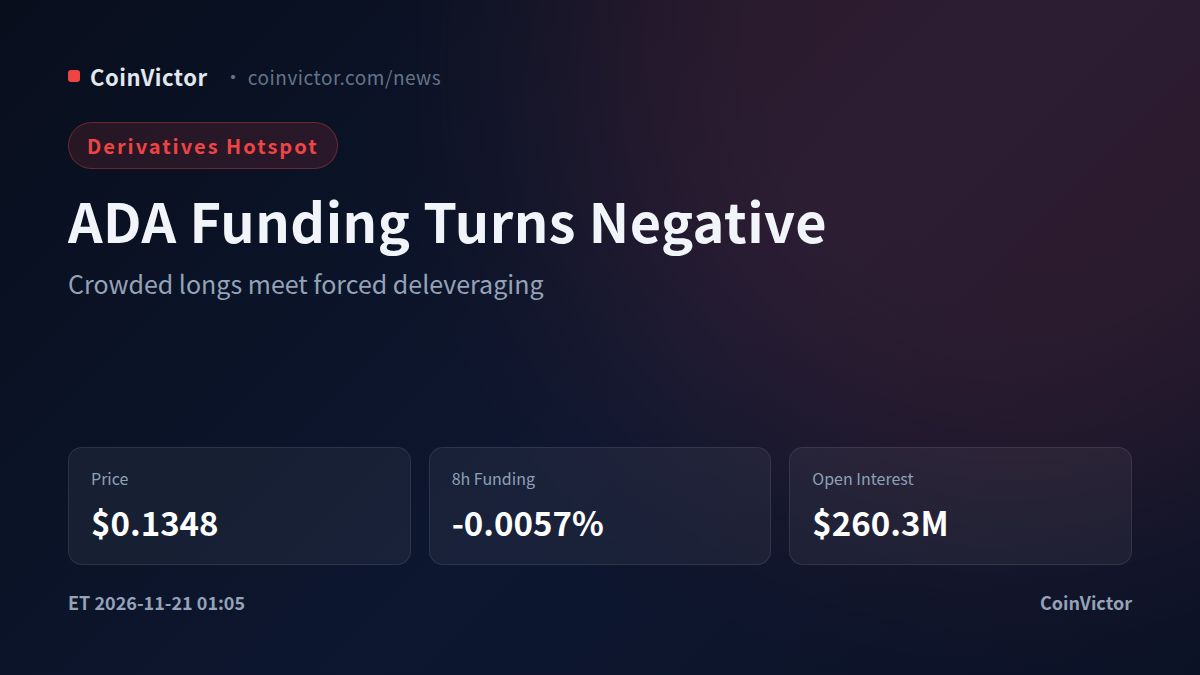
Cardano derivatives show a sharp positioning mismatch: ADA is at $0.1348, average 8-hour funding is -0.0057%, and total open interest is about $260.3M after a 9.7% 24-hour decline. At the same time, long liquidations reached $6.0M, compared with just $33.9K for shorts. The result is not simply a bearish market; it is a forced reset of a long-heavy position structure.
Recent market commentary has questioned Cardano’s adoption progress while noting that ADA remains below former trend support.
OI is falling across the main venues
The open interest distribution shows where the deleveraging is concentrated. Binance holds $54.3M, or 20.9% of tracked ADA OI, down 6.5% over 24 hours. Gate carries $34.7M, or 13.3%, after a much steeper 14.2% decline. Bybit has $31.3M, representing 12.0%, with OI down 9.0%, while Bitget has $21.4M, or 8.2%, after a 12.9% contraction.
These four venues account for the largest visible blocks, and each is shrinking rather than adding exposure. The overall decline is therefore broad-based, not the result of one isolated exchange. Binance’s smaller 5.9% four-hour drop contrasts with Gate’s 8.6%, Bybit’s 9.4%, and Bitget’s 6.6% four-hour declines, showing that the pressure remains active across several major books.
Negative funding is uneven, but meaningful
The funding rate map confirms that sellers are receiving payment on several major venues. Binance is at -0.0177%, OKX at -0.0141%, Gate at -0.0132%, and Bitget at -0.0072%. Bybit is a notable exception at +0.0008%, while several smaller venues are also positive. This spread suggests that the negative-funding signal is strongest where the largest pools of ADA leverage sit, rather than being uniform across every market.
Negative funding normally indicates that short exposure is paying long exposure, but the liquidation data adds an important qualification: longs are still being forced out in size. That combination can appear when traders remain structurally long while aggressive market selling drives the price lower. It also means a short-term rebound could trigger a rapid funding normalization if the liquidation wave exhausts the most vulnerable positions.
Accounts say long; takers say sell
The long/short split is the clearest sign of the positioning conflict. Across the ticker data, 69.1% of accounts are long, while only 35.2% of active taker flow is long. On Binance, 68.5% of accounts are long, but takers are 38.5% long and 61.5% short. Gate shows an even sharper gap: 68.0% of accounts are long, while takers are just 31.9% long and 68.1% short.
Bybit has the most crowded account positioning among the listed major venues, with 74.4% long, while OKX is 70.5% long. Yet the active-flow data points in the opposite direction. This account-versus-taker divergence says passive positioning has not caught up with the selling pressure, leaving long accounts vulnerable to another liquidation burst if ADA fails to stabilize.
Verdict
The exclusive read is bearish-forced-deleveraging rather than clean capitulation: ADA is anchored at $0.1348, OI is near $260.3M, funding is negative on Binance, OKX, Gate, and Bitget, and long liquidations dominate every measured window. The view is invalidated if ADA holds above $0.1348 while OI rebuilds above $260.3M and funding turns positive; without that combination, a long-heavy account base remains a supply risk.
Data as of 14:05 Beijing time on Nov 21, covering Binance, OKX, Bybit and other major venues.