Cardano Basis Backwardation Signals a -28.7% Annualized Carry Gap
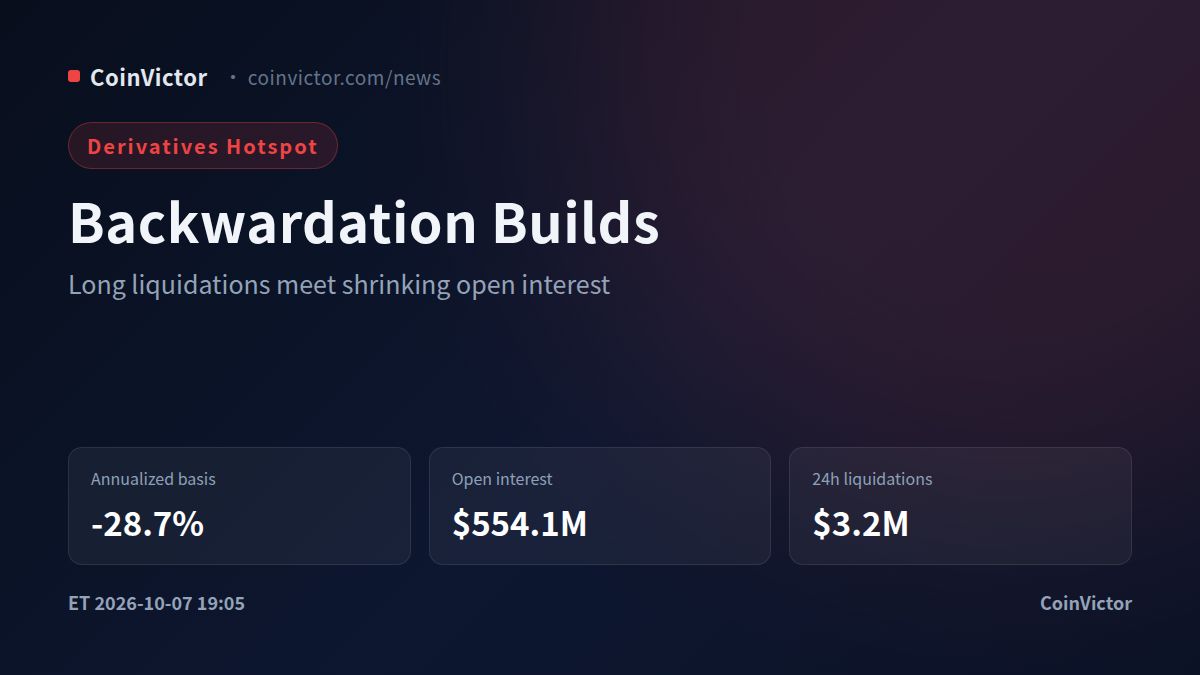
Cardano is trading at $0.2544 after a 5.1% decline, while its basis has slipped to -0.1%, equivalent to -28.7% annualized. That is a distinctly defensive derivatives setup: futures are priced below the reference market, total open interest is down 7.1% over 24 hours to $554.1M, and 24-hour liquidations have reached $3.2M. Separately, current coverage says Cardano’s new token-standard discussion is putting greater attention on issuer controls for freezing or restricting assets.
Positioning is leaving the largest venues
The open-interest map shows the retreat is broad rather than isolated. Binance holds the largest disclosed share at 19.4%, or $107.6M, but its position has dropped 11.8% over 24 hours. Gate is close behind at 18.6% and $103.3M, down 9.4%, while Bybit accounts for 14.1% at $78.0M after a smaller 3.7% decline. Bitget contributes 10.8%, or $59.7M, with open interest down 7.7%.
That concentration matters for the backwardation signal. The biggest venues are not showing a fresh build of leveraged exposure; they are reducing it. Gate did add 0.5% over the latest four-hour window, but that was outweighed by four-hour declines at Binance, Bybit and Bitget. With the aggregate total down 7.1%, the negative basis looks more like forced de-risking and weak futures demand than a cleanly crowded short trade.
Funding is split while longs absorb the damage
The funding rate distribution reinforces the cross-venue stress. Binance is negative at -0.0016%, Bitget is -0.0023%, and Gate is nearly flat at -0.0001%. By contrast, Bybit is at 0.0036% and OKX at 0.0056%, while CoinEx shows an extreme 0.1660%. The ticker-wide average is still positive at 0.0074%, meaning longs are generally paying to hold exposure even though the futures basis remains negative.
That combination is important: positive average funding does not confirm healthy bullish demand when the basis is backwardated. It suggests that some venues still carry long-side premium in periodic funding, but the broader futures curve is discounting ADA. The account-versus-taker split is even sharper. Across the reported account readings, Binance shows 71.6% long and Bybit 74.8% long; OKX is 68.7% long and Gate 64.2% long. Yet active takers are 62.2% short on Binance and 72.2% short on Gate. Passive accounts are leaning long while aggressive flow is selling into them.
Liquidations confirm a long-side flush
The liquidation structure is decisively one-sided. Over 24 hours, long liquidations totaled $3.0M versus $142.8K for shorts, accounting for nearly all of the $3.2M total. The same direction appears over 12 hours, with $243.8K in longs liquidated against $100.8K in shorts, and over four hours, where longs lost $27.0K compared with $2.1K for shorts.
The two largest recorded events were also long liquidations on Hyperliquid: $136.8K at $0.25185644 and $126.7K at $0.24897948. These levels mark the nearest visible stress zone beneath the current $0.2544 price, while the absence of one-hour liquidations suggests the immediate cascade has paused rather than fully reversed.
Verdict
The exclusive read is bearish-to-fragile: ADA remains vulnerable while price is near $0.2544, basis is below zero, and total open interest sits around $554.1M after a 7.1% daily contraction. The $0.25185644 and $0.24897948 liquidation levels are the key downside markers. This view would be invalidated by a sustained recovery above $0.2544 accompanied by open interest rebuilding above $554.1M and the basis turning positive; without that combination, the long-account majority and negative taker flow point to continued deleveraging risk. Data as of 07:05 Beijing time on Oct 8, covering Binance, OKX, Bybit and other major venues.