Cardano Basis Turns -0.1% as $491.2M OI Tests Backwardation
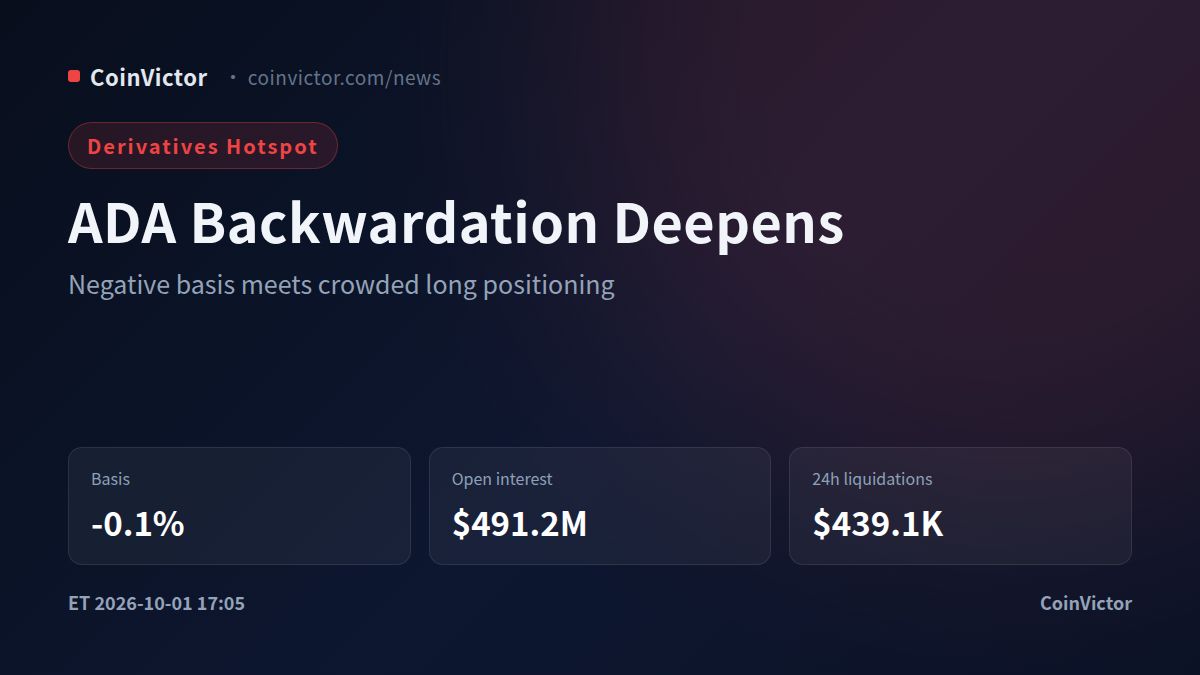
Cardano futures are sending a split signal: the basis is -0.1%, equal to -29.5% on an annualized basis, while open interest remains substantial at $491.2M. That combination points to backwardation rather than a clean risk-on breakout. The market is still carrying leverage, but the futures curve is pricing weaker demand than the spot market would imply.
Recent coverage has focused on Cardano adoption, payment integration and resistance tests, but the derivatives data is less decisive. Price is $0.2473, up 0.9%, while total open interest across the tracked venues is $490.1M, up 0.4% over 24 hours.
Backwardation is concentrated, not uniform
Binance holds the largest reported share of ADA open interest at $98.9M, or 20.2%, after adding 3.9% over 24 hours. Gate follows with $90.1M and an 18.4% share, but its open interest fell 4.5%. Bybit carries $70.7M, or 14.4%, with a 1.3% increase, while Bitget holds $57.3M, or 11.7%, also up 1.3%. OKX is smaller at $33.0M, or 6.7%, yet its open interest rose 3.8%.
This divergence matters for backwardation. Binance and OKX are building exposure, while Gate is shedding it quickly. The overall increase is therefore not broad-based conviction across every major venue. It looks more like selective leverage accumulation alongside a meaningful reduction on one of the larger books, which can keep the aggregate basis negative even as total open interest edges higher.
Funding stays positive despite the negative basis
The funding rate snapshot is mostly positive: Binance, Bybit, Gate, Bitget and OKX each show 0.0% when rounded to one decimal place, while CoinEx is the outlier at 0.2%. Coinbase is at 0.0%, and BitMEX is negative at -0.0%. The raw distribution therefore suggests that longs are generally paying shorts, but the payments are not large enough across the main venues to erase the -0.1% basis.
This is an important distinction. Positive funding normally reflects a long premium, yet the futures-versus-spot relationship remains discounted. In practical terms, traders are willing to maintain long leverage, but the forward contract is not attracting enough demand to trade above spot. That is a more fragile bullish setup than positive funding and positive basis together.
Long accounts face a liquidation imbalance
The positioning data shows a crowded long bias. Across the ticker snapshot, 66.9% of accounts are long and 69.7% of active taker flow is long. Exchange-level account ratios are even more one-sided: Binance has 69.9% longs, OKX 64.3%, Bybit 73.4% and Gate 65.1%. Yet Binance taker flow is almost balanced at 50.4% long versus 49.7% short, while Gate taker flow is 62.3% long.
That account-versus-active-flow split weakens the headline bullish signal. Many accounts remain positioned long, but the largest venue is not showing aggressive long execution at the same intensity. Liquidations reinforce the risk: the 24-hour total is $439.1K, comprising $288.2K of long liquidations and $150.9K of shorts. Over four hours, shorts led with $46.4K versus $26.7K of longs, but the twelve-hour window reversed to $173.8K longs against $83.1K shorts. The largest recorded liquidation was a $26.7K ADAUSDT long at $0.2486 on Gate.
Verdict: ADA derivatives remain structurally defensive despite positive funding and a 0.9% spot gain. The key line is $0.2486: a reclaim above that liquidation level, together with open interest holding above $491.2M, would challenge the backwardation thesis. Until then, the combination of a -0.1% basis, long-heavy accounts and $288.2K of daily long liquidations favors a fragile rebound rather than confirmed trend strength. The view is invalidated if ADA sustains trade above $0.2486 while open interest expands beyond $491.2M and the basis flips positive.
Data as of 05:05 Beijing time on Oct 2, covering Binance, OKX, Bybit and other major venues.