Chainlink Basis Falls to -35.6% Annualized as OI Reaches $556.8M
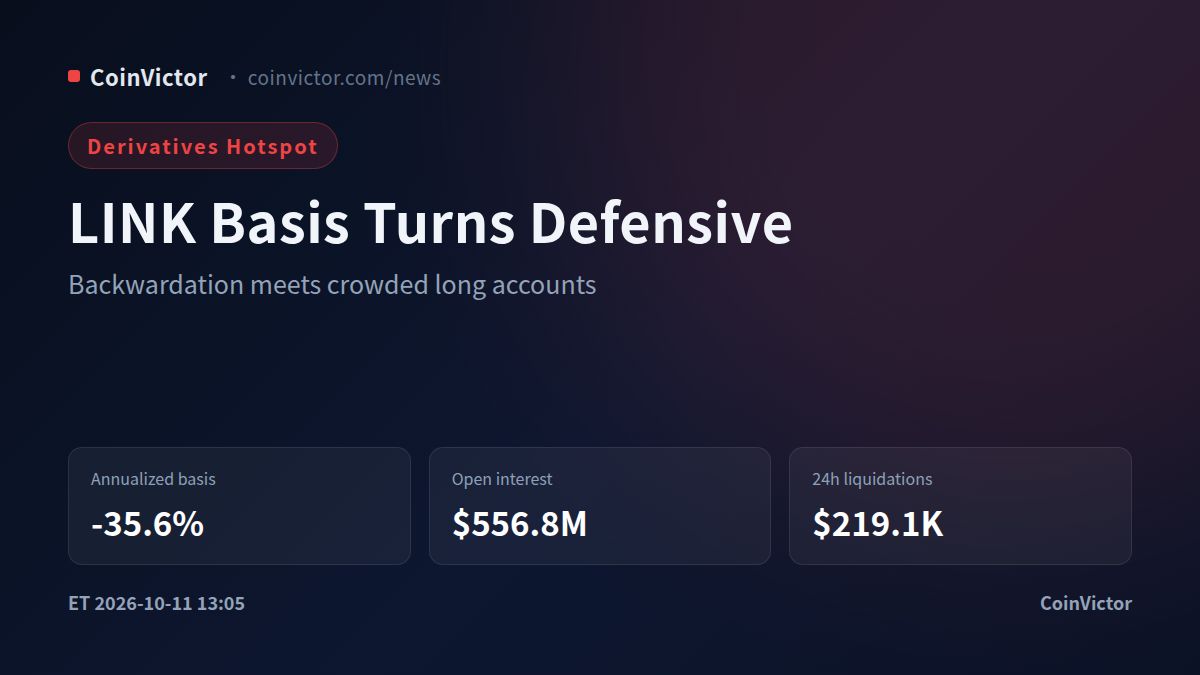
Chainlink is trading at $13.35 while its futures curve shows a -0.1% basis and -35.6% annualized basis, even as aggregate open interest has risen 2.1% in 24 hours to $556.8M. That combination is the central signal: leverage is returning, but derivatives are still pricing a discount rather than a clean bullish carry trade. Recent market coverage has treated Chainlink as a contested comparison asset within the broader crypto market rather than a clear momentum leader.
Backwardation is broad, not empty
The negative basis matters because it appears alongside meaningful participation. Gate carries the largest reported open-interest share at 22.1%, with its position base up 2.7% over 24 hours. Binance follows with 19.9% of the tracked total and a 1.5% daily increase, while Bybit holds 13.0% after adding 1.1%. Bitget contributes 9.0% and is nearly flat at a 0.2% increase.
OKX is the outlier among the larger venues: its 4.6% share has declined 1.1% over 24 hours, although its shorter-term change is positive. The cross-venue picture therefore is not one of wholesale deleveraging. Instead, exposure is building at several major venues while the curve remains backwardated, a pattern consistent with traders paying to maintain directional positions without receiving a positive futures premium.
Funding is positive, but uneven
The funding rate map adds an important nuance. Aster and Bitmex are at 0.01%, Gate is at 0.0097%, Bitget at 0.0091%, and OKX at 0.0070%. Binance is lower at 0.004625%, while Bybit is only 0.000445%. Cryptocom is the notable negative print at -0.001193%, with Bitfinex and CoinEx at 0.0%.
This dispersion says the backwardation is not being reinforced uniformly by negative funding. Several venues still charge longs, but the rate is modest on the largest commonly watched books, and the weakest prints sit close to neutral. The result is a mixed carry signal: spot or immediate demand is not strong enough to lift the futures basis, yet long holders are not being forced into a broad funding washout either.
Positioning conflicts with forced-flow data
Account positioning is decisively long. Across the ticker aggregate, 70.0% of accounts are long, while the active-trader measure is only 41.1% long. The venue split is similarly revealing: Binance accounts are 61.5% long and Bybit accounts 70.6% long, but Gate accounts are 60.5% long while Gate takers are only 30.1% long. Binance takers are almost balanced at 50.8% long and 49.2% short.
That account-versus-taker divergence suggests passive or existing long exposure is much more crowded than fresh aggressive buying. The liquidation tape supports that interpretation without confirming a full trend reversal. In the last 24 hours, longs lost $58.3K against $160.8K of short liquidations, for $219.1K total. The latest hour recorded no long liquidations and $72.1K in short liquidations, while the largest single event was a $52.8K short liquidation on OKX near $13.36. Shorts are being squeezed at the margin, but the negative basis and weak taker-long participation argue against calling that squeeze a durable breakout.
Verdict: The exclusive read is cautiously bearish on the quality of the rally: $13.35 is the key price reference, and $556.8M is the current open-interest checkpoint. A move below $13.35 while OI holds near or above $556.8M would signal that crowded longs are absorbing fresh downside risk, keeping backwardation in control. This view is invalidated if price sustains above $13.35 with OI expanding beyond $556.8M and the basis turns positive, especially if aggressive takers also return to a net-long stance.
Data as of 01:05 Beijing time on Oct 12, covering Binance, OKX, Bybit and other major venues.