Chainlink Basis at -0.1% as Open Interest Climbs 2.4% in 24 Hours
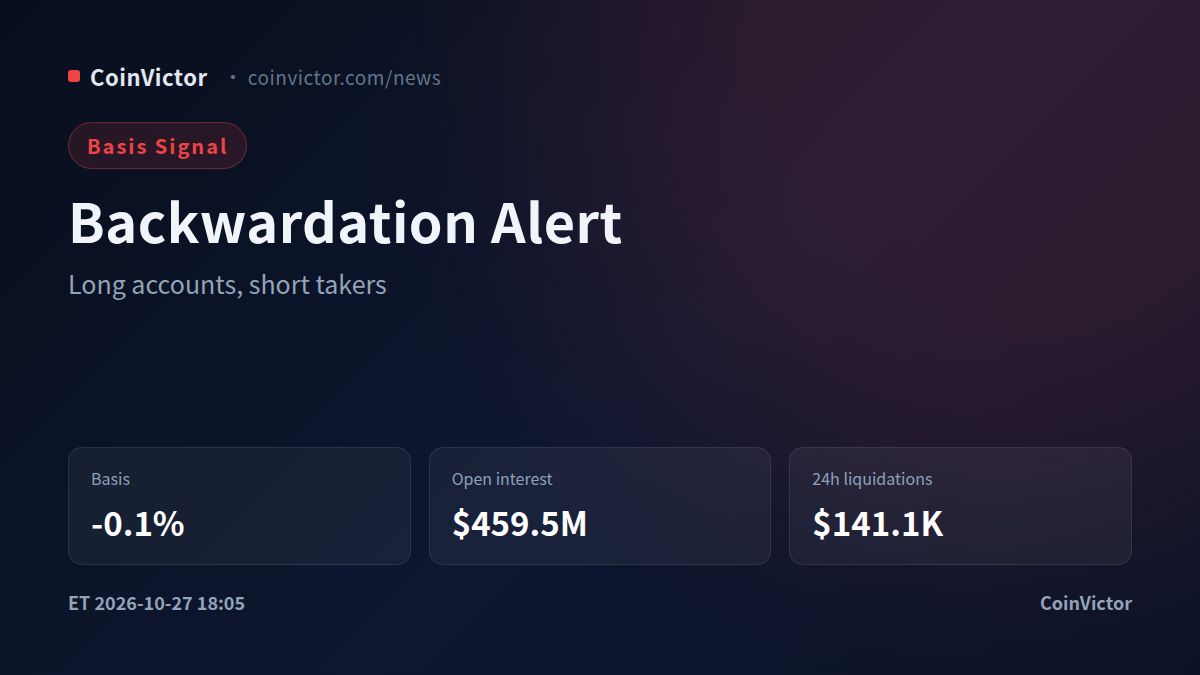
Chainlink futures are flashing a sharp positioning mismatch: the basis is -0.1%, or -19.0% annualized, while total open interest has expanded 2.4% over 24 hours to $459.5M. LINK is at $11.547, up 0.6%, but the derivatives structure remains more defensive than the price move suggests. Recent ecosystem coverage has focused on Chainlink infrastructure integrations and institutional access, yet the market data shows traders are still paying to maintain long exposure while futures sit below the underlying market.
Open interest is concentrated, but not aligned
Binance carries the largest reported share at 20.6%, with $94.5M of open interest and a 3.1% daily increase. Gate is close behind at 19.9% and $91.5M, but its open interest fell 0.8%. Bybit holds 13.9%, or $63.8M, after adding 2.9%, while Bitget accounts for 9.5% and $43.4M after a 1.7% rise. The contrast matters: growth is strongest on Binance and Bybit, while the second-largest venue is trimming exposure. Across the tracked venues, the total change is positive, but it is not a uniform risk-on build.
This distribution makes the backwardation more important. New positions are being added even as the futures curve remains discounted, a pattern consistent with traders accepting adverse carry or with hedging demand pressing futures below spot. The one-hour aggregate OI change is -0.6%, so the latest flow has already cooled from the broader daily expansion.
Funding is positive while flow disagrees
Funding rates are positive across the major venues: Binance is at 0.0093%, OKX at 0.0059%, Bybit at 0.0076% and Gate at 0.0100%. That means long positions are generally paying shorts, despite the negative basis. The cross-venue spread is also meaningful: Kraken is at -0.0009% and Cryptocom at -0.0019%, while several other venues are near zero. LINK therefore has no single market-wide funding signal; the dominant venues lean long, but smaller venues show demand for shorts or little directional pressure.
The account and taker data sharpen that conflict. On Binance, 61.6% of accounts are long, but takers are only 53.8% long. Gate shows the opposite intensity: 63.1% of accounts are long, while takers are 68.8% long. Bybit and OKX are also account-long, at 71.8% and 74.8% respectively. The broad message is that passive positioning is long-heavy, while aggressive flow is not consistently confirming it. That is an unstable setup for a market already trading in backwardation.
Liquidations favor a fragile long bias
The liquidation tape has shifted from short stress to long stress over the wider window. The latest hour recorded $6.2K of short liquidations and no long liquidations; the latest four-hour window showed $6.4K of shorts and no longs. Over 12 hours, however, long liquidations reached $53.1K versus $19.5K for shorts. Across 24 hours, longs accounted for $91.7K against $49.4K for shorts, for a total of $141.1K.
The largest recorded short liquidation was $28.6K at $11.487, while the largest long liquidation was $19.1K at $11.221. This places $11.487 as an immediate upside stress point and $11.221 as a downside leverage reference. The recent short liquidations show that a rebound can still squeeze leverage, but the larger daily long loss indicates that downside moves have been more expensive for the broader account base.
Verdict: LINK remains vulnerable while price stays below $11.487, with $11.221 the key downside liquidation level and $459.5M the current OI reference. The bearish backwardation view would be invalidated by a sustained move above $11.487 accompanied by open interest holding above $459.5M and the basis turning positive; without that combination, positive funding and long-heavy accounts look more like crowded risk than confirmation. Data as of 06:05 Beijing time on Oct 28, covering Binance, OKX, Bybit and other major venues.