Chainlink LINK: $4.5M Liquidations Expose a $528.6M OI Flush
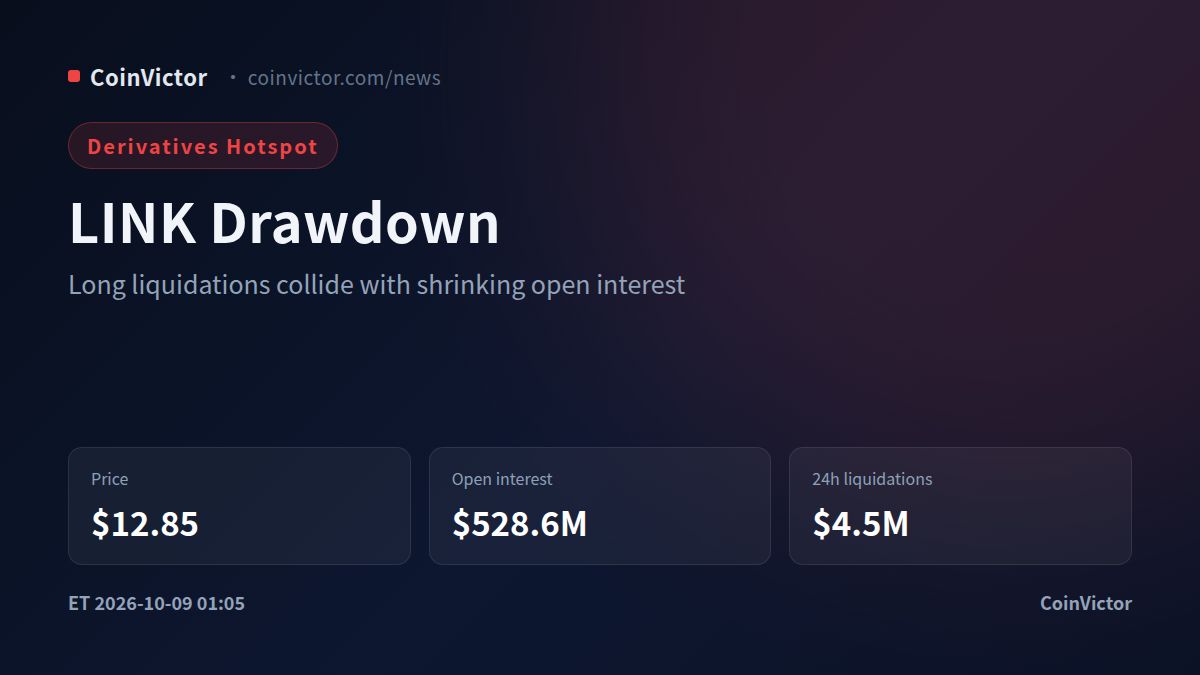
Chainlink is trading at $12.85 after a 2.0% decline, while total open interest has contracted 6.1% to $528.6M and liquidations have reached $4.5M. The pressure is not just a spot-price wobble: the derivatives tape shows leveraged longs being removed faster than shorts, even as active takers sell into a market where account-level positioning remains strongly long. Recent coverage has also highlighted Chainlink’s CCIP Vault Adapter launch and a broader debate over whether the token can recover or lose further support.
OI is shrinking across the main venues
The open-interest distribution is concentrated, but the decline is broad. Gate holds the largest reported share at 22.3%, or $117.9M, with its OI down 5.1% over the period. Binance follows at 20.4% and $107.7M, but its contraction is sharper at 9.6%. Bybit represents 13.0%, or $68.7M, after a 6.2% decline, while Bitget contributes 9.3%, or $49.2M, with a smaller 2.1% reduction. Together, these venues show that the drawdown is being accompanied by leverage removal rather than fresh positioning. The aggregate 4-hour changes are modestly positive at the venue level, but that has not reversed the wider OI loss, leaving the rebound attempt vulnerable if price slips back toward liquidation-heavy levels.
Funding is positive, but positioning is conflicted
The average funding rate is 0.0043%, indicating that longs still pay to remain open. The venue spread is meaningful: Aster, Bitget, BitMEX and WhiteBIT are each at 0.01%, while Bybit is at 0.0085% and Binance at 0.0052%. In contrast, OKX is negative at -0.0015%, Gate is -0.0012%, and Paradex is -0.0035%. This is not a uniform bullish funding signal; it suggests that long-carry demand is concentrated on several major venues while other books are already pricing more defensive or short positioning.
The account-versus-taker split reinforces that interpretation. Overall, 70.7% of accounts are long, yet the taker reading is 45.5% long, meaning active market orders are net short. Binance accounts are 61.1% long, compared with 58.0% long takers. Gate is more extreme: 62.8% of accounts are long, but only 36.2% of takers are long. That gap implies that existing traders are still positioned for a bounce while aggressive flow is selling into it, a classic setup for further long deleveraging unless price can stabilize quickly.
Liquidations show a one-sided flush
The liquidation profile is decisively bearish for leveraged longs. Over the latest 24-hour window, long liquidations total $4.4M against just $61.4K for shorts, accounting for nearly all of the $4.5M turnover in forced closures. The imbalance was already visible over the latest 12-hour window, with $1.3M in long liquidations versus $30.7K in shorts. The latest 4-hour period is different only in scale: shorts account for $17.4K versus $372.6 in longs, suggesting a small counter-move that has not yet changed the broader structure. The latest 1-hour window recorded $269.8 in long liquidations and no short liquidations.
The largest recorded long liquidations clustered at $12.54, $12.46, $12.39, $12.00 and $11.87. With LINK near $12.85, those levels form a visible downside ladder rather than a distant liquidation map. If price breaks through the upper cluster, the lower levels could become the next stress points as remaining long leverage is forced out.
Verdict: The dominant signal is a leveraged-long drawdown, not a confirmed bottom. The key risk zone is the $12.54-$12.46 area, with $12.00 and $11.87 as deeper liquidation levels; the market is carrying $528.6M in OI at the current $12.85 price. This bearish view is invalidated if LINK holds above $12.85 while OI rises back above $528.6M and taker positioning turns long instead of remaining at 45.5% long. Data as of 13:05 Beijing time on Oct 9, covering Binance, OKX, Bybit and other major venues.