Ethereum: $22.0B OI Meets 72.8% Long Accounts and -19.0% Basis
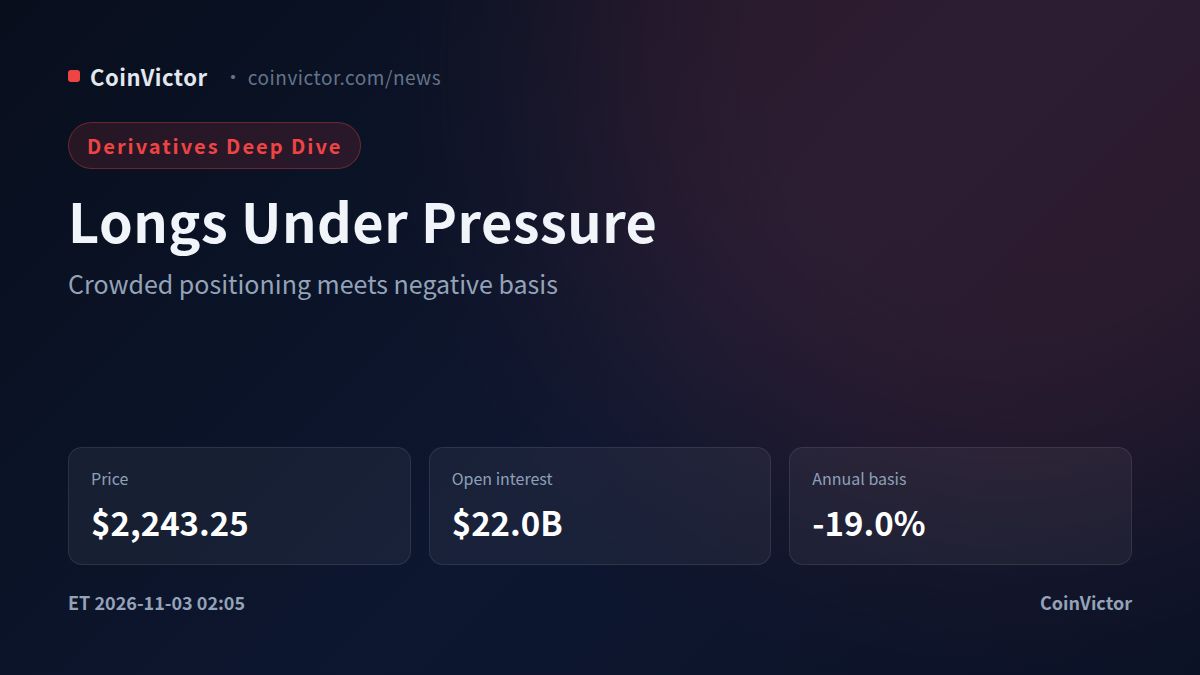
Ethereum is trading at $2,243.25 after a 1.9% decline, but the more important signal is the derivatives stack beneath spot: open interest is $22.0B, down 2.6% over 24 hours, while 72.8% of tracked accounts are long. Annualized basis is deeply negative at -19.0%, and 24-hour liquidations have reached $57.9M, including $47.3M from longs. This is not a simple bullish dip-buying setup. It is a market where long positioning remains crowded even as leverage is being removed and futures trade below spot.
Recent market coverage has centered on subdued trading activity around Ethereum and operational disruptions in the wider crypto infrastructure, but neither theme changes the positioning evidence in the derivatives data.
OI is falling, but the crowd is still long
The headline OI figure is $22.0B across 19 venues, with the market down 2.8% over 24 hours. That decline matters because it arrived alongside a 49.5% increase in spot and derivatives volume, suggesting that turnover is rising while leveraged exposure is shrinking. In a healthy accumulation phase, rising volume accompanied by stable or expanding OI would show fresh risk entering the market. Here, the combination instead looks more like forced de-risking and position cleanup.
The exchange split adds detail. Binance carries $5.3B, or 23.9% of total OI, after a 2.4% daily decline. OKX holds $1.4B and is down 4.4%, while Bybit has $1.7B after a sharper 8.0% fall. Bitget is a notable exception at $1.7B, up 0.6%, and Deribit has $260.7M, up 1.3%. Yet the exceptions are not large enough to reverse the aggregate trend. The one-hour change is only 0.0%, so the latest tape is stabilizing, but it has not yet demonstrated renewed leverage demand.
Account positioning is even more one-sided than aggregate OI. Binance shows 72.8% long accounts, OKX 72.4%, and Bybit 72.5%; Bitget is the most extreme at 79.7%, while Gate still has 67.2% longs. The average account reading of 72.8% therefore reflects a broad, venue-wide bias rather than one isolated exchange.
Funding is positive while basis stays defensive
Funding is positive across the principal venues: Binance, OKX, Bitget and Gate each show 0.0% when rounded to one decimal, with the unrounded readings near 0.01%. That is a small but important distinction. Longs are still paying shorts, even though the futures curve is not rewarding bullish exposure. The market is not paying a large premium for leverage; instead, it is charging a modest carry to a crowded long side while spot conditions remain weak.
The basis reading is more severe. Current basis is -0.1%, equivalent to -19.0% annualized. A negative basis means futures are below the reference spot price, consistent with defensive hedging, liquidation pressure or insufficient demand for leveraged upside. It also means a trader cannot interpret positive funding as proof of strong bullish conviction. In this structure, positive funding is better read as a positioning imbalance: longs are paying while the broader futures curve remains discounted.
Taker flow is mixed rather than decisively bullish. Binance takers are 61.3% long, but OKX is 52.6% short and Gate is 58.7% short. The account data says traders are broadly positioned for upside; the taker data says aggressive execution is already more contested. That divergence raises the probability that passive or trapped longs, rather than fresh buyers, are supporting the long-account percentages.
Liquidations identify the vulnerable side
Liquidation data completes the chain. Over one hour, long liquidations total $3.3M versus $0.3M for shorts. Over four hours, longs account for $4.2M against $0.6M for shorts; over 12 hours, the imbalance widens to $11.9M versus $3.4M. Across 24 hours, $47.3M of longs were liquidated against $10.6M of shorts. Longs have therefore suffered roughly four times the liquidation value of shorts, using the reported totals, even though the account ratio remains heavily long.
The largest recorded long liquidation was $8.3M at $2,232.65 on Binance, followed by $1.1M at $2,240.70 on OKX. Those levels sit close to the current market and mark a clear stress pocket around the low-$2,200 area. On the upside, notable short liquidations appeared at $2,263.84 and $2,307.50, showing that a rebound can still force shorts out, but the imbalance in aggregate liquidations says downside leverage remains the more exposed inventory.
Medium term, the vulnerable side is therefore long. A move below $2,232.65 would reopen the nearby liquidation pocket and could push OI lower without requiring a dramatic change in account ratios. A recovery through $2,263.84 would begin to challenge the immediate bearish structure, but it would need confirmation from OI and basis rather than price alone. If price rises while OI stays flat or falls, the move would look more like short covering than durable demand.
Verdict: ETH has a fragile medium-term structure, with $2,232.65 as the first downside stress level, $2,240.70 as a nearby liquidation reference, and $2,263.84 as the first upside test; aggregate OI should be watched against $22.0B. The bearish, long-vulnerability view is invalidated only if price reclaims $2,263.84 and then holds above it while OI expands beyond $22.0B, basis turns positive and long liquidations stop dominating. Data as of 15:05 Beijing time on Nov 3, covering Binance, OKX, Bybit and other major venues.