Ethereum: $24.6B OI and 72.7% Long Accounts Shape Max-Pain Risk
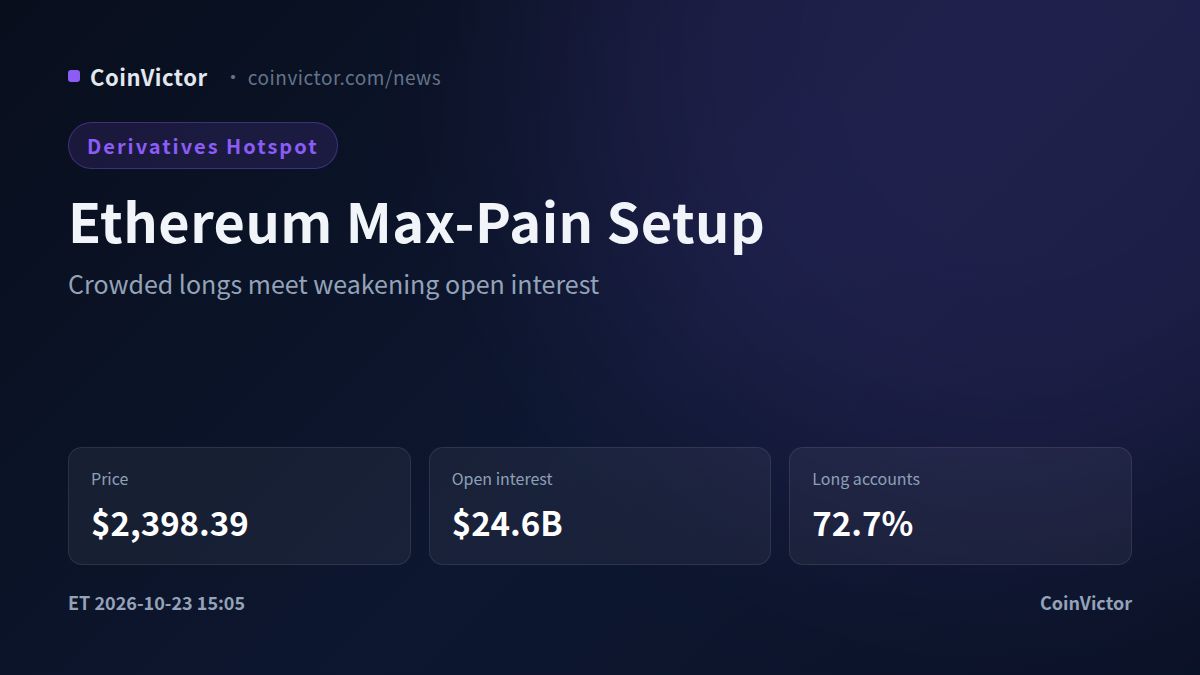
Ethereum is trading at $2,398.39 with $24.6B in open interest and 72.7% of tracked accounts positioned long, creating a crowded setup for a max-pain style move. The important counterweight is that aggregate open interest has fallen 0.6% over 24 hours, while the account reading is strongly bullish but active taker flow is only 48.7% long.
Market coverage also indicates that Ethereum’s planned Glamsterdam upgrade has been delayed again after developers identified risks affecting existing contracts.
Open interest is thinning at the edges
The exchange concentration gives the clearest map of where positioning could unwind. Binance holds $5.6B of ETH open interest, equal to 22.7% of the tracked total, and its position grew 0.1% over 24 hours even as it declined 0.5% over 4 hours. Bybit carries $1.9B, or 7.8%, but its open interest dropped 3.5% over 24 hours. Gate has $1.8B and 7.5% share after a 2.7% daily increase, while Bitget has $1.8B and 7.4% share after the sharpest decline among these major venues, down 5.6%.
This split matters for a max-pain framework. Binance is still absorbing exposure, but Bybit and Bitget are shedding it quickly. If Ethereum remains close to $2,398 while open interest continues to contract, the market may be flushing leverage rather than building a clean directional trend. The observed derivative price anchor is therefore less a breakout signal than a zone where both sides can be forced to reduce risk.
Funding stays positive, but the spread is wide
Current funding rates reinforce the cost of crowded longs across the largest venues. Binance is at 0.00745%, Bybit at 0.005835%, Gate at 0.0068%, Bitget at 0.0062%, and OKX at 0.003475%. That is a consistently positive carry profile, although OKX is charging less than Binance and Bybit. The extreme outlier is CoinEx at -0.070207%, while dYdX is also negative at -0.002985%; those readings show that positioning is not synchronized across the market.
Positive funding alone does not guarantee a long squeeze, but it raises the cost of waiting for accounts already leaning bullish. With the broader basis at -0.0612% and annualized basis at -22.3%, the market is simultaneously paying longs on perpetual contracts while dated exposure reflects defensive pricing. That combination is consistent with a fragile rebound rather than broad conviction.
Liquidations favor the downside stress test
The liquidation structure is decisively long-heavy in the shorter windows. Over 1 hour, long liquidations reached $256.8K versus only $24.09 in shorts. Over 4 hours, longs accounted for $3.2M against $1.2M in shorts, and over 12 hours the split was $15.6M versus $7.8M. The 24-hour total reached $33.1M, with $18.7M in long liquidations and $14.4M in shorts.
The largest recorded event was a $1.6M short liquidation at $2,409.40 on Gate, but the next two were OKX long liquidations near $2,391.99 and $2,388.50, worth $1.2M and $647.9K. That cluster places immediate downside stress just below the current market, while the Gate short liquidation shows that a move above $2,409.40 can still punish late bears.
The long/short split confirms the tension: Binance accounts are 76.3% long, OKX 71.6%, Bybit 72.5%, Bitget 79.5%, and Gate 63.9%. Yet takers are 42.5% long on Binance and 43.8% on Gate, meaning aggressive flow is net short on both. Accounts are leaning bullish, while active execution is selling into the rebound.
Verdict: The max-pain risk remains tilted toward a sweep of the $2,391.99-$2,388.50 liquidation zone while ETH stays below $2,409.40, especially if open interest breaks beneath the current $24.6B area. A sustained move above $2,409.40 accompanied by renewed open-interest growth would invalidate this downside-pressure view; so would a clear reversal in taker flow toward buyers. Data as of 03:05 Beijing time on Oct 24, covering Binance, OKX, Bybit and other major venues.