Ethereum at $2,352: $23.7B OI Reveals a Fragile Long Bias
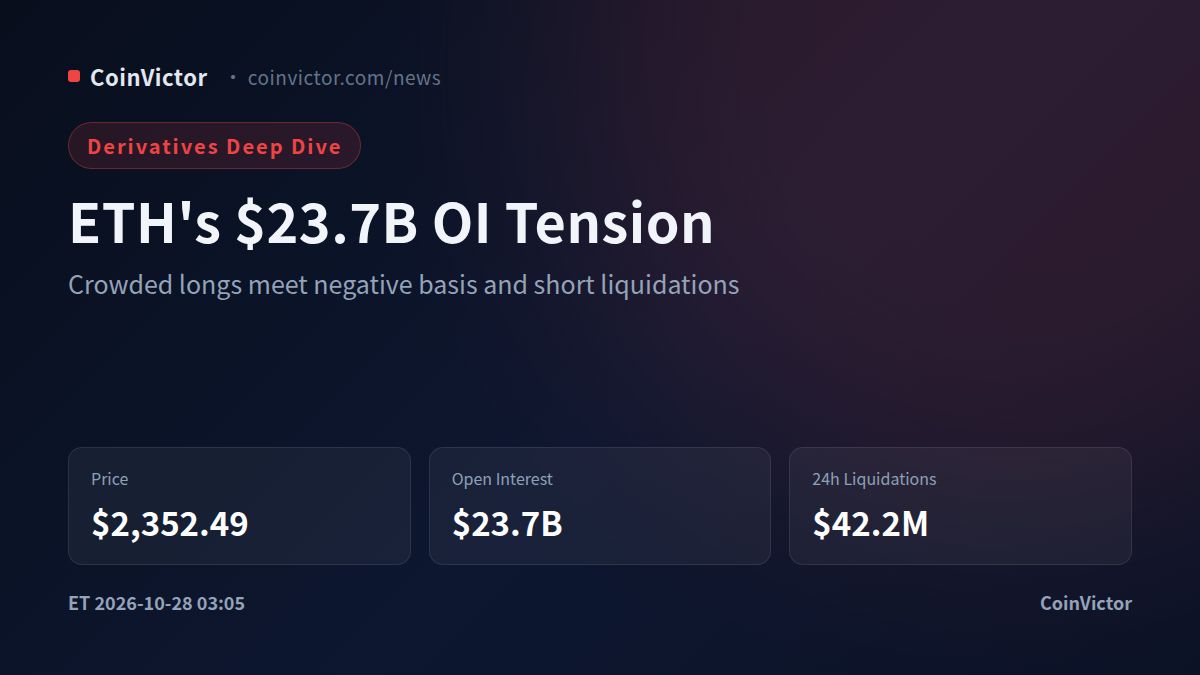
At $2,352.49, Ethereum is showing a market that is recovering in price but not yet repaired in structure. Open interest stands at $23.7B, up 0.5% over 24 hours, while volume has jumped 6.9%. At the same time, 70.9% of tracked accounts are long, taker positioning is 45.5% long, and 24-hour liquidations total $42.2M. The combination says ETH has upside momentum, but the leverage behind that move is uneven: passive positioning is heavily long, while aggressive traders are still selling into the tape.
Recent market coverage has described ETH as attempting to form a local floor, noted a treasury sale by the Ethereum Foundation, and highlighted delays affecting proposed leveraged crypto ETFs.
OI is rising, but the exchange map is split
The open interest structure is large enough to make positioning more important than the headline price change. Binance carries $5.6B, or 23.5% of the tracked total, and its OI is up 1.9% over 24 hours. OKX holds $1.5B, or 6.5%, with OI up 1.4%, while Gate holds $1.8B, or 7.4%, after a 3.2% increase. These are signs of fresh risk being added on several venues.
But the move is not broad-based. Bybit holds $1.8B, or 7.6%, while its OI has fallen 0.9% over 24 hours and 1.2% over four hours. Bitget has $1.8B, or 7.8%, with a 1.1% daily increase but a 0.6% decline over four hours. Deribit, the options-heavy venue in the dataset, has $244.9M and is down 0.8% over 24 hours. This split matters: the aggregate OI increase is modest, and some of the most recent positioning is being reduced rather than chased.
The immediate implication is a two-stage market. If ETH holds above $2,352.49 while OI continues to build, the long crowd can fuel a move into the nearby short-liquidation area. If price stalls and OI remains elevated, however, the market is storing liquidation risk rather than creating durable demand.
Funding and positioning favor a crowded-long diagnosis
The funding rate average is 0.0055% per eight hours, positive but not extreme. Venue rates range from 0.0012% on KuCoin to 0.0100% on Aster and WhiteBIT; OKX is at 0.0093%, Binance at 0.0066%, and Bybit at 0.0043%. Positive funding confirms that longs are paying shorts, yet the dispersion shows that leverage costs are not uniformly overheating. This is a warning of crowding, not proof of a final blow-off.
The account long/short ratio is more aggressive than the taker data. Binance accounts are 74.7% long, OKX accounts 69.0% long, Bybit accounts 72.3% long, and Bitget accounts 77.6% long. Gate is the least one-sided, but even there longs represent 60.8%. In contrast, Binance takers are only 23.3% long and 76.7% short. That divergence is central: existing accounts are positioned for upside, while market orders are leaning short.
Such a split can produce a squeeze if sellers are wrong. It also creates a fragile foundation because the long side owns the inventory while short-term sellers provide the immediate bid-side pressure. A clean rally would need price strength with OI rising moderately and funding staying near current levels. A rally driven by rapidly expanding OI and sharply higher funding would be less healthy, because it would add new longs directly into an already crowded structure.
Liquidations and basis reveal the hidden weakness
The liquidation data currently favors short pain. Shorts account for $37.6M of the $42.4M liquidated over 24 hours, compared with $4.8M for longs. Over 12 hours, short liquidations reach $8.0M against $814.6K for longs. The largest recorded event is a $9.5M Binance short liquidation at $2,367.87, followed by $1.9M on Hyperliquid at $2,346.32 and $1.8M on OKX at $2,344.67. Those prices define a live squeeze zone around the current market.
Yet the basis is deeply negative at -0.0480%, equivalent to an annualized -17.5%. That is not the signature of a market where futures traders are paying an aggressive premium for upside exposure. Instead, it suggests persistent hedging or defensive futures demand even as account data looks long-heavy. The negative basis partly offsets the bullish signal from short liquidations: sellers are being squeezed locally, but the broader derivatives curve still prices caution.
Momentum is also mixed across time frames. The one-hour RSI is 57.6, the four-hour RSI is 50.8, and the daily RSI is 37.8. Short-term recovery is therefore visible, while the daily trend remains damaged. ETH can continue higher because shorts are vulnerable near the liquidation cluster, but the medium-term structure has not yet shifted decisively bullish.
Verdict: squeeze potential, but longs remain the fragile side
The medium-term bias is cautiously bearish on leverage structure, not necessarily immediately bearish on price. The fragile side is the long crowd: 70.9% of accounts are long, funding is positive, and total OI is holding at $23.678B despite a deeply negative basis. The key upside test is $2,367.87, with $2,346.32 and $2,344.67 as nearby liquidation reference points. A sustained move above $2,367.87 accompanied by OI expanding beyond $23.678B while funding remains controlled would invalidate the fragile-long view and confirm a stronger upside regime. Conversely, failure to reclaim $2,367.87 followed by falling price and persistent OI would reinforce the risk of a long liquidation cascade.
Data as of 15:05 Beijing time on Oct 28, covering Binance, OKX, Bybit and other major venues.