Ethereum Derivatives: 69.7% Long Accounts Meet $121.8M in Liquidations
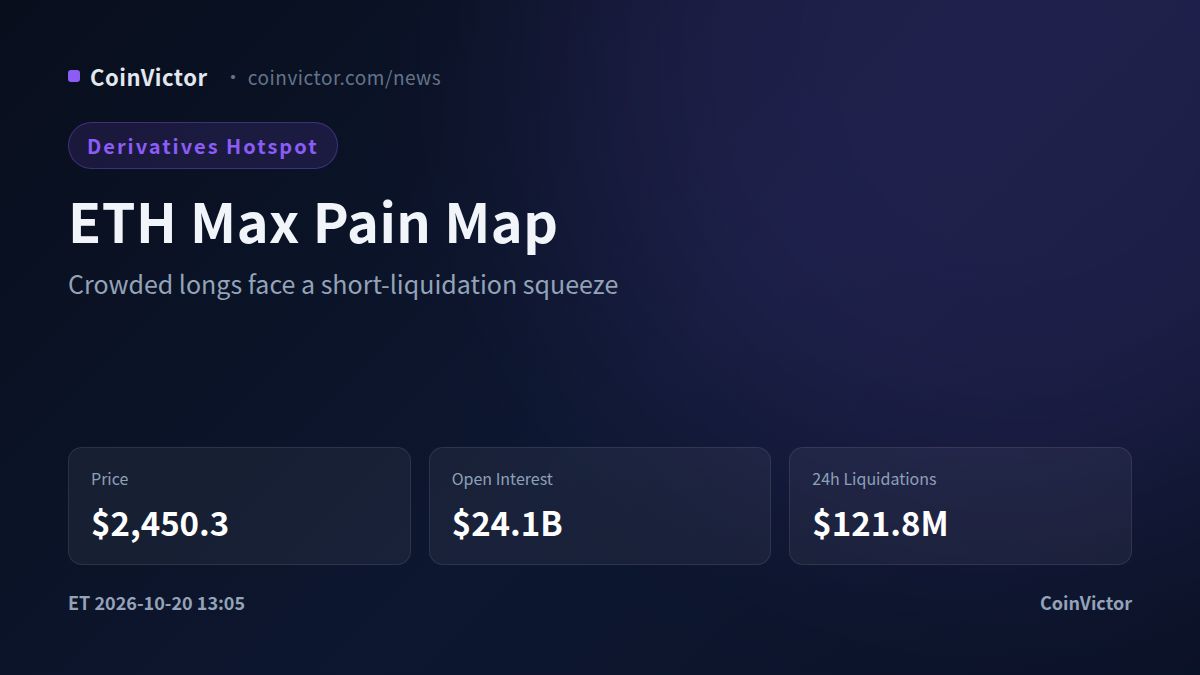
At $2,450.3, Ethereum is sitting inside a highly asymmetric derivatives setup: $24.1B in open interest, 69.7% of tracked accounts long, but only 45.1% of taker flow long. The options-max-pain lens cannot be confirmed with a strike-by-strike options chain in this dataset, so the practical map comes from open-interest concentration, funding dispersion and liquidation levels. That map points to a market with crowded passive longs and aggressive short flow, rather than a clean directional consensus.
The surrounding news flow is focused on Ethereum’s planned network upgrade and broader institutional and stablecoin adoption themes, but derivatives positioning currently offers the sharper near-term signal.
Open interest is concentrated, not evenly distributed
Binance holds the largest ETH open-interest block at $5.6B, or 23.3% of the tracked total, and its OI rose 2.3% over 24 hours and 0.8% over four hours. Bybit follows with $1.9B, or 7.9%, up 0.1% over 24 hours but down 0.6% over four hours. Gate accounts for 7.8%, with $1.9B, but its OI fell 4.8% over 24 hours and 4.6% over four hours. Bitget contributes 7.6%, or $1.8B, after a 0.2% daily decline and a sharper 3.0% four-hour drop.
This distribution matters for a max-pain-style interpretation. Binance is still adding exposure while Gate and Bitget are reducing it, so the market is not expressing one unified hedge. The top four venues represent a meaningful share of visible positioning, and the divergence suggests that any price move through the nearby liquidation bands could force venue-specific repositioning rather than a uniform unwind.
Funding is positive, but the spread is unusually wide
Funding remains positive at several major venues, although the absolute rates are modest and widely separated. Aster is at 0.009816%, Binance at 0.008502%, Bybit at 0.007515% and OKX at 0.006747%. Bitget is much lower at 0.0023%, while Deribit is 0.0020%. The most extreme reading is CoinEx at -0.070207%, showing that one venue is pricing a very different side of the market.
That spread weakens the case for treating the average funding rate as a standalone bullish signal. Positive funding on the largest visible venue supports the idea that long holders are paying to maintain exposure, but the negative CoinEx reading and lower Bitget and Deribit rates point to fragmented hedging. In a market framed by options max pain, this is consistent with a pull toward a crowded positioning zone rather than a guaranteed breakout.
Liquidations favor a short squeeze, despite long-account crowding
The liquidation tape is the clearest counterweight to the account data. Over 24 hours, ETH liquidations reached $121.8M: $84.7M from shorts versus $37.1M from longs. The same imbalance appeared over four hours, with $77.3M in short liquidations against $21.3M in long liquidations. In the last hour, shorts still accounted for $1.4M versus $0.4M for longs.
The largest recorded long liquidation was $11.7M at $2,414.88 on Binance. The largest short liquidation was $8.3M at $2,483.88, also on Binance, while additional short liquidations appeared at $2,472.07, $2,466.89 and $2,457.17. These levels create a usable pressure corridor: losses below $2,414.88 would test the crowded long side, while a recovery through the $2,457.17-$2,483.88 area could continue forcing shorts to cover.
Verdict
The exclusive read is a short-squeeze-biased pinning setup, not a clean long signal: $2,414.88 is the key downside liquidation shelf, $2,450.3 is the current pivot, and $2,483.88 is the decisive upside squeeze level against roughly $24.1B of open interest. As long as price holds above $2,414.88 while OI remains near $24.1B, the liquidation imbalance favors a test of $2,483.88; that view is invalidated by acceptance below $2,414.88 or a sustained move above $2,483.88 accompanied by expanding OI, which would show the market escaping the current pinning zone. Data as of 01:05 Beijing time on Oct 21, covering Binance, OKX, Bybit and other major venues.