Ethereum ETF Flow Stress: $23.3B OI Meets 43.9% Long Liquidations
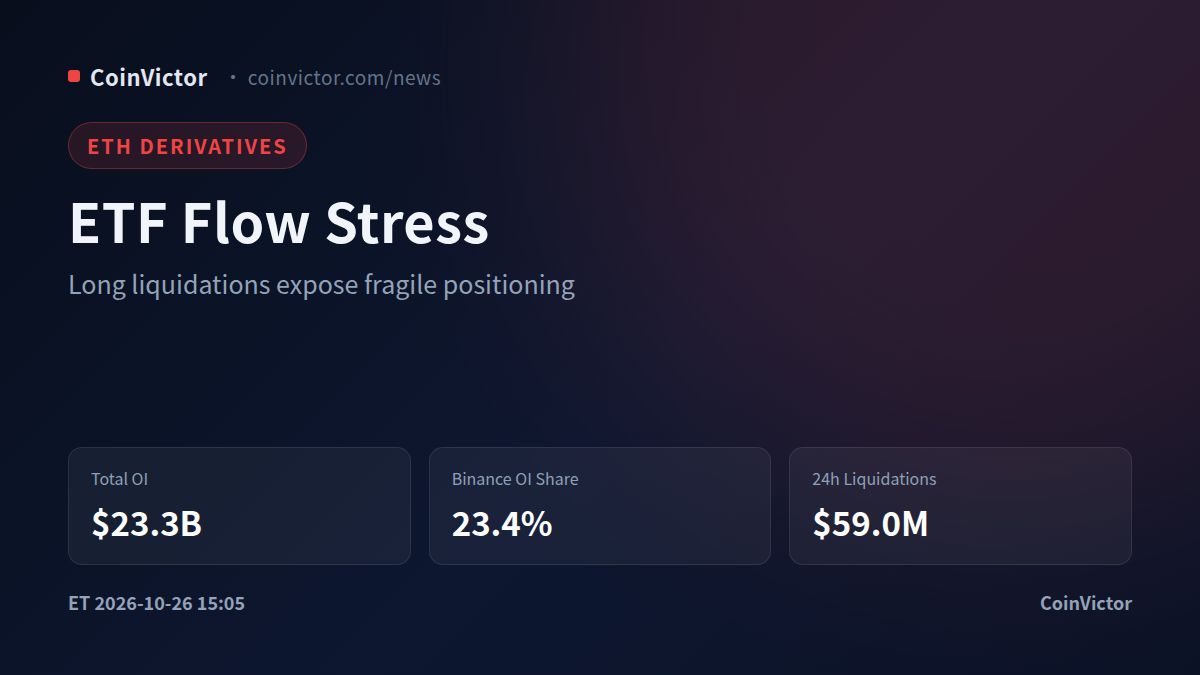
Ethereum derivatives are signaling stress beneath any optimism around ETF flows: total open interest stands at $23.3B while 24-hour liquidations reached $59.0M. The imbalance is clear, with $43.97M of long positions wiped out against $15.04M of shorts, while the aggregate account long share remains 73.6%. This is not a clean risk-on setup; it is a market where crowded positioning is absorbing a price decline.
Market coverage has also focused on a possible policy-driven turn in broader crypto markets and on whether Ethereum can outperform Bitcoin in the next month.
OI is stable overall, but uneven by venue
The first ETF-flow takeaway is that derivatives exposure has not collapsed uniformly. Total OI fell just 0.3% over 24 hours, yet the exchange-level picture splits sharply. Binance holds $5.4B, or 23.4% of the tracked total, and increased OI by 0.5%. OKX carries $1.5B, or 6.3%, with a 1.0% daily increase. Those additions provide a modest buffer against forced unwinding.
By contrast, Bybit holds $1.8B, or 7.7%, after a 2.8% decline, while Bitget holds $1.8B, or 7.6%, after falling 1.4%. Their four-hour changes were even weaker at -1.2% and -2.1%. Gate, with $1.7B and 7.2% of OI, dropped 3.1% over 24 hours and 2.3% over four hours. The implication is important for an ETF-flow thesis: headline-level demand has not translated into broad, synchronized derivatives accumulation.
Funding stays positive while traders sell aggressively
The funding rate average is 0.0064% on an eight-hour basis, still positive and consistent with a long-carry premium. But venue dispersion shows that the premium is not uniform. Binance, OKX and Aster each print 0.010%, while Bitget is at 0.0069% and Bybit at 0.006958%. Deribit is only 0.0005%, and dYdX is at 0.000%, showing much less demand to pay for long exposure in those markets.
Position data adds a sharper warning. Across accounts, the long share is 73.6%, but active takers are only 37.4% long. Binance takers are 40.9% long, OKX takers 48.4%, and Gate takers just 28.1%. In other words, many accounts still hold long exposure, while the traders initiating new market orders are predominantly selling. That account-versus-flow divergence weakens the case that current ETF interest is producing durable directional demand.
Liquidations show the cost of crowded longs
The liquidation structure confirms the pressure. In the latest hour, long liquidations totaled $882.5K versus $39.4K for shorts. Over four hours, the balance flipped temporarily, with $4.5M of shorts liquidated against $3.5M of longs, suggesting a short squeeze near local rebounds. Yet the 12-hour total still shows $12.6M in long liquidations versus $9.2M in shorts, and the 24-hour gap widens to $44.0M versus $15.0M.
The largest recorded long liquidation was worth $6.9M at $2,305.78 on Binance, followed by $3.5M at $2,297.37. On OKX, long liquidations appeared at $2,328.25 and $2,316.88, while a $926.1K short liquidation printed at $2,326.01. These levels map a nearby battlefield: longs have already been forced out across the $2,297.37-$2,328.25 area, but that band remains the clearest test of whether demand can rebuild.
Verdict: The exclusive signal is bearish-to-fragile until ETH reclaims $2,328.25 and total OI rises above $23.3B without another surge in long liquidations. A break below $2,297.37 with OI expanding rather than contracting would invalidate the stabilization view and confirm that ETF-flow optimism is failing to absorb leverage. Data as of 03:05 Beijing time on Oct 27, covering Binance, OKX, Bybit and other major venues.