Ethereum ETF Flows Face $19.9B OI and $265.4M Long Liquidations
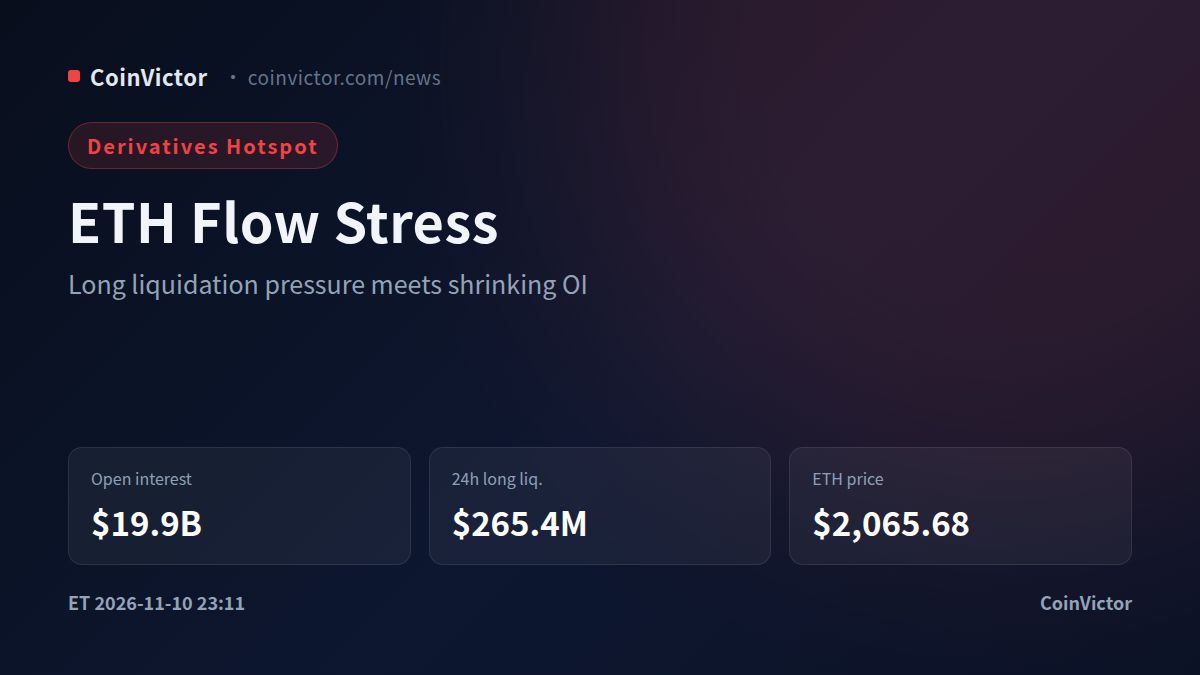
Ethereum is trading at $2,065.68 as aggregate open interest sits near $19.9B, down 4.2% over 24 hours. The ETF-flow angle is therefore meeting a derivatives market that is shedding exposure rather than building a clean upside chase. The most immediate evidence is liquidation asymmetry: $265.4M of long positions were cleared in 24 hours, compared with $28.8M of shorts.
News coverage has generally described Ethereum as lagging while broader technology equities advanced, while other reports have focused on staking returns and longer-term price expectations.
OI is contracting, but not evenly
Binance remains the largest venue in the snapshot, carrying $4.8B of ETH OI and a 23.9% share, with its exposure still up 0.3% in 24 hours. The next large concentrations are Gate at $1.7B and 8.6% of total OI, Bitget at $1.6B and 8.1%, and Bybit at $1.5B and 7.6%. Their daily changes split the market: Gate added 2.2%, while Bitget and Bybit fell 3.2% and 3.2% respectively.
This distribution matters for an ETF-flow thesis. A broad institutional bid would ideally coincide with expanding exposure across the largest venues. Instead, Binance is stable to slightly higher, Gate is adding risk, while two meaningful pools are reducing it. The overall ticker OI is also $19.2B, with its 24-hour change at -5.2%, reinforcing the conclusion that leverage is being removed faster than directional conviction is forming.
Funding is positive in some pockets, negative in others
Funding rates show no unified bullish premium. Whitebit is the high end at 0.01%, followed by Paradex at 0.005576% and Bybit at 0.003306%. At the other side, Gate is at -0.0021%, OKX at -0.001697%, and Binance at -0.000357%. That range suggests the cost of holding long exposure is venue-specific rather than a market-wide signal.
The positioning data adds an important split. Across the tracked account measure, 75.7% of accounts are long. Binance accounts are 77.2% long and OKX accounts are 77.1% long. Yet the active long/short taker mix is less aggressive: Binance takers are 72.1% long, while OKX takers are only 51.8% long. The gap between passive account direction and actual execution implies that many traders remain structurally long, but fresh market orders are far less one-sided.
Liquidations favor a defensive read
The liquidation tape is the clearest warning for the ETF-flow setup. In the latest 24-hour window, long liquidations reached $265.4M against $28.8M for shorts, a much more severe imbalance than the 12-hour window, where longs accounted for $16.7M and shorts $14.0M. The 4-hour window was different, with $936.3K of longs and $5.6M of shorts, indicating that the most recent burst of forced selling had already cooled into short-side clearing.
Several large long events cluster near the current market. A $31.5M liquidation printed at $2,020.42, followed by $11.5M at $2,047.95 and $8.9M at $2,041.87. These levels are more useful than a generic support claim because they identify where leverage was actually removed. If price approaches that zone again while OI remains compressed, the market may be testing whether ETF-related demand can absorb existing supply rather than creating a new leveraged trend.
Verdict: The near-term bias remains fragile-to-bearish below $2,065.68, with $2,047.95, $2,041.87, and especially $2,020.42 as the key liquidation levels. The view is invalidated if ETH holds above $2,065.68 while aggregate OI turns higher through $19.9B and its 24-hour change becomes positive; that combination would show fresh leverage returning alongside price rather than continued de-risking. Data as of 12:11 Beijing time on Nov 11, covering Binance, OKX, Bybit and other major venues.