Ethereum Liquidations: $47.0M in 24h Reveals a Split Market
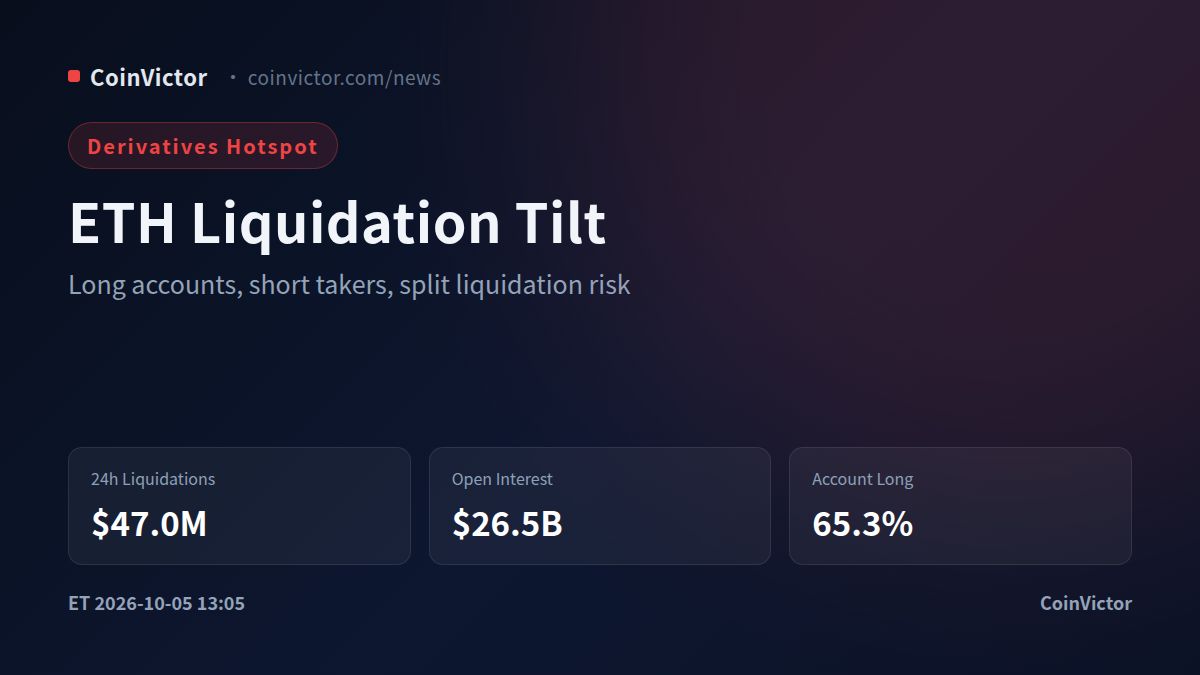
Ethereum is trading at $2,692.13 while $47.0M in positions were liquidated over the past 24 hours. The headline split is unusual: shorts absorbed $28.0M of that total, but the shorter liquidation windows remain dominated by longs, with $10.2M of long liquidations versus $1.5M of shorts over four hours. That makes the current market less a one-way bearish unwind than a crowded long book repeatedly taking damage before short squeezes appear.
Recent market coverage has highlighted thinner Ethereum liquidity relative to Bitcoin, a backdrop that can make these liquidation clusters more abrupt when leverage is concentrated.
OI is broad, but leverage is retreating
Aggregate open interest stands at $26.5B and is almost flat over 24 hours, down 0.0%, while the one-hour change is more decisive at -0.6%. The largest venue is Binance at $6.2B, or 23.4% of the tracked total, with its OI up 0.1% over 24 hours but down 2.2% over four hours. Bybit holds $2.2B, or 8.3%, and has declined 0.9% over 24 hours and 2.3% over four hours.
Gate carries $2.2B, or 8.2%, yet contrasts with the larger venues: its OI is up 0.1% over 24 hours and 4.5% over four hours. Bitget contributes $2.0B, or 7.7%, down 0.4% over 24 hours but up 1.0% over four hours. The pattern suggests leverage is being removed from Binance and Bybit while some risk is rebuilding on Gate and Bitget. That dispersion matters because a market-wide OI drop would support a clean deleveraging view; instead, the venue data points to rotation and uneven liquidation pressure.
Funding is mixed, not uniformly crowded
The funding rate reinforces the split. Binance is slightly negative at -0.0003%, Bybit is more negative at -0.0028%, and OKX is positive at 0.0035%. Bitget is also positive at 0.0046%, while Gate is positive at 0.0031%. The broad average is -0.0010% on the 8-hour basis. This is not a market where every venue is charging longs heavily; instead, long exposure is expensive on some exchanges and lightly rewarded on others.
The negative funding on Bybit and Binance can help explain why short liquidations still appeared near the upper price band. If shorts are established into a rebound while OI remains elevated, a move through nearby liquidation levels can force buybacks. Conversely, positive funding on OKX, Bitget and Gate leaves long holders vulnerable if price slips back toward the lower liquidation pocket.
Accounts lean long, execution leans short
Positioning data shows the sharpest contradiction. Across the tracked account measure, 65.3% of accounts are long, but active takers are only 42.6% long, meaning aggressive flow is net short. Binance has 72.1% long accounts, yet its takers are 46.4% long; Bybit has 67.2% long accounts, while its taker reading is not provided in the venue breakdown. On Gate, 59.2% of accounts are long, but just 32.7% of takers are long, leaving 67.3% on the short side.
This account-versus-taker divergence usually describes passive long positioning meeting immediate sell pressure. The liquidation tape supports that interpretation in the short term: the one-hour window shows $3.9M of long liquidations against $0.1M of shorts, and the four-hour window shows $10.2M versus $1.5M. Over 12 hours, longs still lead at $12.3M against $6.9M. Only the full 24-hour window flips, with short liquidations reaching $28.0M against $19.0M for longs.
Verdict: The liquidation skew remains bearish for crowded longs below $2,708.28, where a recorded $1.4M long liquidation occurred, while $2,724.07, $2,734.06 and $2,738.63 mark a visible short-liquidation cluster. With OI at $26.5B, a fall back below $2,708.28 accompanied by renewed OI growth would favor another long flush; a reclaim of $2,738.63 with OI holding above $26.5B would invalidate that view and shift the risk toward a short squeeze. Data as of 01:05 Beijing time on Oct 6, covering Binance, OKX, Bybit and other major venues.