Ethereum at $1,700: OI Falls 2.7% as Longs Face a Fragile Setup
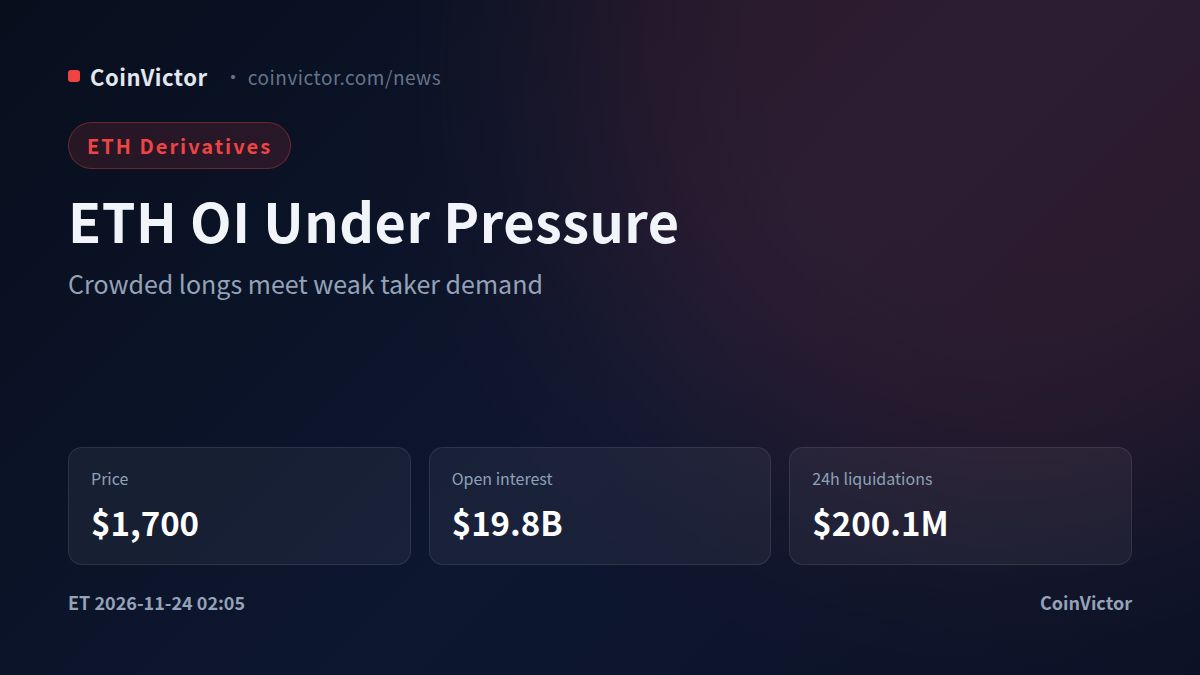
Ethereum is trading at $1,700.39, down 1.4%, while aggregate futures open interest sits at $19.8B after contracting 2.7% over 24 hours. The first read is defensive rather than decisively bearish: leverage is being removed, but the positioning that remains is still strongly tilted long. With account longs at 73.5%, taker buying below selling, and the futures basis negative, the market is showing a fragile long-heavy structure rather than a cleanly balanced reset.
Market coverage describes a broad crypto rebound alongside continued concern that major assets remain vulnerable after the sell-off.
OI is falling, but not yet washed out
The open interest profile points to deleveraging across most major venues. Binance holds $6.3B, or 31.9% of tracked ETH OI, and its 24-hour position change is relatively contained at -0.9%. By contrast, OKX is down 3.4%, Bybit is down 4.7%, Bitget is down 5.4%, and Gate is down 4.3%. The broad decline matters more than any single exchange: this is not merely a local liquidation event, but a reduction in gross exposure across the market.
There is, however, an important counter-signal in the shorter window. Binance OI is up 0.9% over four hours, while OKX is up 2.3%, Bitget is up 1.2%, and Deribit is up 0.1%. That rebound in exposure has arrived without a convincing price recovery. It suggests traders are rebuilding positions near $1,700, but the direction of that new leverage remains vulnerable because the wider 24-hour trend is still contraction. A sustainable bullish reversal would ideally pair higher prices with broader OI expansion; otherwise, the recent increase can simply reload liquidation risk.
Long positioning is crowded, while takers sell
The long/short split is the clearest structural warning. Binance accounts are 69.7% long, OKX accounts are 74.7% long, Bybit accounts are 76.4% long, and Bitget reaches 83.4%. The aggregate account reading is 73.5% long. This is not proof that price must fall, but it means the long side has less room for disappointment. A modest decline can force position reduction when so many accounts are leaning the same way.
Taker data makes the imbalance more concerning. Binance takers are 41.5% long against 58.6% short, OKX is 44.9% long against 55.1% short, Bitget is 45.6% long against 54.4% short, and Gate is only 33.7% long against 66.3% short. In other words, passive account positioning is long, but aggressive execution is selling. That combination often describes trapped dip buyers or longs waiting for a rebound while sellers control the immediate tape.
The funding rate is not yet showing a universal bullish premium. The ticker average is 0.0022%, while current readings are mixed: Binance is positive at 0.0041%, Bybit is negative at -0.0009%, and Deribit is negative at -0.0019%. The dispersion prevents a simple overcrowded-funding conclusion. Still, positive funding on some high-volume venues alongside a 73.5% long account share means longs are paying to maintain exposure in a market where takers are leaning short.
Liquidations and basis favor a defensive interpretation
The liquidation tape shows that long-side stress has already appeared. Over four hours, long liquidations total $9.0M versus $2.8M for shorts. Over 12 hours, the gap widens to $43.0M against $5.1M. Across 24 hours, however, the market is closer to balanced at $96.6M of long liquidations and $103.5M of short liquidations, for a total of $200.1M. This sequence suggests that the initial pressure hit longs, while subsequent rebounds or short squeezes produced meaningful short damage as well.
The largest recorded short liquidations cluster above the current market: $2.3M at $1,752.23, $1.8M at $1,761.78, $5.6M at $1,801.18, $4.2M at $1,805.50, and $2.2M at $1,809.69. These levels define a potential upside squeeze zone. Yet they do not automatically establish a bullish trend; they show where short leverage may be forced out if ETH can recover.
The basis is -0.1%, reinforcing the defensive signal. Futures are trading below spot rather than carrying a meaningful premium, so derivatives participants are not pricing an aggressive near-term expansion. The daily RSI is also 28.7, indicating deeply weak momentum, while the four-hour RSI is 46.0 and the one-hour RSI is 42.4. That mix allows for a sharp technical bounce, but it does not by itself repair the medium-term structure.
Verdict: fragile longs, conditional rebound
My medium-term view is cautiously bearish-to-neutral: the vulnerable side is the crowded long, not because funding is extreme, but because account longs remain at 73.5%, taker flow is seller-led, basis is negative, and OI has fallen to $19.8B without a decisive recovery in price. The key support reference is $1,700, while $1,752.23 is the first upside squeeze threshold and $1,801.18 is the more important liquidation-defined resistance zone. A break below $1,700 with OI rebuilding would signal fresh short pressure and weaken the rebound case. Conversely, a reclaim of $1,752.23 followed by a move through $1,801.18, accompanied by OI expansion above $19.8B and improving taker demand, would invalidate the fragile-long bearish view. Data as of 15:05 Beijing time on Nov 24, covering Binance, OKX, Bybit and other major venues.