Ethereum Options Max-Pain Proxy: $26.0B OI Faces a Long Trap
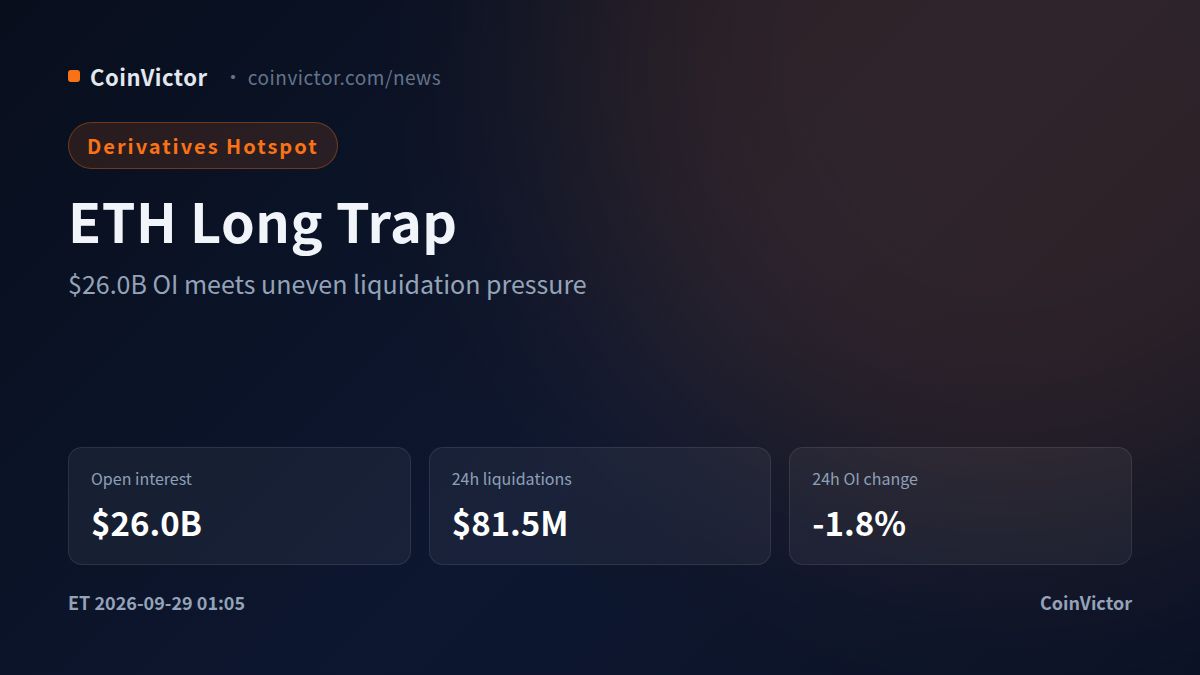
At $2,666.74, Ethereum is sitting inside a crowded derivatives structure: total open interest is $26.0B after falling 1.8% in 24 hours, while $81.5M in positions were liquidated. The options-max-pain lens is therefore best treated as a positioning proxy here: without an options strike and expiry distribution, the clearest pressure points are the liquidation clusters, exchange OI concentration and the gap between account direction and active flow.
Separately, current crypto coverage presents Ethereum as evolving beyond its original blockchain role, but that narrative backdrop does not remove the near-term derivatives imbalance.
OI is shrinking, but concentration remains high
Binance carries the largest disclosed ETH OI share at 23.2%, worth $6.0B, and its position count is down 1.0% over 24 hours. Gate has 8.2% of OI, or $2.1B, but suffered the sharpest contraction among the major disclosed venues at 11.2%. Bitget holds 8.1%, or $2.1B, with OI down 0.8%, while Bybit has 7.9%, or $2.0B, after a 3.3% decline. OKX contributes 5.9%, or $1.5B, and is down 4.7%.
The cross-venue pattern matters for a max-pain proxy. OI is not expanding into the current price; it is being reduced, especially on Gate and OKX. Yet Binance still dominates the risk map, so a move through its liquidation levels could transmit more broadly than the headline daily OI decline suggests.
Funding is positive, while active flow is less confident
The funding rate remains positive across most major venues, but the spread is wide. Binance is at 0.008131%, OKX at 0.006973%, Gate at 0.0064%, and Bitget at 0.010000%. Bybit is much lower at 0.000794%, while Deribit is at 0.0039%. This is a long-paying environment overall, but not a uniformly aggressive one. The negative readings on CoinEx at -0.070207% and KuCoin at -0.0006% show that positioning is fragmented rather than cleanly one-sided.
That fragmentation is reinforced by the long/short ratio. Across the reported market, 65.3% of accounts are long, but only 55.6% of active taker flow is long. Binance accounts are 73.3% long versus 59.7% long takers; Bybit accounts are 67.9% long, while Binance remains the strongest long-account venue. OKX is the key counter-signal: accounts are 59.0% long, but takers are 54.0% short. The result is a crowded passive-long base meeting more balanced or outright defensive execution.
Liquidation map favors downside pain first
The liquidation structure is asymmetric over shorter windows. In the last hour, shorts lost $134,258.65 against $31,361.63 in longs, a modest upside squeeze. Over four hours, however, long liquidations reached $8.6M versus only $263,934.30 for shorts. The 12-hour window is more balanced, with $17.2M in longs and $14.5M in shorts, while the full day totals $46.8M in long liquidations against $34.6M in shorts.
The largest recorded event was a $11.7M Binance long liquidation at $2,634.46. Other important markers include a $1.3M OKX long liquidation at $2,660.88 and a $1.3M OKX short liquidation at $2,697.46. Together, these levels frame the current pain corridor: downside has already produced the larger recent flush, but upside above $2,697.46 could still force a short-covering extension.
Verdict: The preferred max-pain proxy is a retest of $2,660.88 and potentially $2,634.46 while OI remains near $26.0B and account longs remain materially above taker longs. This view is invalidated by a sustained break above $2,697.46 accompanied by renewed OI growth, because that would signal fresh upside participation rather than trapped longs. Data as of 13:05 Beijing time on Sep 29, covering Binance, OKX, Bybit and other major venues.