Ethereum at $2,396: Why Longs Look More Fragile Than Shorts
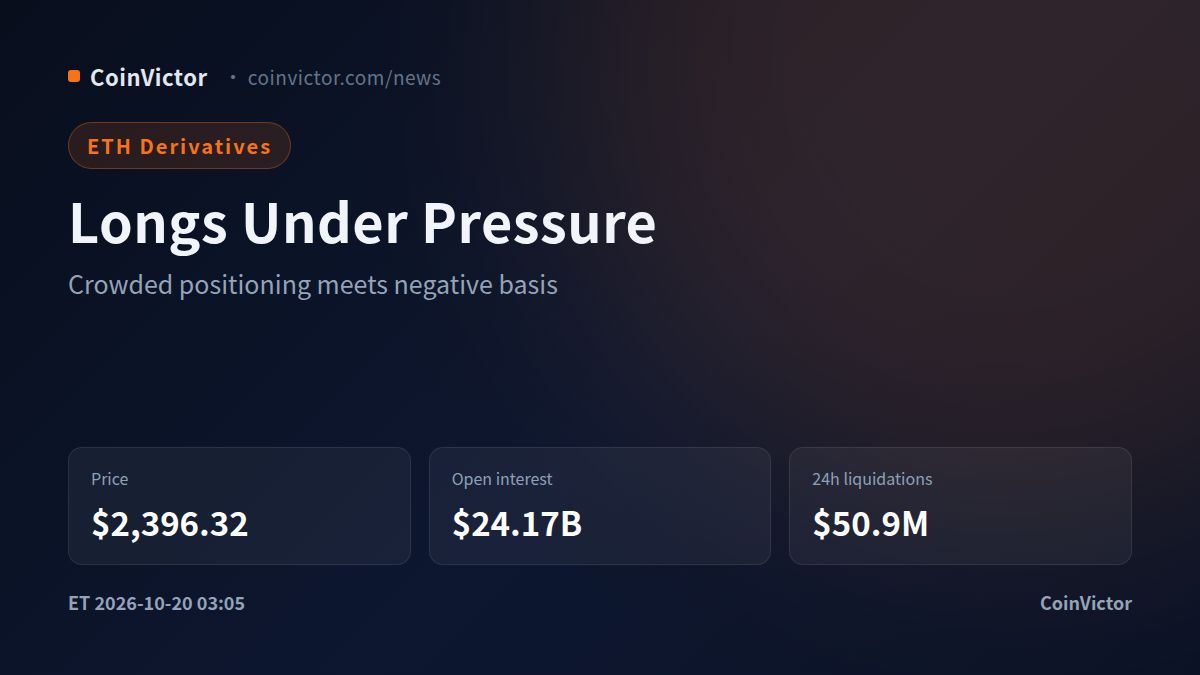
Ethereum is trading at $2,396.32, down 1.4%, while derivatives still carry $24.17B in open interest. The immediate contradiction is clear: account positioning is 71.2% long, yet taker positioning is only 34.8% long, the 24-hour liquidation total has reached $50.9M, and the futures basis is negative at -0.1%, equivalent to an annualized -25.6%. This is not a clean capitulation signal. It is a market where many accounts remain structurally long, but aggressive traders are leaning toward selling and forward pricing is weaker than spot.
Recent market coverage broadly frames ETH as holding a support area while remaining below important trend resistance, with attention also turning to whether the asset is becoming an under-owned trade. The derivatives data adds a more specific interpretation: the vulnerable side is still the crowded long, but a short squeeze remains possible if price absorbs the current supply without a fresh expansion in leverage.
Open interest is contracting, not resetting
Total open interest across nineteen venues is $24.13B in the exchange aggregation, down 0.5% over 24 hours. The ticker measure shows the same broad direction, with open interest down 0.4% over 24 hours even as one-hour positioning has increased 0.2%. That combination suggests a small, recent attempt to rebuild exposure inside a larger deleveraging process rather than a decisive new trend.
Concentration matters. Binance holds $5.51B, or 22.9% of the tracked total, with a 0.8% daily decline. Bybit has $1.88B and is down 2.0%, while OKX holds $1.44B and is down 1.0%. In contrast, Gate carries $1.99B and has added 3.3%, and Bitget holds $1.87B after a 1.3% increase. The split implies that leverage is not being removed uniformly; it is rotating between venues. That can delay a full flush, but it also means a sharp move through nearby liquidation levels could force synchronized repositioning.
The key structural point is that open interest has not collapsed alongside price. At $24.17B, it remains large relative to the current directional conviction shown by takers. A durable recovery would ideally require price appreciation accompanied by renewed open-interest growth, not merely passive holding. Conversely, a decline toward the recent long-liquidation cluster while open interest stays elevated would leave the downside more vulnerable to another forced unwind.
Positioning says crowded long, active sellers
The account figures are consistently long across the major venues: Binance is 75.1% long, OKX 69.7%, Bybit 71.7%, Bitget 78.2%, and Gate 61.4%. This is a broad positioning bias rather than an isolated exchange anomaly. Yet the long/short ratio among takers tells a different story. Binance takers are 34.1% long, OKX 46.1%, and Gate only 24.2% long. In other words, many existing accounts are holding long exposure, while traders initiating or closing aggressively are more willing to sell.
That divergence makes longs the more fragile side in the medium-term structure. A high account-long share can support a rebound if those positions refuse to exit, but it can also create a supply overhang whenever price stalls. The liquidation ledger confirms this imbalance in recent stress: $27.8M of long positions were liquidated over 24 hours versus $23.1M of shorts. Over four hours, long liquidations reached $1.30M against $384.2K for shorts. The market has already punished longs more heavily, but the surviving long concentration means the process may not be complete.
There is still a counter-risk for bears. A $3.46M short liquidation occurred at $2,444.84, showing that upside squeezes can be material when price moves above the nearby supply zone. The current funding picture does not fully confirm an overheated long market: average funding is only 0.0010%, although Binance is at 0.0053%, OKX at 0.0053%, and Bitget at 0.0063%. Funding is positive, but not extreme across the principal venues. That leaves room for a squeeze if shorts become too confident.
Negative basis defines the medium-term handicap
The funding rate is mildly positive on most large venues, while the aggregate basis remains negative. This pairing is important. Perpetual traders are paying a small amount to maintain long exposure, but dated futures are still priced below spot. The market is therefore willing to finance longs tactically without assigning a strong medium-term premium to ETH. It is a defensive carry profile, not a confident bullish one.
Price levels from the liquidation map define the practical battlefield. The recent long liquidations at $2,365.55, $2,370.18 and $2,387.21 sit close to the current $2,396.32 price, making that area an immediate test of whether demand can absorb forced selling. Above, $2,417.05 marks a notable short-liquidation level, while $2,444.84 is the clearest upside squeeze reference. A move through the lower cluster with open interest holding near $24.17B would be more bearish than a move accompanied by rapid deleveraging, because it would indicate fresh shorts are replacing flushed longs.
Verdict: ETH has a medium-term bearish-to-neutral structure, with crowded account longs more vulnerable than shorts. The critical downside zone is $2,365.55-$2,387.21; the recovery trigger is a sustained reclaim of $2,417.05 and then $2,444.84. The view would be invalidated if ETH reclaims $2,444.84 while open interest rises above the current $24.17B and taker longs recover from 34.8%, because that would show aggressive demand replacing trapped positioning rather than merely short covering. Data as of 15:05 Beijing time on Oct 20, covering Binance, OKX, Bybit and other major venues.