GRAM Open Interest Rises 4.2% as Gate Leads a $136.7M Surge
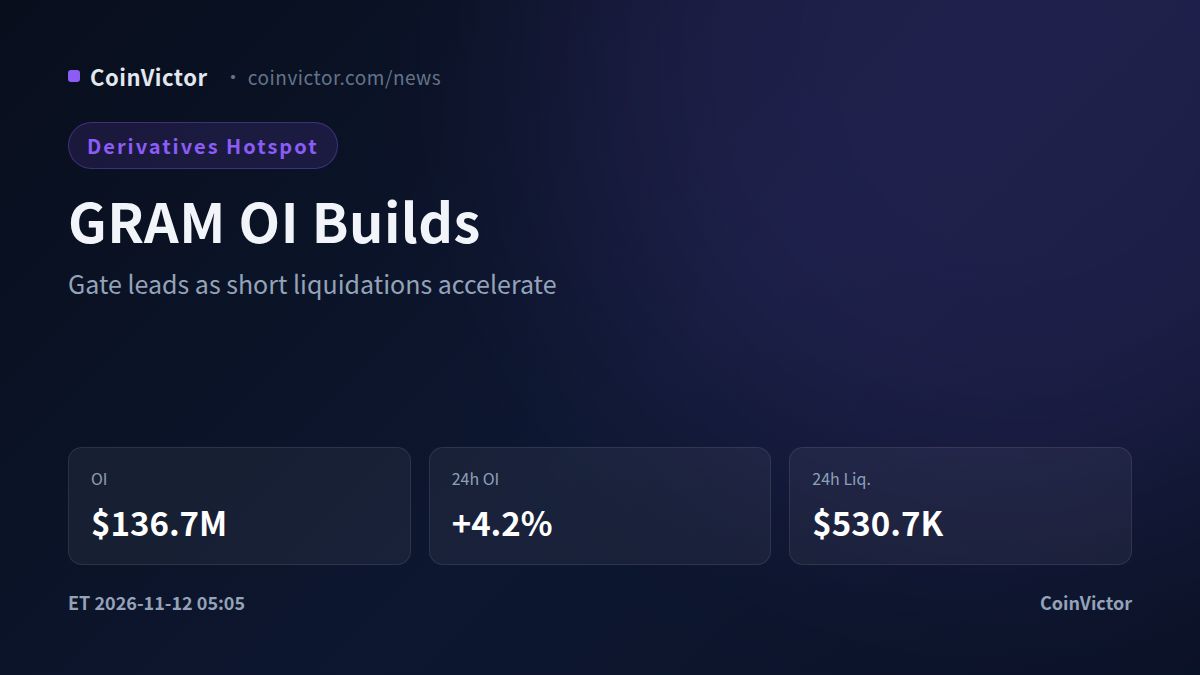
GRAM derivatives are showing a clear open-interest expansion: aggregate open interest reached $136.7M, up 4.2% over 24 hours, while the token traded at $1.24 after a 3.5% rise. The key question is whether this is fresh directional conviction or leverage building into a crowded long bias. Recent commentary around Pavel Durov has added a bullish narrative, but the derivatives tape is more nuanced than the price move alone suggests.
Gate drives the biggest OI expansion
Among the largest reported venues, Gate carries $30.4M of GRAM OI, equal to 22.2% of the tracked total, and its positioning grew 25.8% in 24 hours. Bybit remains the second-largest venue at $27.3M and 20.0% share after a 4.2% increase, while Binance holds $21.7M and 15.9% after rising 4.5%. OKX is smaller at $9.0M and 6.6%, but its OI advanced 7.3%.
That distribution matters because the expansion is not concentrated only in the biggest global venue. Gate’s jump is the strongest among the top four, while the broader total also shows momentum across other platforms. Bitget added 0.7% over 24 hours but accelerated 7.3% over the latest 4-hour comparison. Aster, with $5.6M and 4.1% share, rose 24.0% over 24 hours and 10.8% over 4 hours. The result is a market adding leverage at several venues rather than a single-exchange anomaly.
Funding is split, not uniformly bullish
The funding rate map does not confirm a one-sided long squeeze setup. Bybit’s current rate is -0.0401%, the most negative reading among the major venues listed, while OKX is at -0.0084%, Binance at -0.0059%, Gate at -0.0036% and Bitget at 0.0036%. Aster and HTX are both at 0.0050%, while Cryptocom is the positive outlier at 0.0621%.
This dispersion suggests that the cost of holding GRAM exposure depends heavily on venue and that some traders are paying shorts rather than longs. The ticker’s average 8-hour funding rate is 0.0251%, but the exchange-level readings show why that average should not be treated as a uniform market signal. Negative funding alongside rising OI can reflect defensive short positioning, hedging or short-term attempts to fade the advance.
Liquidations favor shorts in the near term
The liquidation structure is also time-sensitive. Over the latest hour, only $916.6 of short positions were liquidated and no longs were recorded. Across 4 hours, however, short liquidations reached $34.4K versus $5.2K for longs. Over 12 hours, shorts accounted for $38.0K against $24.5K for longs. The full 24-hour picture reverses the balance: long liquidations reached $378.7K, compared with $152.0K for shorts, for a $530.7K total.
The largest recorded forced exits were long positions at $1.193 on Bybit, worth $36.1K, and $1.213241 on Aster, worth $35.5K. Those levels provide practical reference points beneath the current price. Meanwhile, account positioning remains long-heavy: the aggregate ticker reading is 62.4% long, while active taker positioning is closer to balanced at 50.8%. On Binance, accounts are 62.1% long, and on Bybit they are 71.2% long; Gate is the exception, with accounts at 52.3% long and takers at 47.9% long.
Verdict: The OI surge is constructive for trend persistence only while GRAM holds above the $1.213241 liquidation reference and keeps OI near or above $136.6M. A push through the $1.237 current-price area with OI expansion would strengthen the continuation case, but a break below $1.193 together with OI falling under $136.6M would invalidate it and point to leverage unwinding rather than accumulation. Data as of 18:05 Beijing time on Nov 12, covering Binance, OKX, Bybit and other major venues.