Jupiter JUP: 14.9% Open Interest Surge Meets 0.005% Funding
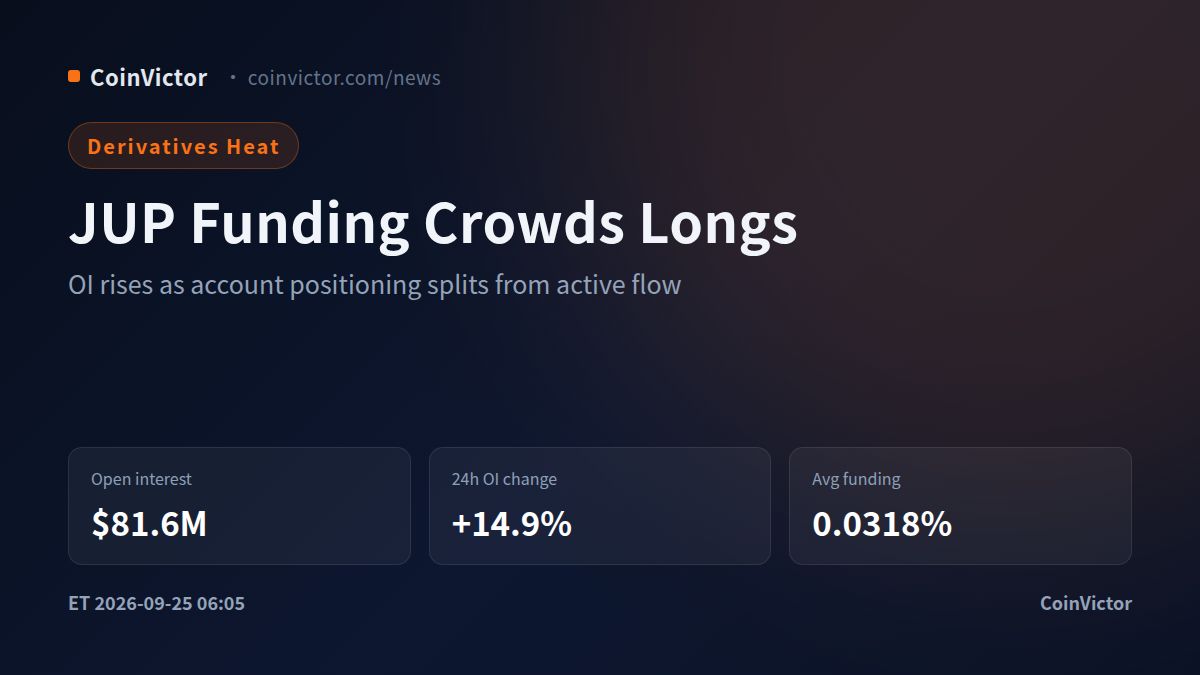
Jupiter derivatives are showing a crowded but unstable setup: aggregate open interest stands at $81.6M after rising 14.9% in 24 hours, while the ticker’s average 8-hour funding rate is 0.039728%. The most important tension is that account positioning remains long-heavy even as the active-flow reading points the other way. That combination makes the current rally vulnerable to a funding-led shakeout rather than a clean continuation.
Separate market coverage has discussed a decline in Oracle shares connected to delays around a project also called Jupiter, but that story is distinct from JUP’s exchange positioning.
OI growth is broad, not isolated
The open interest ranking shows Binance holding $17.7M, or 21.7% of tracked OI, after a 16.5% daily increase and a 4.1% increase over four hours. Bybit is close behind at $16.4M and 20.2% share, with OI up 11.2% over 24 hours and 2.0% over four hours. Bitget contributes $6.3M, or 7.7%, after a 15.9% daily rise, while OKX has $4.0M and 4.9% share after a 7.0% increase.
This is the signature of crowded funding: leverage is not concentrated on one venue, and the largest books are still adding exposure. Binance and Bybit are both expanding over the latest four-hour window, so a reversal could transmit across the main liquidity pools instead of remaining an isolated exchange event. The total OI increase is also much larger than the latest one-hour change of 0.1%, suggesting that the build happened primarily over the broader daily window rather than through a fresh burst in the last hour.
Funding is positive, but uneven
The funding rate is positive on Binance, Bitget, Bybit, OKX and several other major venues, but the pricing is not uniform. Binance, Bitget and OKX each show 0.005%, while Bybit is only 0.000473%. Backpack is at 0.002559%, and Coinbase is at 0.0017%. Kraken is negative at -0.005654%, creating a meaningful cross-venue contrast rather than a one-way consensus.
The extreme outlier is CoinEx at 0.763063%, but its JUP OI is only $19.6K, so it should not be treated as the market-wide signal. The practical read is that the larger books are charging longs, while Bybit’s lower rate and Kraken’s negative rate show that hedging or short demand remains present. Positive funding therefore confirms long crowding, but it does not yet prove that every venue is positioned for the same direction.
Liquidations favor shorts; positioning does not
In the liquidation windows, the 24-hour structure is sharply short-led: short liquidations reached $104.5K against $10.7K for longs. The same pattern appears over four hours, with $62.1K in short liquidations versus $3.6K in long liquidations, and over 12 hours, with $74.0K versus $4.1K. The largest single event was a $42.5K short liquidation on Hyperliquid at $0.32093343.
That short squeeze explains why price can rise even while funding turns expensive. Yet the long/short ratio adds a warning: Binance accounts are 65.8% long, while the dashboard’s active-taker reading is only 32.9%. In other words, passive account positioning leans long, but the active execution signal is much less supportive. Shorts are being forced out, but fresh directional buying is not matching the apparent long bias.
Verdict
JUP’s crowded-funding setup favors a pullback or consolidation risk after the short-liquidation burst: price is $0.3137, OI is $81.6M, and the key nearby stress point is the $0.32093343 liquidation level. The view is invalidated if JUP clears $0.32093343 while OI expands beyond $81.6M instead of unwinding, because that would show that new demand is absorbing the funding burden. Data as of 18:05 Beijing time on Sep 25, covering Binance, OKX, Bybit and other major venues.