Litecoin Funding Turns Negative as $416.6M OI Drops 6.9% Today
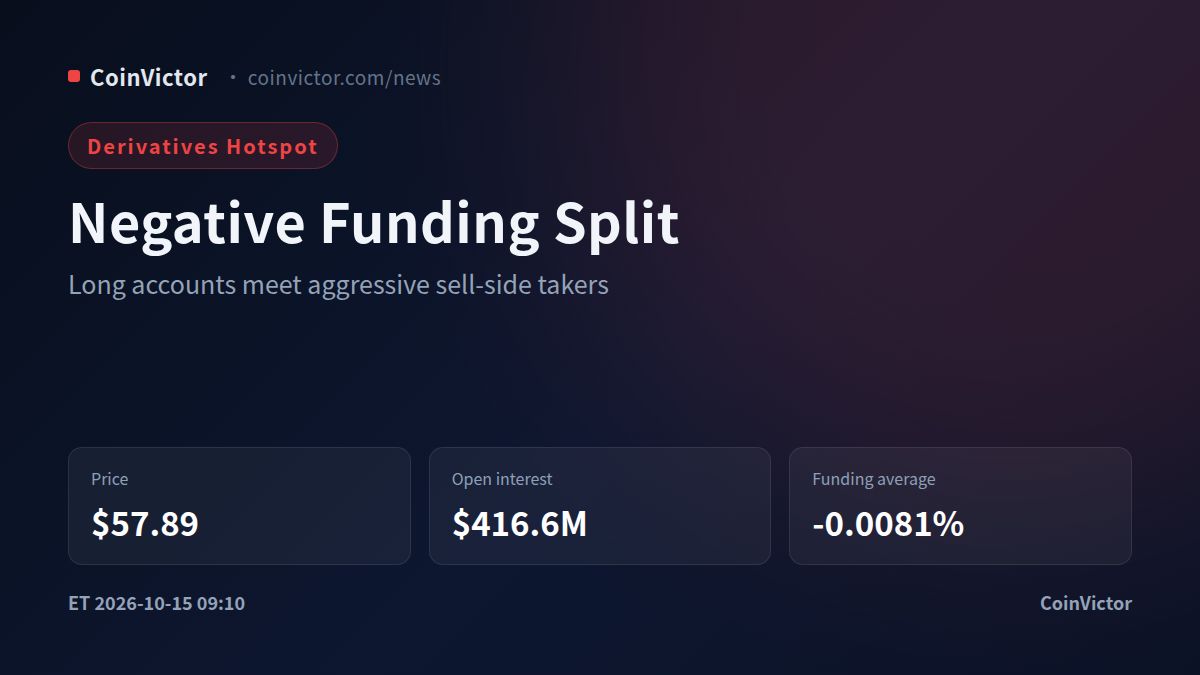
Litecoin is showing a sharp derivatives imbalance: price is $57.89, total open interest is $416.6M after a 6.9% daily contraction, and the average 8-hour funding rate is -0.0081%. That combination points to a market where leverage is being removed while shorts are generally being paid to hold positions. External market commentary also describes momentum as stalled, with selling pressure building near lower volatility-band support.
OI contraction is broad, not isolated
The largest visible OI share sits on Gate at $88.3M, or 21.2% of the tracked total, and it is down 6.7% over 24 hours. Binance follows with $68.1M and a 16.3% share, down 5.5%, while Bybit holds $66.1M, or 15.9%, after the steepest decline among these major pools at 8.3%. OKX contributes $29.2M, a 7.0% share, and is down 2.9%. The top venues therefore show synchronized deleveraging rather than a single-exchange distortion. Their four-hour changes are also negative, ranging from 1.0% lower on OKX to 1.9% lower on Bybit, with Binance down 1.8%.
The broader tape reinforces that pressure. Trading volume is up 53.3% over 24 hours even as OI falls, while the futures basis is -5.2% and its annualized reading is -18.9%. Higher activity alongside shrinking exposure is more consistent with position turnover and forced reduction than with confident fresh long accumulation.
Funding is negative, but the split is uneven
Funding is not uniformly bearish across venues. Gate shows -0.0075%, Binance -0.0035%, OKX -0.0034%, Bybit -0.0019%, and Aster -0.0019%. At the other end, Bitget is positive at 0.0097%, while Coinbase and Lighter each show 0.0096%; WhiteBIT is higher at 0.0219%. CoinEx is the outlier at -0.2029%, far below the rest of the displayed market. This dispersion matters: the negative aggregate is being driven by several large venues, but it does not represent a universal short premium.
Negative funding normally means shorts pay longs, yet it can also appear during a falling market when traders aggressively hedge or chase downside. Here, the negative basis and falling OI make the second interpretation more persuasive. Shorts are active, but they are not building a broad, durable leverage stack across every venue.
Accounts lean long while takers sell
The positioning data adds the clearest contradiction. Long accounts represent 71.2% of the aggregate account mix, while the aggregate taker split is only 45.7% long, implying that active execution is materially more sell-oriented than the headline account ratio. Binance is the sharpest example: 69.0% of accounts are long, but only 18.6% of taker flow is long. Gate is less extreme, with 66.4% long accounts and 61.4% long takers. On the account side, Bybit reaches 74.7% long and OKX 72.5%, both against a market where liquidations are overwhelmingly long.
In the liquidation windows, long losses total $1.6M over 12 hours versus $75.1K for shorts. Across 24 hours, long liquidations reach $2.2M against $93.3K short liquidations, or $2.3M in total. The structure suggests that crowded long accounts are absorbing the immediate damage while short takers press the market lower.
Verdict: The negative-funding signal remains bearish for Litecoin’s near-term structure, but it is a crowded-positioning warning rather than proof of unlimited downside. The key reference is $57.89 with OI at $416.6M: a break below price while OI stays below that level would favor further long unwinding, whereas a reclaim of $57.89 accompanied by OI rising above $416.6M would invalidate the downside-continuation view. Data as of 21:10 Beijing time on Oct 15, covering Binance, OKX, Bybit and other major venues.