Polkadot DOT Derivatives: $178.1M OI and 67.8% Long Accounts
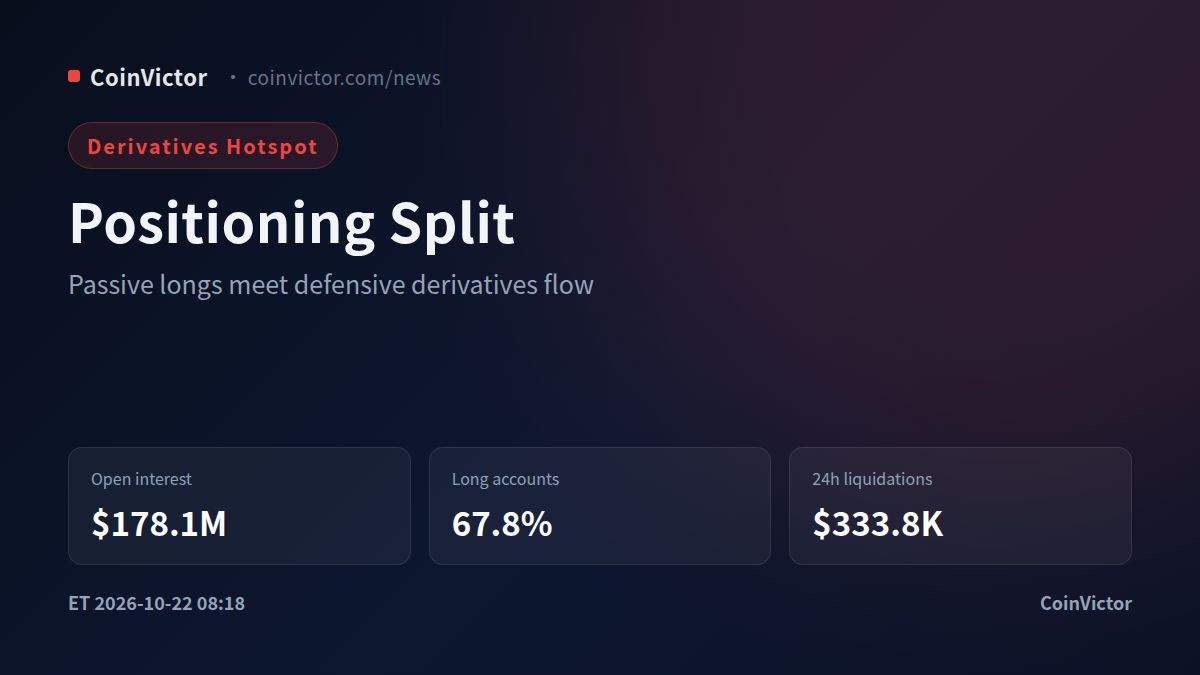
Polkadot derivatives are showing a clear positioning divergence: price is $1.1254, total open interest is $178.1M after a 3.2% daily drop, yet 67.8% of tracked accounts remain long. The more tactical signal is weaker, with the active taker reading at 29.6. That combination suggests many traders are still holding directional long exposure while recent execution has been notably less supportive.
OI is concentrated, but the rebound is uneven
Gate carries the largest reported DOT position at $36.2M, or 20.3% of the total, followed by Binance at $34.7M and 19.5%. Bybit contributes $23.4M, or 13.2%, while Bitget holds $21.0M, or 11.8%. Together, these venues dominate the visible positioning map, but their daily changes show broad deleveraging: Gate fell 5.4%, Bybit declined 5.1%, and Bitget dropped 2.0%. Binance was comparatively stable at a 0.8% decline.
The shorter horizon is less uniform. Binance open interest rose 3.1% over the latest four-hour window, OKX gained 5.0%, Bitget added 2.9%, and Bybit increased 1.6%. The largest venues are therefore rebuilding some exposure after the daily reduction, but that recovery has not yet reversed the broader contraction. A rising short-window position count inside a falling daily base can reflect fresh hedges or attempts to average into a pressured market rather than clean bullish conviction.
Funding confirms a venue-level split
The funding rate map is mixed rather than uniformly long-biased. Binance is at -0.0%, OKX at -0.0%, Bybit at -0.0%, and Gate at -0.0%, while Bitget and Aster each show 0.0%. The displayed differences are small in rounded percentage terms, but their signs still matter: several of the largest venues are charging shorts less or rewarding them, consistent with defensive positioning.
At the extremes, CoinEx is at -0.2%, while Coinbase is at 0.1%. That gap is materially wider than the readings on the major venues. The ticker's average eight-hour funding is also negative at -0.0%, reinforcing the view that leverage is not paying a broad premium for long exposure. Funding alone does not establish a trend, but alongside falling daily open interest it argues against reading the account-long majority as fresh, aggressive demand.
Liquidations expose the cost of crowded longs
The liquidation structure is the clearest evidence of positioning stress. Over 24 hours, long liquidations reached $279.4K versus $54.4K for shorts, for a total of $333.8K. The 12-hour window is even more one-sided, with $162.2K in long liquidations against only $279 in shorts. The latest one-hour window recorded $31 in short liquidations and no long liquidations, but the four-hour window recorded no liquidations on either side.
This sequence suggests the forced selling has been concentrated in earlier long unwinds rather than an active short squeeze. The account ratio remains long-heavy, but liquidation losses show that this positioning has not translated into protection during the decline. The gap between 67.8% long accounts and the 29.6 taker reading therefore matters more than the headline account majority: passive positioning is long, while active flow is not confirming it.
Verdict: The immediate bias remains defensive while DOT trades around $1.1254 and open interest sits at $178.1M. A move below $1.1254 accompanied by another open-interest reduction would validate continued long de-risking; the view would be invalidated if DOT holds above $1.1254 while open interest rises beyond $178.1M and the active taker reading recovers above 29.6. Data as of 20:18 Beijing time on Oct 22, covering Binance, OKX, Bybit and other major venues.