Solana at $96.32: $4.46B OI Meets a -15.2% Annual Basis
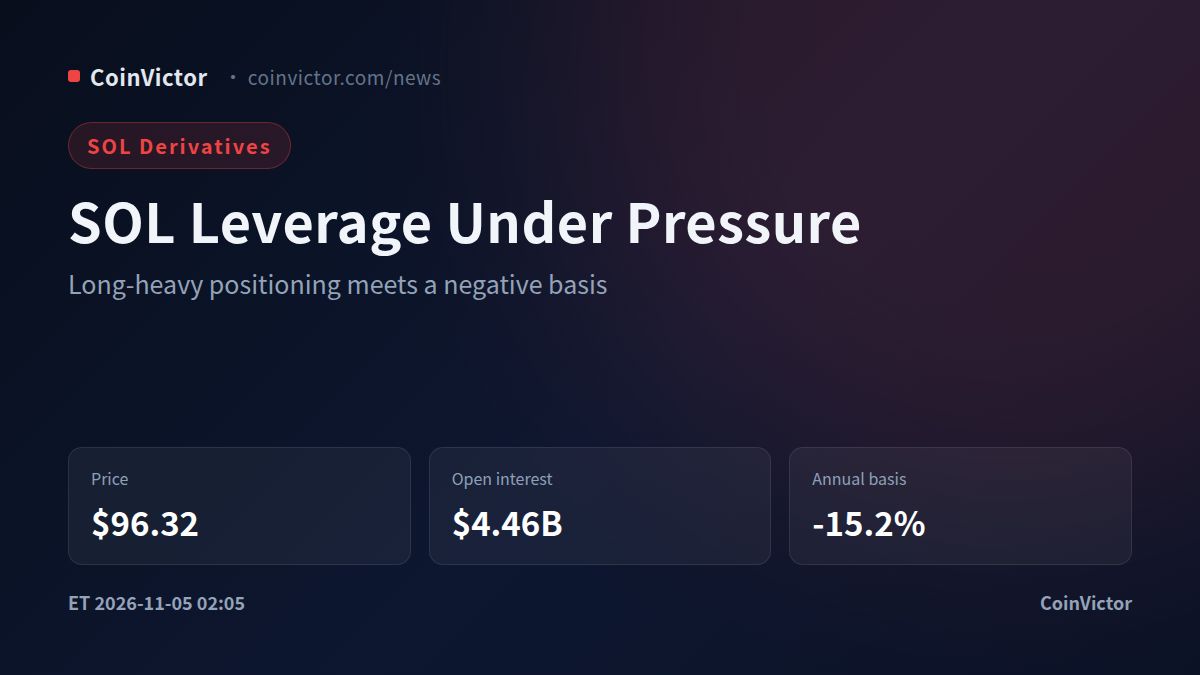
Solana is trading at $96.32 after a 3.8% move, but the derivatives picture is more conflicted than the spot rebound suggests. Total open interest is about $4.46B, up 0.5% over 24 hours while volume has risen 29.4% to $6.64B. That combination says leverage remains active rather than washed out. At the same time, the annualized basis is -15.2%, a strong discount that points to defensive futures pricing. The central question is therefore not simply whether SOL can bounce, but whether the bounce can absorb crowded long exposure without rebuilding the same downside risk.
Recent coverage has emphasized SOL’s downside pressure, a co-founder view on redirecting data-center activity toward crypto, and the emergence of open-source tools for monitoring complex on-chain operations.
OI is stable, but not evenly distributed
The aggregate OI change is modest, yet the exchange breakdown reveals rotation beneath the surface. Binance holds $887.3M, or 19.9% of the total, and its OI is up 2.6% over 24 hours but down 0.9% over the latest four-hour window. Gate carries $756.4M, or 17.0%, with OI up 4.0% over 24 hours and 1.4% over four hours. Bitget is smaller at $423.3M, or 9.5%, but has added 5.1% over 24 hours. By contrast, Bybit holds $582.0M, or 13.1%, while OI has fallen 1.6% over 24 hours and 1.4% over four hours.
This is not a clean, broad-based expansion of risk. Some venues are adding contracts while Bybit and Binance show short-term contraction. The result is a market with enough leverage to amplify a move, but without a single exchange-wide signal confirming that fresh longs are confidently in control. The rise in volume relative to the smaller OI increase also leans toward active repositioning rather than passive accumulation.
Longs are crowded, while takers sell
The account data is the clearest structural warning. Across the tracked market, 76.6% of accounts are long. Binance shows 73.7% long accounts, OKX 76.1%, Bybit 77.3%, Bitget 86.8%, and Gate 69.5%. Bitget’s 6.6 long-to-short ratio is particularly one-sided, while even Gate remains above two long accounts for each short account.
Yet taker flow is less bullish than account positioning. Binance takers are 38.7% long and 61.3% short; OKX is 45.2% long and 54.8% short. Gate is the exception, with 56.5% long takers. This split matters: many accounts may be holding or adding long exposure, but aggressive execution on key venues is still tilted toward selling. Positive funding is consistent with that crowding, although the average eight-hour funding reading is only 0.00005371 in decimal terms, not an extreme payment burden by itself.
The liquidation record reinforces the asymmetry. SOL liquidations reached $23.3M over 24 hours, including $17.8M of shorts against $5.5M of longs. That short-liquidation dominance helps explain why price can rebound even while the broader account structure remains long-heavy. However, the shorter windows are less decisive: four-hour liquidations total $527,437.80, with $353,939.60 from shorts and $173,498.20 from longs. A continuation higher could still squeeze shorts, but the market has not yet demonstrated that it can sustain that squeeze without new leverage replacing it.
Negative basis changes the medium-term read
The negative basis is the most important counterweight to the crowded-long signal. Futures trading at a -0.041589% basis, equivalent to -15.2% annualized, indicates that derivatives traders are pricing meaningful downside carry despite the spot recovery. In practical terms, the market is simultaneously long by account count and defensive by forward pricing. That usually creates a fragile rebound: longs can be forced out if support fails, while shorts can be squeezed if spot clears nearby liquidation zones.
The liquidation map identifies the immediate battleground. A large short liquidation sits at $97.29, with another at $98.14. Below market, long liquidations cluster at $94.79 and $95.10, while a further short liquidation is recorded at $94.55. These are not guaranteed support or resistance levels, but they define where forced flows may accelerate. A move through $97.29 could pull price toward $98.14 and pressure shorts; a break through $95.10 and $94.55 would instead expose the crowded long side.
Momentum is mixed across timeframes. The one-hour RSI is 59.3 and the four-hour RSI is 55.5, showing that the rebound has improved short-term conditions. The daily RSI remains 38.0, however, keeping the medium-term backdrop below neutral. That combination favors a tradable recovery inside a still-damaged structure rather than a confirmed trend reversal.
Verdict: The medium-term bias remains fragile and slightly bearish because long accounts dominate while the annual basis sits at -15.2%. The key downside zone is $94.55-$95.10; a sustained break there would expose the crowded long structure. The upside test is $97.29-$98.14, with total OI near $4.46B as the leverage gauge. This view is invalidated if SOL reclaims $98.14 while OI remains above $4.46B and the negative basis turns decisively positive, signaling that the rebound is attracting durable demand rather than only short covering. Data as of 15:05 Beijing time on Nov 5, covering Binance, OKX, Bybit and other major venues.