Solana Liquidation Skew: $5.8M Longs vs $1.4M Shorts in 24H
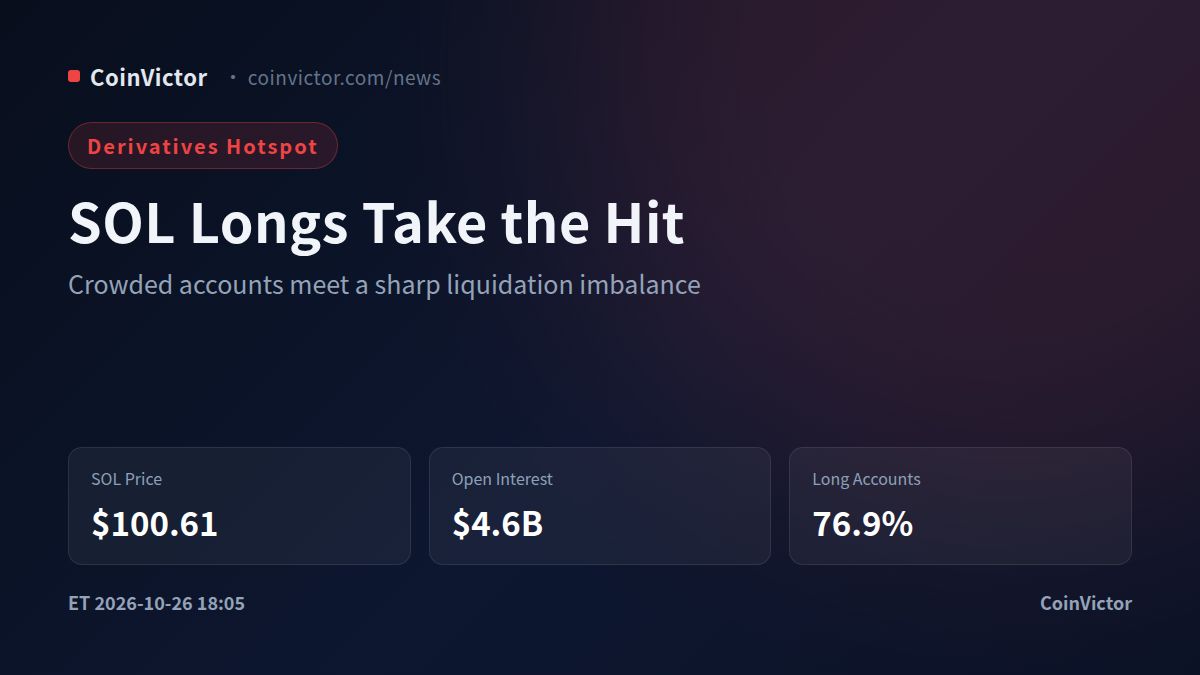
Solana is trading at $100.61, but its derivatives profile is more fragile than the headline price suggests: 24-hour liquidations reached $7.2M, with $5.8M from longs against $1.4M from shorts. At the same time, aggregate open interest climbed to about $4.6B, up 2.0% over 24 hours. That combination points to leverage building into a market where long positions are already absorbing most of the forced selling.
Separately, Hong Kong has identified a Nasdaq-listed Solana-focused company as a strategic enterprise, adding a constructive institutional narrative even as the derivatives tape remains defensive.
Long exposure is concentrated at the top venues
The largest open-interest pools are Binance at $890.9M, or 19.4% of the tracked total, Gate at $822.1M and 17.9%, Bybit at $593.3M and 12.9%, and Bitget at $418.6M and 9.1%. Their changes show an important split. Binance open interest rose 2.9% over 24 hours, Gate gained 2.5%, and Bitget edged up 0.4%, while Bybit fell 2.3%. Over the shorter four-hour window, Binance, Gate, and OKX still expanded, but Bybit contracted 1.2% and Bitget declined 0.4%.
This is not a clean, broad-based risk-on build. It is a selective increase in exposure, with some venues adding contracts while Bybit and Bitget reduce them. Because total open interest is rising despite heavy long liquidations, the market may be replacing closed positions rather than fully clearing leverage.
Funding is positive, but the pressure is uneven
The current funding rate is positive across most major venues. Binance, OKX, Bybit, Bitget, Gate, and several other exchanges show 0.010%, while Backpack and Hyperliquid are at 0.00125%. Crypto.com is at 0.002043%, Kraken at 0.00193%, and dYdX is nearly flat at 0.000024%; Bitfinex is at 0%.
Positive funding means longs are paying shorts, reinforcing the cost of maintaining the crowded side. Yet the dispersion matters: the highest readings are concentrated across the biggest venues, while smaller or alternative venues show much lighter funding. That makes the liquidation skew more credible than a simple funding-based bearish call. The market is paying to stay long, but not every venue is carrying the same degree of imbalance.
Accounts are bullish while active flow sells
The long/short ratio split is the clearest warning. Long accounts represent 75.4% on Binance, 75.7% on OKX, 76.6% on Bybit, 86.2% on Bitget, and 70.8% on Gate. Bitget is therefore the most crowded account-level venue, while Gate is the least extreme among the listed exchanges.
Active taker flow points the other way. Shorts account for 70.3% of taker activity on Binance, 59.0% on OKX, and 53.9% on Gate. In other words, traders are holding long positions in their accounts while aggressive execution is predominantly selling. That account-versus-taker divergence can precede another flush: passive longs remain exposed, while active traders continue pressing the offer.
The liquidation windows confirm that downside leverage has already been punished. Long liquidations reached $59.3K in one hour versus $1.0K in shorts, then $1.2M versus $1.2K over four hours. Across 12 hours, longs accounted for $2.5M against $894.2K in shorts; over 24 hours, the gap widened to $5.8M versus $1.4M. The largest prints clustered around $99.38-$99.40, including a $981.2K Binance liquidation at $99.40. Other large long liquidations appeared at $100.24, $100.40, and $100.74, showing that forced selling is not limited to one isolated price level.
Verdict: The immediate bias remains liquidation-skewed to the downside while SOL stays below $100.74, with $99.38-$99.40 the key stress zone and roughly $4.6B in open interest still supporting a crowded leverage structure. This view is invalidated by a sustained reclaim above $100.74 alongside aggregate open interest expanding beyond $4.6B and active taker flow no longer remaining short-dominant. Data as of 06:05 Beijing time on Oct 27, covering Binance, OKX, Bybit and other major venues.