Stellar XLM: $171.4M OI and a 6.3% Daily Reset Shape Risk
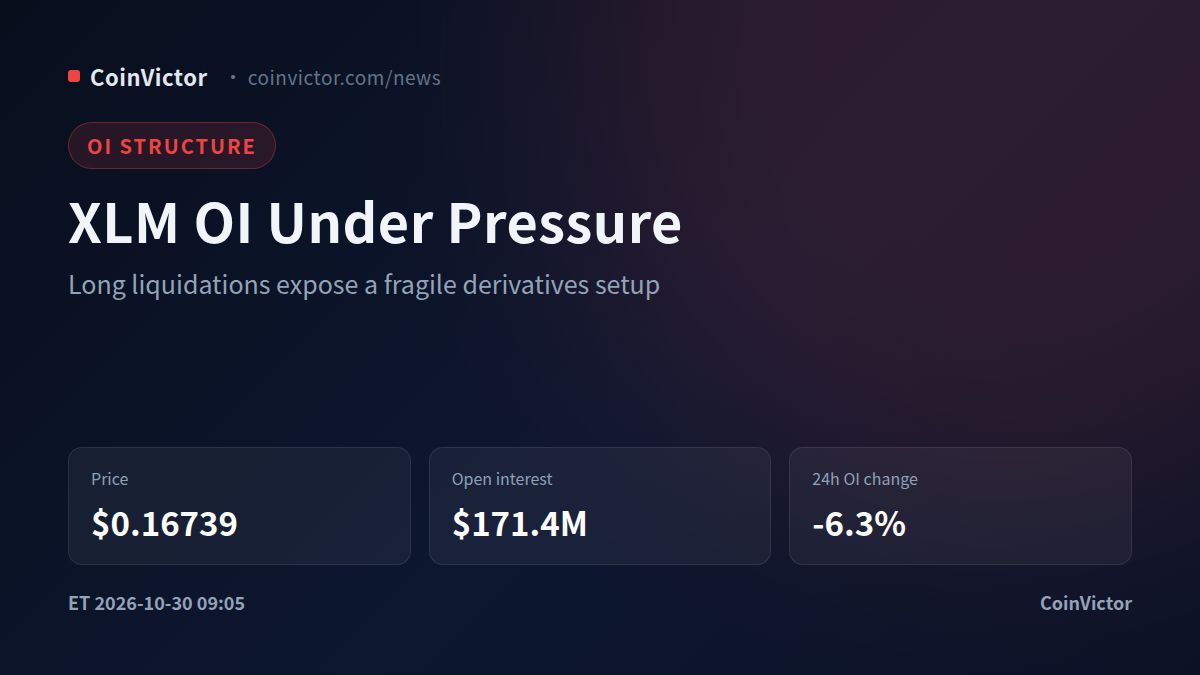
Stellar XLM is trading near $0.16739 while aggregate open interest has fallen to $171.4M, down 6.3% over 24 hours. The combination points to a market reducing exposure during weakness rather than building a clean bullish continuation. The structure is also uneven across venues, making exchange-level flows more informative than the headline total.
Recent coverage has highlighted Stellar’s expanding role in tokenized funds, cross-chain messaging and settlement infrastructure.
OI is concentrated but not moving together
Bybit carries the largest reported share at 19.0%, with $32.6M in XLM OI after a 9.7% daily decline. Binance is close behind at 18.0% and $30.9M, but its reduction is sharper at 14.3%. Gate holds 16.4%, or $28.1M, and is the clear outlier on the other side: its OI increased 9.8% over 24 hours and 10.5% over 4 hours.
Bitget contributes 11.2% and $19.3M, down 4.8% on the day. OKX is smaller at 5.0% and $8.5M, with a 9.1% decline. Taken together, the largest venues show contraction, while Gate is adding risk into the same price environment. That divergence can mean either localized conviction or delayed deleveraging, but it does not yet resemble broad-based accumulation. The one-hour ticker change adds a short-term wrinkle: total OI was up 3.3%, even as the 24-hour trend remained negative.
Funding shows a fragmented positioning battle
The funding map is far from uniform. Bitfinex shows the strongest positive rate at 0.120%, while KuCoin and WhiteBIT are both at 0.010%. By contrast, Bybit is negative at -0.021%, Kraken is -0.006%, and Binance and LBank are each -0.002%. This split matters because positive funding usually reflects a cost for longs, while negative funding indicates that shorts are paying.
The ticker’s average funding rate is 0.007796% on an 8-hour basis, but that average masks the venue dispersion. Bitfinex’s positive extreme sits alongside Bybit’s negative rate, despite those venues representing very different OI footprints. Binance’s slightly negative funding is particularly relevant because it combines with a 14.3% OI reduction. That is more consistent with long-side cleanup than with an aggressively crowded short trade.
Liquidations confirm asymmetric downside pressure
Liquidation data gives the clearest directional signal. Over 24 hours, XLM liquidations totaled $2.8M, with $2.8M from longs and only $15.8K from shorts. The imbalance is much less extreme over shorter windows: the 12-hour window recorded $15.7K in long liquidations versus $12.9K in shorts, while the 4-hour window had $1.2K versus $475. The latest 1-hour window was also modest, at $389 in longs and $475 in shorts.
The largest recorded event was a $553.3K long liquidation on Hyperliquid at $0.15954732. This level is important because it marks a demonstrated stress point below the current market, not merely a theoretical support zone. Binance’s account split remains mildly long at 53.0% versus 47.0% short, with a 1.1263 ratio. That account bias, paired with the liquidation imbalance, suggests long exposure is still more vulnerable than the account percentage alone implies.
Verdict: The near-term structure is fragile and mildly bearish while XLM remains below $0.16746 and aggregate OI stays around or below $171.4M. A move toward the $0.15954732 liquidation level would test whether the remaining long base can absorb another flush. This view is invalidated if price reclaims $0.16746 while OI rebuilds above $171.4M and long liquidations stop dominating the 24-hour flow.
Data as of 21:05 Beijing time on Oct 30, covering Binance, OKX, Bybit and other major venues.