TRON: $325.4M Open Interest Splits Four Major Venue Positions
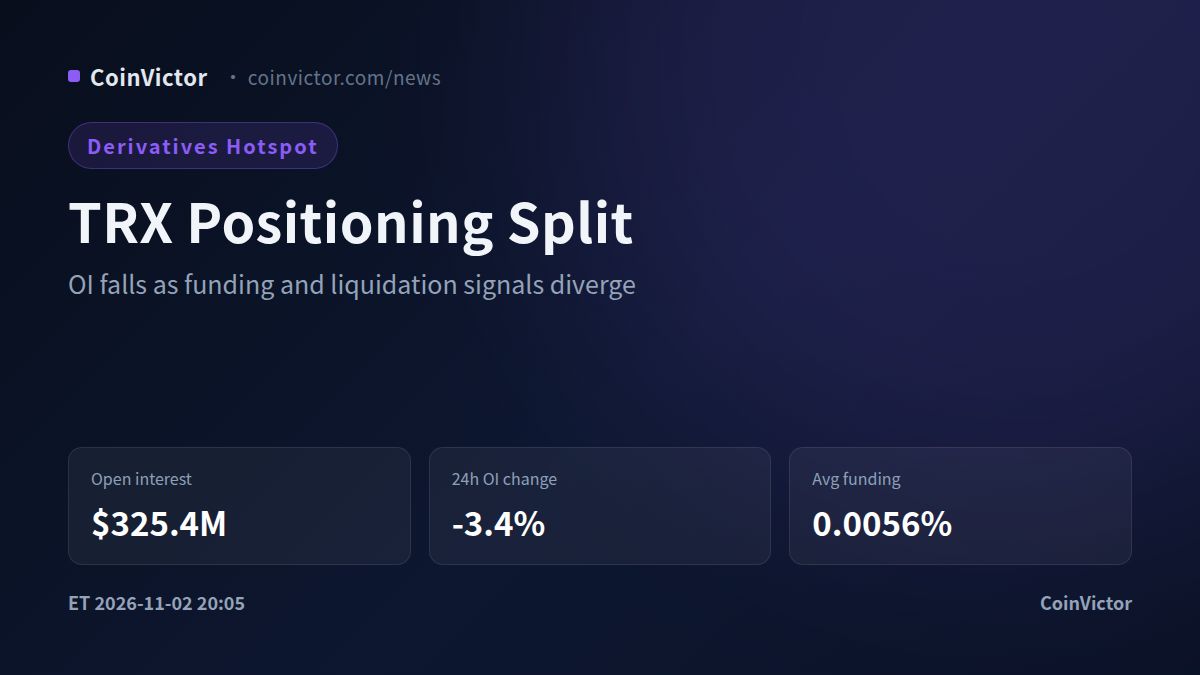
TRON derivatives are sending a divided signal at $0.3204: aggregate open interest is $325.4M after a 3.4% 24-hour decline, yet funding remains positive and the account-versus-taker positioning gap leans in opposite directions. The result is not a clean bullish or bearish setup. It is a market where venue concentration, crowded accounts and fading exposure need to be read together.
OI is concentrated, but not moving together
The exchange breakdown is the clearest sign of positioning divergence. Gate carries the largest share at $86.3M, or 26.5% of tracked open interest, but its OI has dropped 6.6% over 24 hours and 3.1% over 4 hours. Binance follows with $75.3M, a 23.1% share, and its 24-hour OI is down 3.7%, although its latest 4-hour change is a modest 0.1% increase.
Bybit holds $66.3M, equal to 20.4%, and is moving against the larger contraction: its OI is up 1.0% over 24 hours and 0.5% over 4 hours. OKX is smaller at $24.2M, or 7.4%, but its increases are stronger at 3.9% over 24 hours and 0.5% over 4 hours. The four leading venues therefore combine more than half of tracked exposure while showing materially different flows. Gate and Binance are shedding positions; Bybit and OKX are adding them.
Funding stays positive while participation disagrees
Current funding rates reinforce the split. Binance, Bybit, Gate and several other venues print 0.010%, the highest repeated reading in the supplied snapshot. MEXC and LBank also show 0.010%, while Lighter is at 0.0096% and Paradex at 0.008917%. In contrast, OKX is only 0.000795%, Hyperliquid is 0.00125%, and Bitget is negative at -0.0004%. Backpack is lower still at -0.001689%.
The aggregate average is 0.0056% on the 8-hour basis. That positive average suggests longs are still paying to maintain exposure, but the cost is uneven rather than universal. The positioning totals make the divergence sharper: the ticker shows 69.4% of accounts long, compared with 53.4% on the active-taker measure. On Binance specifically, the account split is much less extreme at 53.2% long versus 46.8% short, with a 1.1349 ratio. Accounts are therefore more bullish in aggregate than the traders driving immediate executions, a setup that can leave passive longs vulnerable if momentum fails.
Short liquidations lead the near-term tape
The liquidation structure is also time-sensitive. In the latest 1-hour window, all $5,304.38 of liquidations came from shorts, with no long liquidations recorded. Over 4 hours, shorts accounted for $14,895.75 versus only $247.70 for longs, for a $15,143.45 total. This is consistent with brief upside pressure forcing out leveraged shorts even while OI contracts across the broader market.
The picture changes over the longer windows. During 12 hours, long liquidations reached $77,034.37 against $30,534.07 for shorts, and the 24-hour totals were $80,605.63 for longs versus $34,283.65 for shorts. Total 24-hour liquidations were $114,889.28. In other words, the recent short squeeze signature sits on top of a larger period in which long positions absorbed most forced selling. That combination argues for unstable positioning rather than a confirmed trend reversal.
Verdict
The exclusive read is mildly defensive: $0.3204 is the key observed price, while $325.4M is the aggregate OI reference and $86.3M is the largest venue block at Gate. Positive funding and short-heavy 1-hour and 4-hour liquidations can support another squeeze, but the 3.4% daily OI decline, long-heavy 12-hour and 24-hour liquidations, and 69.4% account-long reading leave the upside fragile. This view is invalidated if TRX holds above $0.3204 while aggregate OI rebuilds above $325.4M, especially if the active-taker long share rises from 53.4% rather than merely following crowded account positioning.
Data as of 09:05 Beijing time on Nov 3, covering Binance, OKX, Bybit and other major venues.