TRON Funding Hits -0.0336% While $305.8M OI Stays Elevated
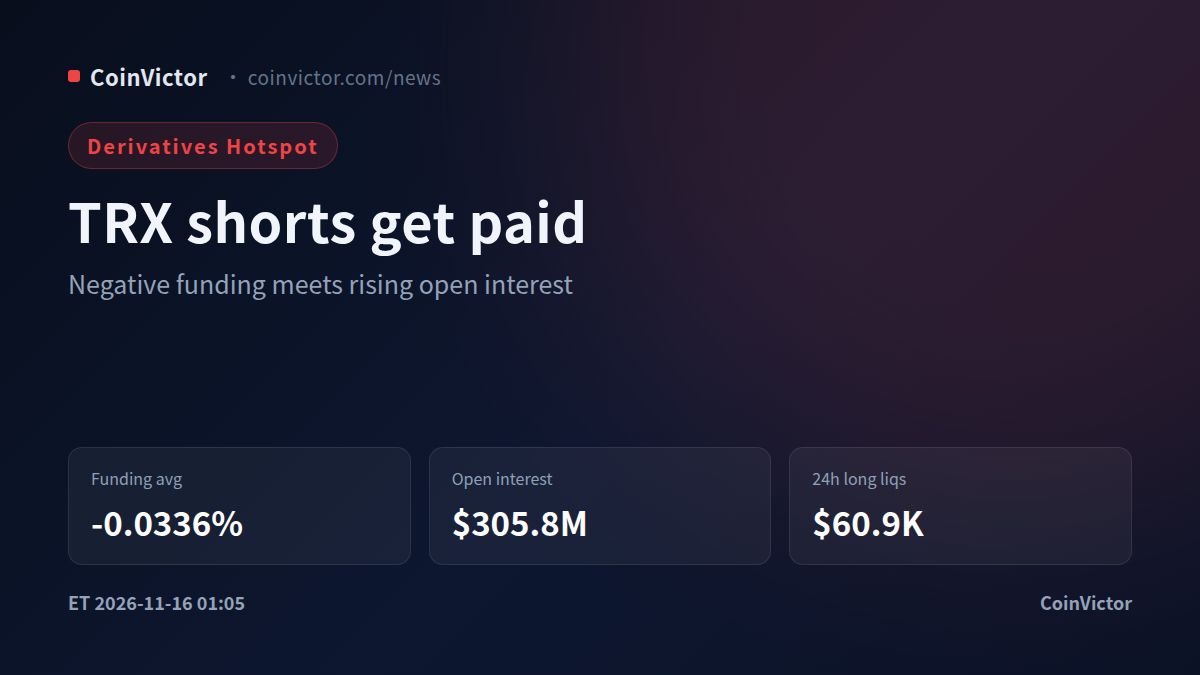
TRON perpetuals are flashing a clear bearish stress signal: the average eight-hour funding rate is -0.0336%, while aggregate open interest has climbed 1.5% in 24 hours to $305.8M. That combination means short-position holders are being paid as leverage remains in the market, rather than being washed out. The token trades at $0.3026, down 1.3%, with the one-hour, four-hour and daily RSI readings at 36.7, 30.6 and 32.3 respectively.
A recent market commentary questions whether traders are allocating capital to the strongest blockchain venues, adding a broader skeptical tone around current network preferences.
Funding is negative across the main venues
The funding stress is broad, but not uniform. Aster shows the most negative reading at -0.0648%, followed by Binance at -0.0446%, LBank at -0.0443%, MEXC at -0.0444% and OKX at -0.0369%. Bybit is also negative at -0.0308%, while Gate records -0.0304%. The only positive major reading in the supplied set is HTX at 0.0100%; dYdX is neutral at 0.0000%.
This dispersion matters because it shows the bearish carry is concentrated most heavily on several active derivatives venues, rather than being an isolated print from one exchange. The negative average therefore supports a short-heavy positioning interpretation, but the size of the payment also raises the risk of a sharp squeeze if price stabilizes and shorts begin closing.
Open interest is still expanding
The largest TRX positions sit on Gate at $84.8M, representing 27.8% of tracked open interest, followed by Binance at $73.6M and 24.1%, Bybit at $57.7M and 18.9%, and OKX at $26.6M and 8.7%. Together, these four venues account for most of the observed positioning. Their direction is mixed: Gate open interest increased 4.8% over 24 hours, Binance rose 2.8% and OKX rose 2.8%, while Bybit declined 1.2%.
That split helps explain why the market can show negative funding without a broad collapse in leverage. New or maintained positions are still building on several venues, and total open interest is up 1.5% even as spot-related activity weakens. The lack of a supplied taker long/short reading prevents a firm comparison between account positioning and aggressive execution. The available account measure is more balanced: Binance accounts are 49.5% long and 50.5% short, while the wider account snapshot is 54.4% long.
Long liquidations dominate the damage
The liquidation structure is decisively one-sided. Over 24 hours, TRX long liquidations reach $60.9K versus $6.9K for shorts, out of a $67.9K total. Over 12 hours, longs contribute $34.2K against $2.4K for shorts. The shorter windows show the same pattern: $2.6K of longs and no shorts in one hour, then $2.8K of longs versus $76.4 in shorts over four hours.
This is not a high-dollar liquidation event, but the direction is consistent. Longs are absorbing the immediate losses while short traders collect negative funding, creating a market structure that remains vulnerable to either continued drift lower or a reflexive squeeze if selling pressure fades.
Verdict: The bearish bias remains valid while TRX stays around or below $0.3026 and aggregate open interest holds near or above $305.8M, because rising leverage combined with negative funding and long-led liquidations favors further downside pressure. A sustained move above $0.3026 together with open interest falling below $305.8M would invalidate that view by signaling short covering and leverage reduction rather than fresh downside positioning. Data as of 14:05 Beijing time on Nov 16, covering Binance, OKX, Bybit and other major venues.