TRON Funding Turns Negative With 57.1% of Accounts Still Long
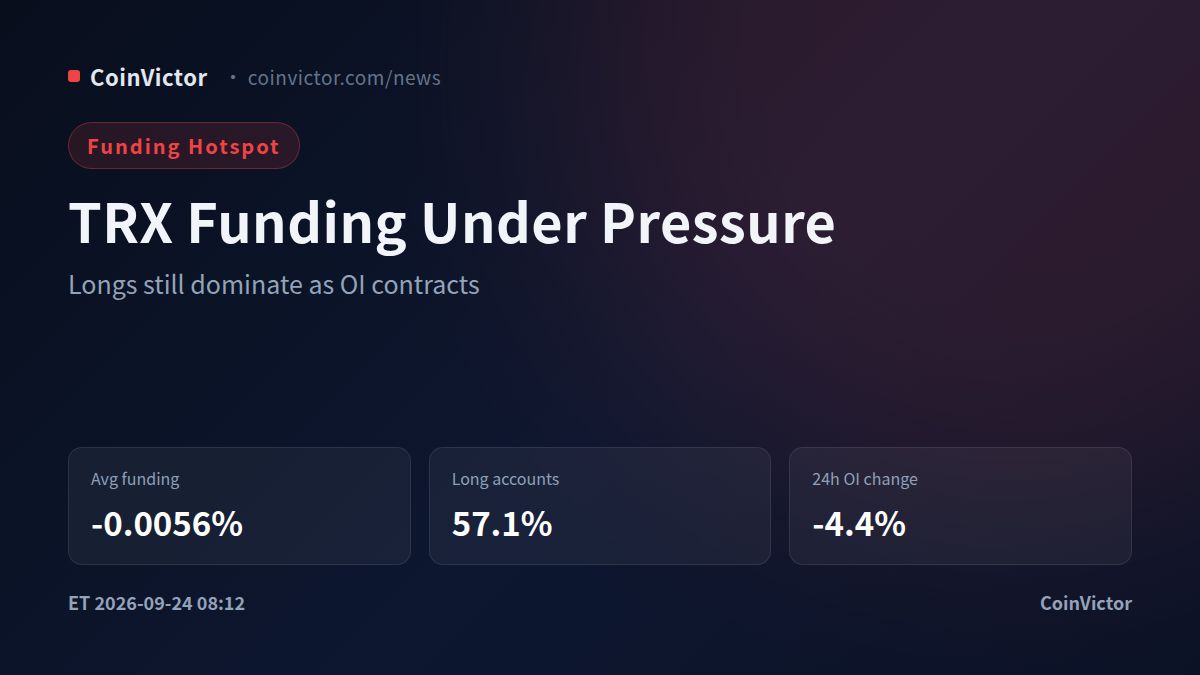
TRON is showing a clear derivatives imbalance: its average funding rate is -0.0056%, while 57.1% of Binance accounts are long and active takers are even more aggressively positioned at 68.3%. At the same time, open interest has contracted 4.4% over 24 hours to $242.1M. The combination points to long exposure being reduced under pressure, but not yet fully flushed from the market.
Recent coverage has paired TRON ecosystem updates with broader discussion of stablecoin settlement activity.
Negative funding is broad, but not uniform
The funding signal is not confined to one venue. Bybit shows the sharpest negative reading among the major exchanges at -0.0273%, followed by Binance at -0.0143% and OKX at -0.0107%. Bitget is also negative at -0.0127%, while Gate is milder at -0.0084%. This spread matters: traders on Bybit are paying the strongest premium to maintain short exposure, suggesting that bearish positioning is most crowded there.
There are still pockets of positive funding. CoinEx is at 0.0127%, while dYdX is 0.0033% and Lighter is 0.0072%. That dispersion argues against a clean, market-wide short consensus. The broader derivatives basis remains weak, however, at -0.1%, with the annualized basis at -18.3%. In practical terms, futures pricing continues to reflect defensive demand rather than a confident upside chase.
Open interest is concentrated in declining venues
Binance remains the center of TRX derivatives activity with $97.1M of open interest, representing 40.1% of the tracked total. Bybit follows with $51.8M and a 21.4% share, while OKX holds $13.7M, or 5.7%. Together, these three venues account for most of the visible positioning, so their changes are more important than isolated activity on smaller exchanges.
Each of the three largest books is shrinking: Binance is down 2.7% over 24 hours, Bybit is down 2.0%, and OKX is down 5.4%. The fourth-largest listed venue, Bitget, has $9.0M in open interest and is down 5.2%. This is a deleveraging pattern rather than a straightforward increase in bearish risk. Traders are removing contracts while negative funding remains in place, which can reduce liquidation pressure but also leaves the market vulnerable to a sharp squeeze if spot demand returns.
Liquidations confirm long-side stress
The liquidation profile is heavily one-sided. Over 24 hours, TRX recorded $216.3K in long liquidations against just $3.9K in short liquidations. The same structure appears over 12 hours, with $34.3K in long liquidations versus $1.4K in shorts, and over 4 hours, with $34.2K in longs versus $15.68 in shorts. The latest 1-hour window contained $9.78 in long liquidations and no short liquidations.
This aligns with the long/short ratio divergence: account positioning is moderately long at 57.1%, but taker positioning is materially more long at 68.3%. Accounts represent the wider participant base, while taker flow captures more immediate trade aggression. Both readings lean bullish, yet the liquidation data shows that longs have been paying for that conviction. The market is therefore not simply bearish; it is long-biased and being forced to unwind.
Verdict: The negative-funding thesis remains active while TRX holds below $0.33938 and total open interest stays below $242.1M, especially with long liquidations dominating. A move above $0.33938 accompanied by open interest rebuilding above $242.1M and funding turning positive would invalidate the bearish-deleveraging view. Data as of 20:12 Beijing time on Sep 24, covering Binance, OKX, Bybit and other major venues.