TRON OI Structure: $293.3M Open Interest Meets Uneven Funding
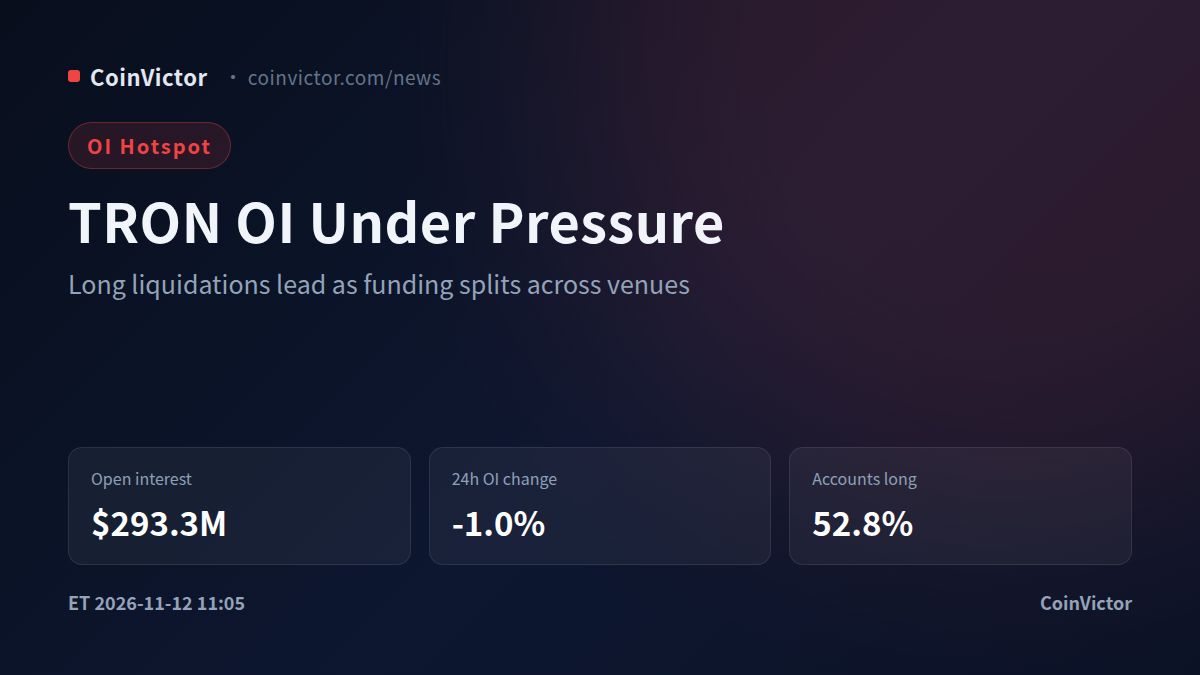
TRON is trading at $0.3156 while its open interest stands at $293.3M, down 1.0% over 24 hours. That combination points to a soft deleveraging phase rather than a clean directional expansion: price is weak, total positioning is shrinking, and the derivatives market has not yet shown the kind of fresh risk build that would support a durable rebound.
Separately, reports indicate that TRON, Tether and Chainalysis are coordinating efforts aimed at responding to crypto-related crime and AI-enabled threats.
Concentration is high, but not uniform
The exchange structure gives the clearest read on where the remaining risk sits. Gate leads with $74.4M, or 25.4% of tracked open interest, followed by Binance at $68.5M and 23.3%, and Bybit at $60.1M and 20.5%. OKX is a more distant fourth at $23.9M and 8.2%. Together, the top three venues account for the overwhelming majority of the visible book, making their changes more important than activity on smaller platforms.
Those positions are not moving in the same direction. Binance open interest rose 1.9% over 24 hours, while Bybit was nearly flat at 0.0%. Gate declined 0.8% and OKX slipped 0.4%. The result is a split structure: Binance is adding exposure into weakness, but the largest venue by share is reducing it. That is less consistent with broad conviction than with selective repositioning.
Funding shows a divided derivatives market
The funding rate map is unusually mixed. Bybit and HTX are positive at 0.010% each, while Gate is also positive at 0.002%. In contrast, OKX is negative at -0.01481%, Binance is negative at -0.007982%, and Bitget is more negative at -0.015%. The average funding reading is -0.003763% on an 8-hour basis.
This spread matters because it weakens the case for a one-sided crowded long. Traders on some venues are still paying to hold longs, but the most negative readings show that short-side demand or defensive hedging is stronger elsewhere. With the aggregate rate below zero, the broader derivatives tone remains cautious even though isolated venues retain positive funding.
Liquidations favor the downside, while positioning stays mild
The liquidation record reinforces that interpretation. Over 24 hours, long liquidations reached $92.9K against only $6.0K for shorts, for a total of $98.9K. The imbalance was already visible over 12 hours, with $15.1K of longs liquidated versus $4.6K of shorts. In the last 4 hours, long liquidations were $13.7K compared with $4.5K for shorts.
That is a meaningful asymmetry, but not yet a full capitulation event. Binance accounts are 52.8% long and 47.2% short, a modest long bias rather than an extreme crowding signal. The active taker long/short reading is unavailable, so there is no reliable evidence that aggressive buyers are absorbing the forced selling. The account data and liquidation data therefore point in the same broad direction, while the missing taker measure limits confidence in any immediate reversal call.
The exclusive verdict is that TRX remains structurally fragile around $0.3156, with $293.3M of open interest still needing to stabilize before a bullish price structure can be trusted. A move back above $0.3156 accompanied by open interest expanding above $293.3M would invalidate the bearish-deleveraging view; without that combination, the dominant signal remains long liquidation and uneven venue participation.
Data as of 00:05 Beijing time on Nov 13, covering Binance, OKX, Bybit and other major venues.