Uniswap Basis Turns -52.9% Annualized as $512.3M OI Contracts
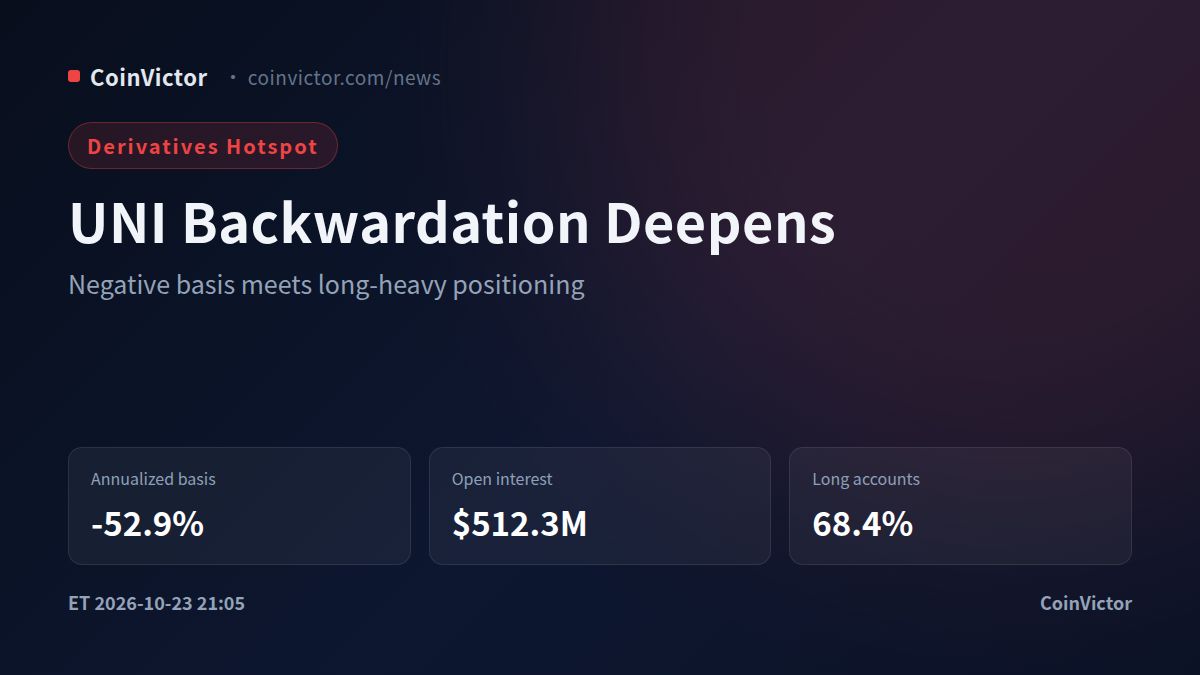
The Uniswap derivatives market is flashing a clear backwardation signal: its basis is -0.1%, equivalent to -52.9% annualized, while aggregate open interest sits near $512.3M after shrinking 3.0% over 24 hours. The pressure is not simply a low-volume move. UNI is down 1.7%, turnover is $343.4M, and open interest has also declined 1.1% in the latest hour, suggesting positions are being removed as price weakens rather than renewed through aggressive dip buying.
Recent coverage has highlighted Uniswap’s expansion of external DEX routing through its v4 aggregator hooks.
OI contraction is broad, but not uniform
Binance remains the dominant venue with $151.3M, or 29.5% of tracked UNI open interest, and its position base has fallen 3.9% in 24 hours. Gate holds the second-largest block at $93.0M and 18.2%, but it is the outlier: its OI increased 0.4% over the same period. Bybit contributes $57.5M, or 11.2%, after a 2.6% decline, while OKX accounts for $36.4M, or 7.1%, after a 2.3% drop.
This split matters for the negative basis. The largest books are generally contracting, which reduces the fuel for an immediate bullish reversal, while Gate’s modest expansion may reflect shorts being added rather than constructive long accumulation. Across the tracked venues, the total OI change is -3.0%, consistent with a deleveraging market rather than a clean trend reset.
Funding confirms a venue-level short bias
The funding rate map is mixed, but the important signals lean negative. CoinEx shows -0.2%, the weakest reading in the table, while Bybit is -0.0% and Binance is also -0.0% after rounding to one decimal place. In contrast, Gate is +0.0%, OKX is +0.0%, and Coinbase is +0.0%. The small positive readings on several venues do not outweigh the negative rates on the larger derivatives venues, especially when paired with a deeply negative annualized basis.
That divergence says the market is not uniformly short. Instead, carry is being priced differently across venues, with the most liquid futures books showing enough short pressure to keep contracts below spot expectations. For basis traders, the key risk is that a crowded negative carry can unwind quickly if price recovers without a fresh OI build.
Liquidations expose the long-side weakness
UNI liquidations totaled $3.1M over 24 hours, with $2.8M from longs against $0.3M from shorts. The imbalance was even more severe over four hours: $2.3M in long liquidations versus only $3.6K in shorts. The largest recorded event was a $1.0M Binance UNIUSDC long liquidation at $6.6944, followed by another Binance long liquidation worth $96.5K at $6.7400. A $66.1K OKX long liquidation occurred at $6.9560.
Positioning data adds an important contradiction. Accounts remain long-heavy: Binance is 61.9% long, OKX is 71.8%, Bybit is 69.8%, and Gate is 70.3%. Yet Gate’s aggressive taker flow is only 8.5% long and 91.5% short, a stark gap between passive account positioning and active execution. This is the defining tension in the setup: traders still hold long exposure, but the orders hitting the market are predominantly defensive or bearish.
Verdict: The bearish UNI derivatives view remains valid while price stays below the $7.324 liquidation reference and OI remains around or below $512.3M; the $6.6944 area is the key downside stress level. A sustained move above $7.324 with OI rebuilding above $512.3M would invalidate the backwardation-led bearish read by showing that fresh leverage is returning alongside price. Data as of 09:05 Beijing time on Oct 24, covering Binance, OKX, Bybit and other major venues.