Uniswap UNI: $599.9M Open Interest Builds as Liquidation Skew Splits
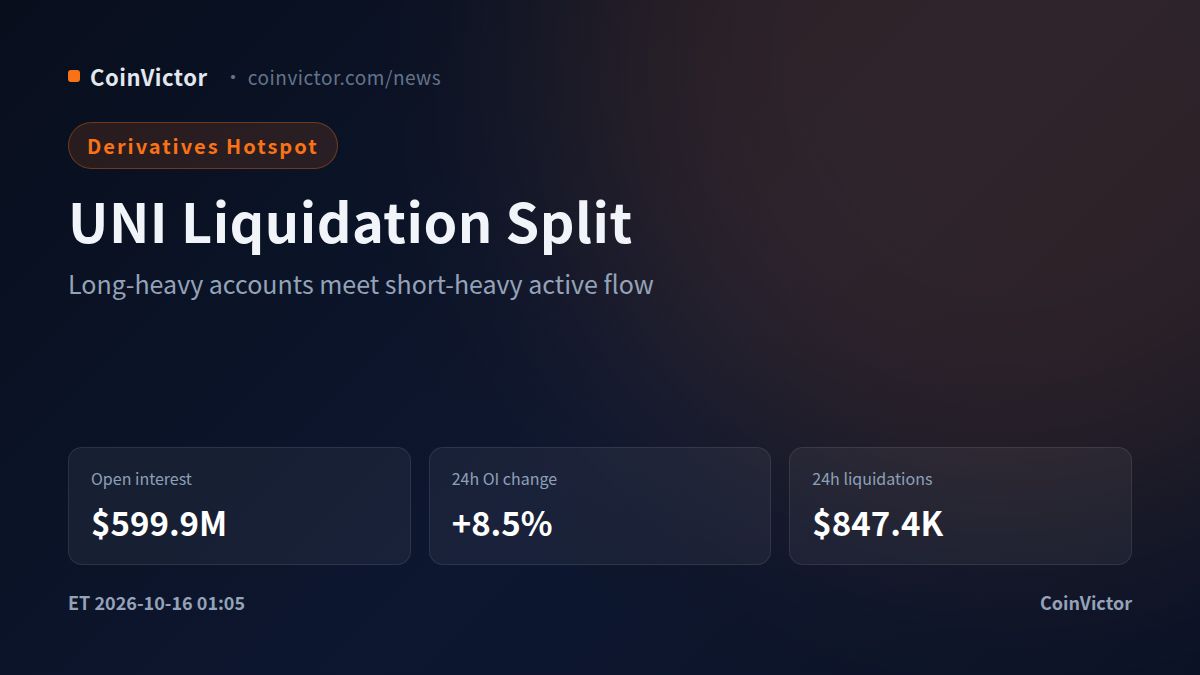
At $7.50, Uniswap is sitting inside a sharp derivatives expansion: aggregate open interest is $599.9M, up 8.5% in 24 hours, while reported liquidations reached $847.4K. The headline risk is not simply bullish or bearish. It is a split liquidation-skew setup, with account positioning leaning long, active takers leaning short, and the timing of forced exits changing across windows. Recent coverage has also pointed to renewed Uniswap activity and a rise in futures positioning.
OI growth is concentrated, not uniform
Binance remains the dominant venue with $183.8M of UNI open interest, or 30.6% of the tracked total, after an 8.5% daily increase. Gate holds $113.3M and 18.9% share, with the fastest large-venue growth at 12.2%, while Bybit carries $68.6M, or 11.4%, after a 12.9% rise. OKX contributes $43.6M and 7.3%, up 9.0%.
The concentration matters for liquidation risk. Gate's four-hour open interest fell 0.7% even as its daily figure rose, while Bybit and OKX added 1.9% and 2.6% over the same shorter window. That divergence suggests that some of the daily expansion is being refreshed rather than accumulated evenly across venues. The broader 8.5% increase therefore raises the amount of leverage exposed to a reversal, but it does not identify one clean directional crowd.
Funding is positive, but the cross-venue signal is noisy
The current funding rate profile is mostly positive. Binance, Bybit, OKX and several other major venues print 0.0% after one-decimal formatting, while Gate is also 0.0%. CoinEx is the clear negative outlier at -0.2%, compared with Coinbase at 0.0%. The ticker's average eight-hour funding reading converts to 0.0% at the same precision.
This is a mild carry signal rather than an extreme one. Positive funding across the largest pools is consistent with long holders paying to stay exposed, but the negative CoinEx print and the low displayed average argue against treating funding alone as proof of a crowded long squeeze. In this setup, liquidation direction and taker flow are more informative than the rounded funding headline.
Liquidations expose the short-term fault line
The one-hour window shows $16.5K of liquidations, including $16.5K from shorts and just $37.1 from longs. That short squeeze has already appeared in the tape. Over four hours, however, the structure flips: long liquidations total $102.8K against $20.3K for shorts. Over twelve hours, longs account for $131.6K and shorts $72.5K. Across 24 hours, the split is nearly even, with $404.9K in long liquidations versus $442.5K in shorts.
That progression describes a market that first punished shorts, then began testing long leverage. The positioning data reinforces the tension. The overall account long share is 63.7%, yet the active taker long share is only 43.1%. On Binance, accounts are 60.4% long, but takers are almost balanced at 50.1% long. Gate is more revealing: accounts are 68.0% long while takers are 40.0% long, meaning aggressive flow is 60.0% short. Passive traders are leaning into upside exposure while immediate execution is leaning the other way.
Verdict: UNI's near-term skew is fragile and favors another long-liquidation test rather than a clean continuation, because $7.50 price exposure sits against $599.9M of open interest, long-heavy accounts and increasingly short active flow. The view is invalidated if UNI holds above $7.50 while open interest expands beyond $599.9M without four-hour long liquidations rising beyond $102.8K; that combination would show absorption rather than forced unwinding. Data as of 13:05 Beijing time on Oct 16, covering Binance, OKX, Bybit and other major venues.