Uniswap UNI OI at $784.1M as Long Bias Meets Divergent Signals
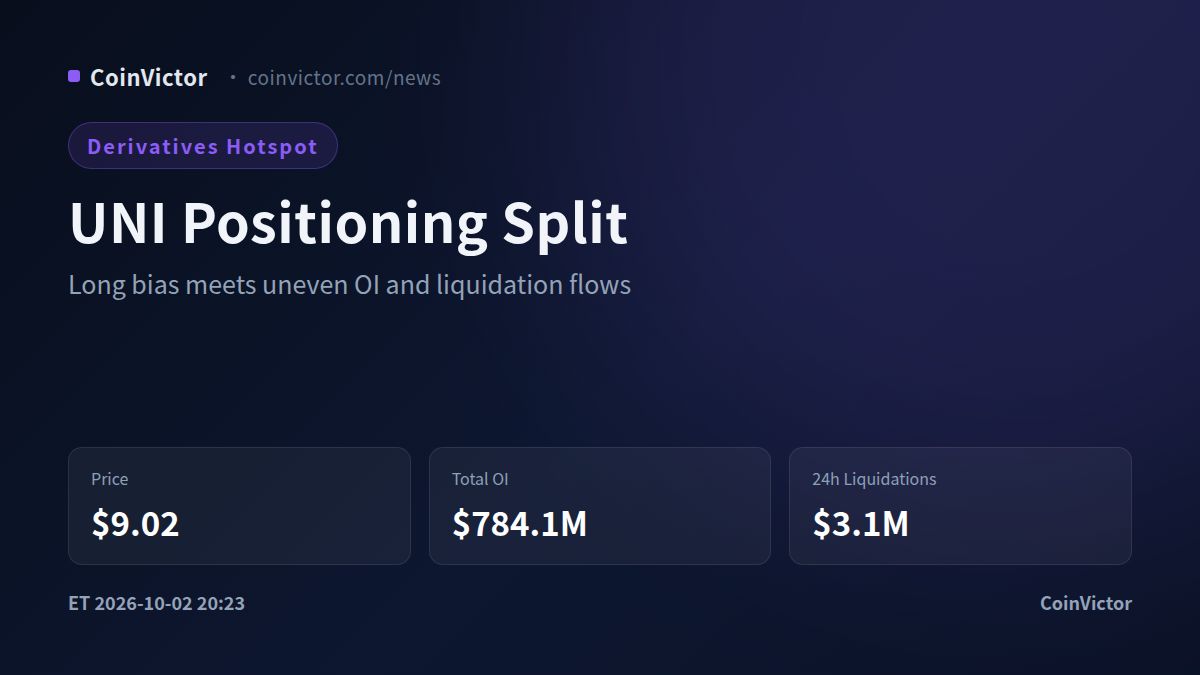
Uniswap derivatives are opening with UNI near $9.02, total open interest at $784.1M and 64.1% of tracked accounts positioned long. That combination looks bullish at first glance, but the underlying structure is less decisive: total OI is down 2.3% over 24 hours, while the 24-hour liquidation bill reached $3.1M and was dominated by long liquidations. The key market story is therefore positioning divergence, not a clean directional consensus.
News context: Uniswap is also being linked with a Japanese securities firm on a planned DeFi gateway intended to expand access under local compliance requirements.
OI concentration hides a venue split
The open-interest map is concentrated but internally divided. Binance holds the largest share at 32.3%, with $253.0M in UNI OI and a 1.6% 24-hour increase. Bybit is smaller at 10.9% and $85.6M, yet its OI is also up 0.2%. Together, those two venues show fresh risk being added where liquidity is deepest and where the short-term four-hour changes are positive at 2.2% and 2.5%, respectively.
That accumulation is offset by heavy contraction elsewhere. Gate represents 19.4% of total OI, or $151.8M, but its 24-hour OI has dropped 11.5%. OKX holds 6.4% and $50.1M after a 4.0% decline. Across all tracked venues, the result is a 2.3% daily reduction to $784.1M. This is a meaningful divergence: Binance and Bybit are rebuilding exposure while Gate and OKX are removing it, so the headline OI total understates the disagreement between venue cohorts.
Funding is positive, but not uniformly convincing
The funding-rate picture supports a mild long premium rather than an overheated one. Binance, Bybit and OKX are all positive at 0.0% when rounded to one decimal place, while Gate is also 0.0% and CoinEx is the clear negative outlier at -0.2%. Coinbase is the highest positive reading at 0.0% on the same display basis. The average funding reading is therefore close to neutral despite the account imbalance.
That matters because the account long share is 64.1%, while the active taker long share is only 60.5%. Binance shows the sharpest disagreement: 59.8% of accounts are long, but taker flow is nearly balanced at 50.7% long. Gate is the extreme opposite, with 65.9% of accounts long and 93.7% of taker flow long. In other words, passive account positioning is broadly bullish, but active execution is concentrated on one venue and almost neutral on another. The market is long-biased, yet its most aggressive participants are not expressing that view consistently.
Liquidations favor a recent short squeeze, not a clean trend
The liquidation windows add another layer to the split. Over one hour, shorts lost $21.0K versus only $62.72 in long liquidations. Over four hours, short liquidations were $26.1K against $2.3K for longs. However, the twelve-hour picture reverses sharply: $2.5M in longs were liquidated compared with $75.2K in shorts. Across 24 hours, long liquidations reached $2.7M while shorts accounted for $325.2K.
This sequence suggests that the latest upward pressure has been squeezing shorts after a much larger long washout, rather than reflecting broad, stable demand. The largest reported liquidation was a $166.5K Binance long at $8.499, followed by $98.0K and $97.5K long positions at $8.590 and $8.555. Those levels mark a visible downside stress zone beneath the current $9.02 price.
Verdict: UNI is showing a fragile recovery inside a divided derivatives market. Holding $8.50, near the largest liquidation zone, while price reclaims $9.02 and OI rebuilds above $784.1M would strengthen the upside case. The view is invalidated if UNI loses $8.50 while OI expands rather than contracts, signaling that new risk is reinforcing the downside. Data as of 08:23 Beijing time on Oct 3, covering Binance, OKX, Bybit and other major venues.