Uniswap UNI Positioning Splits as $356.1M OI Meets 62.4% Long Accounts
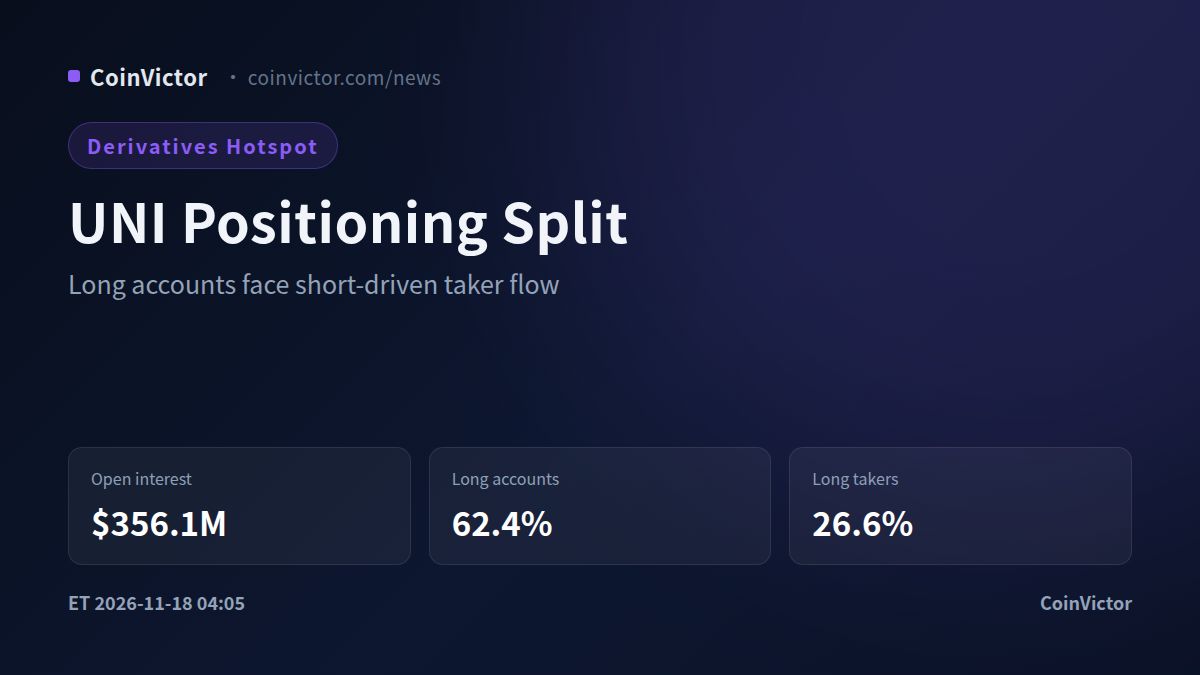
Uniswap derivatives show a clear positioning divergence at $5.25: open interest is $356.1M, down 1.5% over 24 hours, while 62.4% of tracked accounts remain long. Active taker positioning tells the opposite story, with only 26.6% of takers long. The result is a market carrying a large passive long bias while aggressive flow is predominantly selling. Recent coverage has focused on stranded fees and broader market conditions that have kept UNI under scrutiny.
Open interest is concentrated but not expanding
The open interest structure is led by Binance at $114.5M, representing 32.2% of the tracked total. Gate follows with $53.4M and a 15.0% share, while Bybit holds $38.7M, or 10.9%, and OKX holds $33.6M, or 9.4%. These venues account for most of the visible positioning, but their daily changes are not aligned with the current account bias.
Binance open interest fell 2.1% over 24 hours, Gate declined 5.5%, OKX dropped 3.6%, and Bybit was nearly unchanged at -0.0%. Yet each of those venues posted a positive four-hour change: Binance rose 0.2%, OKX 1.1%, Bybit 0.6%, and Gate 0.6%. That combination suggests a modest short-term rebuilding of exposure inside a broader daily reduction, rather than a clean return of leverage. Across the tracked market, the 1-hour change is 0.3%, but the daily trend remains negative.
Funding rates split the venue complex
The funding rate map adds another layer to the divergence. Gate is paying longs 0.0088%, while OKX is at 0.004354% and Bybit is charging longs -0.006888%. Binance is also negative at -0.00331%, and Kraken is at -0.002465%. This spread means the cost of holding a long depends heavily on venue selection: longs are expensive on Gate and OKX, but shorts receive funding on Bybit and Binance.
The market-wide eight-hour average is 0.001747%, mildly positive, but that average hides the cross-venue disagreement. Positive funding on several venues is consistent with the 62.4% account-long reading, while negative funding on the largest venues by visible activity provides evidence that active positioning is leaning the other way. With the basis at -0.1%, the futures structure also lacks a strong bullish premium.
Liquidations favor a long-side reset
The liquidation profile shows that long positioning has been paying the immediate price. Over 24 hours, long liquidations reached $440.2K versus $147.7K for shorts, for a total of $587.9K. The imbalance was even sharper over 12 hours, with $124.6K in long liquidations against $15.7K in short liquidations. The latest window was quieter: four-hour liquidations totaled $3.3K, split between $1.8K longs and $1.5K shorts, while the latest hour recorded only $275.71 in long liquidations.
That liquidation pattern does not confirm a fresh long squeeze is accelerating, but it does show that the long-account majority has already absorbed meaningful pressure. The most striking contradiction appears in the long/short readings: Binance accounts are 55.6% long and Bybit accounts 69.9% long, yet Gate takers are only 1.0% long and 99.1% short. Binance takers are closer to balanced at 52.3% long, but the aggregate taker reading remains just 26.6% long. Passive longs are therefore meeting forceful short execution, especially on Gate.
Verdict
At $5.25 with $356.1M in open interest, UNI has a fragile positioning setup rather than a confirmed bullish reversal. The key risk is that account-long exposure remains crowded while takers continue selling and long liquidations dominate. The bearish-divergence view would be invalidated if UNI holds above $5.25 while open interest rises above $356.1M and taker positioning moves materially away from its 26.6% long reading; that would signal genuine demand replacing passive longs.
Data as of 17:05 Beijing time on Nov 18, covering Binance, OKX, Bybit and other major venues.