Uniswap UNI: $6.38 Price Breakout Meets a 6.4% Open-Interest Slide
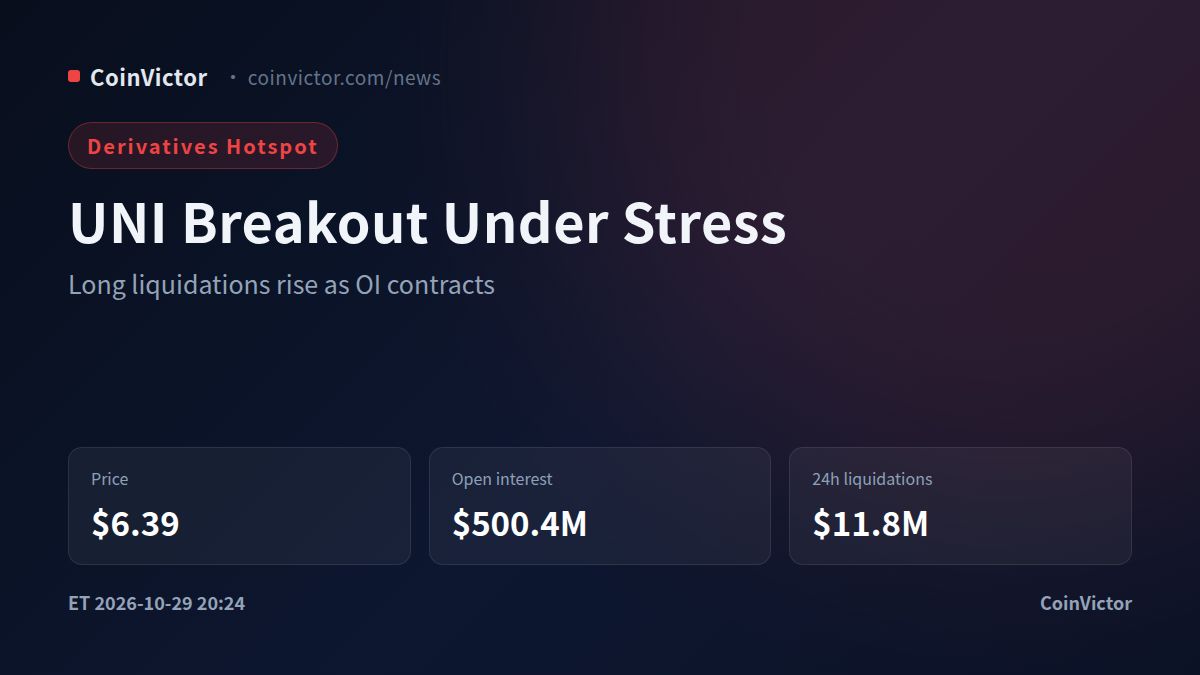
Uniswap is trading at $6.39 after a 12.3% decline, but the more important signal for a potential price breakout is contraction: aggregate open interest is $500.4M, down 6.4% over 24 hours, while spot and derivatives volume reached $1.1B. That combination suggests forced deleveraging is still overpowering fresh directional demand. Recent coverage has centered on renewed wallet activity and Uniswap’s fee-conversion tooling, but the derivatives tape is not yet confirming a durable upside turn.
Binance leads the OI retreat
Binance holds the largest reported UNI derivatives position at $147.4M, or 29.5% of tracked open interest, and its exposure fell 7.7% over 24 hours and 8.3% over four hours. Gate, with $71.4M and a 14.3% share, also contracted 8.1% in a day and 7.2% over four hours. These are meaningful reductions at two of the larger venues, so a price bounce would currently look more like short-term liquidation relief than a broad-based build in leverage.
The exception is Bybit: its $61.6M position represents 12.3% of the total and expanded 7.1% over 24 hours and 10.9% over four hours. OKX is smaller at $40.3M, or 8.1%, with a milder 1.3% daily decline. The split matters: Bybit is adding risk while Binance and Gate are removing it, leaving the market without a unified OI expansion signal.
Funding is positive, but longs are crowded
Current funding rates remain positive across the major venues, with Binance at 0.0054%, OKX at 0.0072%, Bybit at 0.0100%, and Gate at 0.0062%. The highest major-venue readings are on Bybit and OKX, while Binance’s lower rate sits alongside the deepest OI contraction. This is not an aggressive short-funding setup; longs are still paying to maintain exposure, even as leverage is being removed elsewhere.
The positioning data sharpens that warning. Account ratios show 63.6% long on Binance, 69.7% on OKX, 65.1% on Bybit, and 67.2% on Gate. Yet active taker flow is bearish where reported: Binance takers are 47.6% long versus 52.4% short, while Gate takers are only 32.7% long against 67.3% short. In other words, many accounts remain long, but aggressive market orders are leaning short. That account-versus-taker divergence can fuel a rebound if shorts are trapped, but it also shows that buyers are not controlling immediate execution.
Liquidations define the downside map
Liquidations are overwhelmingly long-sided. Over 24 hours, long positions accounted for $11.3M of $11.8M total liquidations, versus only $540.8K for shorts. The four-hour window is similarly one-sided, with $10.1M in long liquidations and $179.2K in shorts, while the latest hour still shows $2.0M in long liquidations against $6.7K in shorts. This structure indicates that the selloff has already cleared a large portion of leveraged buyers, but it has not yet produced a meaningful short squeeze.
The largest recorded forced exits also frame nearby stress points. A $610.4K long liquidation occurred at $6.4966, and another worth $348.8K hit at $6.2459; a Binance long liquidation worth $250.9K printed at $6.4070. These levels show that both the $6.50 area above and the $6.25 area below are active risk zones rather than clean technical markers.
Verdict
The immediate bias is bearish-to-neutral, not a confirmed breakout. UNI needs to reclaim $6.50 while aggregate OI rebuilds above $500.4M; without that combination, positive funding and long-heavy accounts are more likely to represent overhead supply than breakout fuel. A move below $6.2459 with OI continuing to contract would reinforce downside continuation. The bearish view is invalidated if price clears $6.50 and OI rises back above $500.4M while taker flow turns net long; a price-only bounce without that OI response does not qualify.
Data as of 08:24 Beijing time on Oct 30, covering Binance, OKX, Bybit and other major venues.