Uniswap at $7.061: Zero Basis Meets $526.3M Open Interest
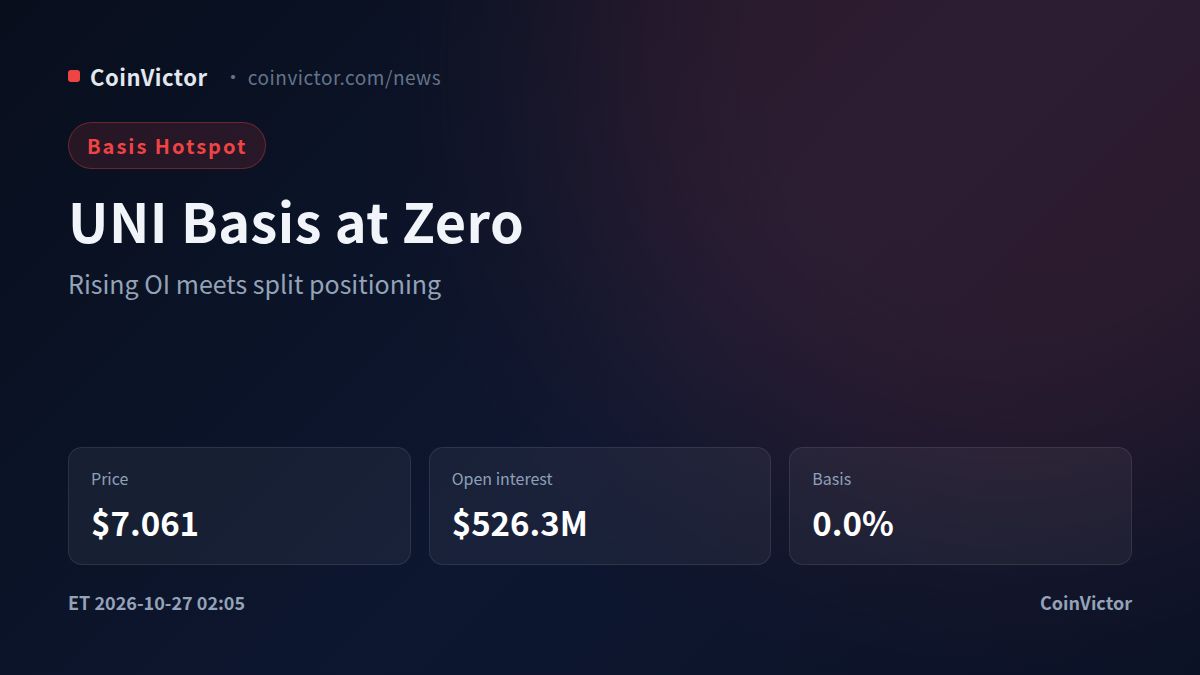
Uniswap is trading at $7.061 while its futures basis sits at 0.0%, a strikingly neutral reading beside $526.3M in total open interest. That open interest has climbed 3.5% over 24 hours, yet the average 8-hour funding rate is only 0.0031%. The combination points to leverage returning without a clear premium for longs, so the basis-backwardation angle is better described as an unresolved pressure signal than a confirmed bearish structure.
Market coverage has focused on a recent UNI bounce, weakness below nearby trend references, and the token’s expansion to another high-speed trading chain.
OI is rising, but leadership is uneven
The exchange distribution gives the first clue. Binance holds $155.7M, or 29.6% of UNI open interest, after a 2.8% daily increase, but its four-hour change is negative at 0.6%. Gate carries $79.1M, or 15.0%, and is the strongest major venue in the latest window: its open interest is up 4.0% over 24 hours and 1.2% over four hours. Bybit accounts for $57.0M, or 10.8%, with a 1.0% daily rise but a 0.7% four-hour decline. OKX has $37.7M, or 7.2%, up 0.9% daily and down 0.2% over four hours.
This split matters for a basis trade. The daily build is broad enough to keep liquidation risk elevated, but the short-term contraction on Binance, Bybit and OKX means the headline increase is not being reinforced evenly across the largest venues. Gate’s positive four-hour impulse is the exception, leaving the market vulnerable to a localized squeeze rather than a clean, venue-wide directional move.
Funding is positive on some venues, negative on others
The funding rate map is fragmented. OKX, Gate, Aster and KuCoin show the highest positive reading at 0.010%, while Binance is positive at 0.008% and MEXC at 0.008%. By contrast, Bybit is negative at 0.001%, Bitget at 0.001%, Kraken at 0.001%, Lighter at 0.003%, and Whitebit at 0.012%. Bitfinex and dYdX are at 0.0%.
That dispersion argues against treating the zero basis as a simple market-wide short premium. Some venues are charging longs, while others are paying them, which is consistent with cross-exchange positioning friction. The aggregate funding average remains positive, but its size is modest relative to the open-interest expansion. A genuine backwardation setup would become more convincing if negative carry spread across the largest OI venues while total OI continued to rise.
Positioning and liquidations disagree
Account positioning is decisively long-heavy: Binance shows 64.5% long accounts, OKX 68.2%, Bybit 64.8%, and Gate 66.7%. Yet active taker flow is less uniform. Binance takers are 59.8% long, while Gate takers are 37.2% long and 62.8% short. This account-versus-execution gap suggests many traders remain structurally long even as aggressive participants are willing to sell into the market.
The liquidation windows add another layer. In the latest hour, shorts lost $2.3K versus $1.3K for longs. Over four hours, however, long liquidations reached $24.6K against $7.2K for shorts. The twelve-hour split was nearly balanced, with $37.6K in long liquidations and $33.0K in short liquidations, while the twenty-four-hour total favored short liquidations at $188.5K versus $116.5K for longs. The largest recorded event was a $19.2K short liquidation at $7.118 on Binance, showing that upside squeezes remain possible even with long-heavy accounts.
Verdict: UNI’s immediate structure is neutral-to-fragile rather than cleanly backwardated. The key reference is $7.061, with $7.118 acting as the nearest demonstrated squeeze level; on the derivatives side, $526.3M in open interest is the level that keeps crowding risk active. The bearish basis view is invalidated if price holds above $7.118 while open interest expands beyond $526.3M and funding turns positive across the major venues; that would signal renewed long leverage instead of persistent downside carry. Data as of 14:05 Beijing time on Oct 27, covering Binance, OKX, Bybit and other major venues.