Whale Profits $31.3M at 30.7% Win Rate: HL's ROI Math
The whale behind the number
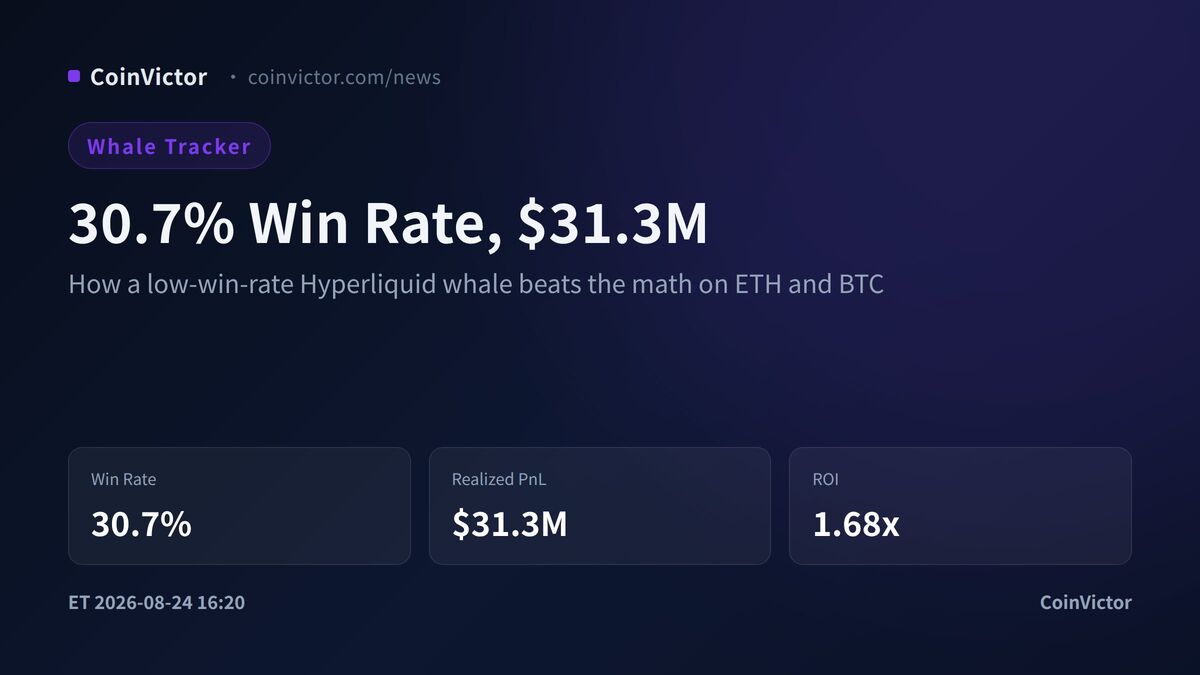
A Hyperliquid account that wins fewer than one trade in three has turned that record into $31.3M in realized profit. The address 0xa5b0edf6b55128e0ddae8e51ac538c3188401d41 has closed 1,055 trades over a 252-day window, won 324 of them, and never once got liquidated. It was active again in the last few hours, so this is not a dormant historical ledger but a live book.
The headline metric is the win rate: 30.7%. Most retail traders treat anything below 50% as failure. This account is the counterexample, and the reason is in the payoff ratio, not the hit rate.
Why a losing majority still prints money
Winning 324 of 1,055 trades means 731 trades lost money. Yet realized PnL sits at $31.34M with fees of $425K paid along the way. That math only works if average winners are several times larger than average losers. The account has an ROI of 1.68x on the capital it deployed, which is the more honest measure of edge than win rate alone.
For context, its total trading volume is $1.42B, so per-trade volume averages around $1.35M. This is not a scalper grinding tiny edges; it is a large-position trader letting winners run and cutting losers early. The 30.7% figure is the cost of admission, not the source of the profit.
ETH and BTC carry the whole book
Top coins are ETH and BTC, the two most liquid perpetual markets on the platform. That matters for a simple reason: a $1.35M average ticket needs depth, and only the majors can absorb that size without moving the market against the trader. The account has stayed out of the meme and micro-cap pools where funding can be extreme and exits messy.
Fee discipline is visible too. $425K in fees against $31.3M in profit is a 1.4% drag, roughly in line with a high-volume taker-heavy style. Nothing about the account suggests it is subsidized or model-generated; the numbers are consistent with a well-run directional book.
No liquidations, but a $13.9M drawdown
The clean sheet on liquidations is the strongest part of the profile. Over 252 days, with 90+ trades a week at this size, zero forced exits implies position sizing that never put the account at the mercy of a single candle. The max drawdown of $13.9M, about 44% of total profit, is the honest counterweight: the equity curve still swings hard between wins.
That drawdown-to-profit ratio is a reminder that even a profitable book like this one spends long stretches in the red. The 324 wins were not evenly distributed; they came in bursts that paid for many small losses in between.
What a retail trader can take from this
First, stop treating win rate as the scoreboard. A strategy with a 30% hit rate and a 4:1 average winner-to-loser ratio is structurally sound; a 90% hit rate with small wins and occasional large losses can blow up quietly. Second, the zero-liquidations record matters more than any single trade. Position sizing that survives the bad stretch is what lets the good stretch compound.
This account also shows the value of staying in liquid majors. The opportunity to deploy $1.35M tickets without slippage is itself an edge that most small accounts cannot access, and it is a reason the same math does not always scale down to micro caps.
Data as of 04:20 Beijing time on August 25, covering Binance, OKX, Bybit, Hyperliquid, Gate and Bitget among major exchanges. Hyperliquid profile data via CoinVictor whale tracking.