XRP at $1.26: $1.97B OI Reveals a Fragile Long Bias in Futures
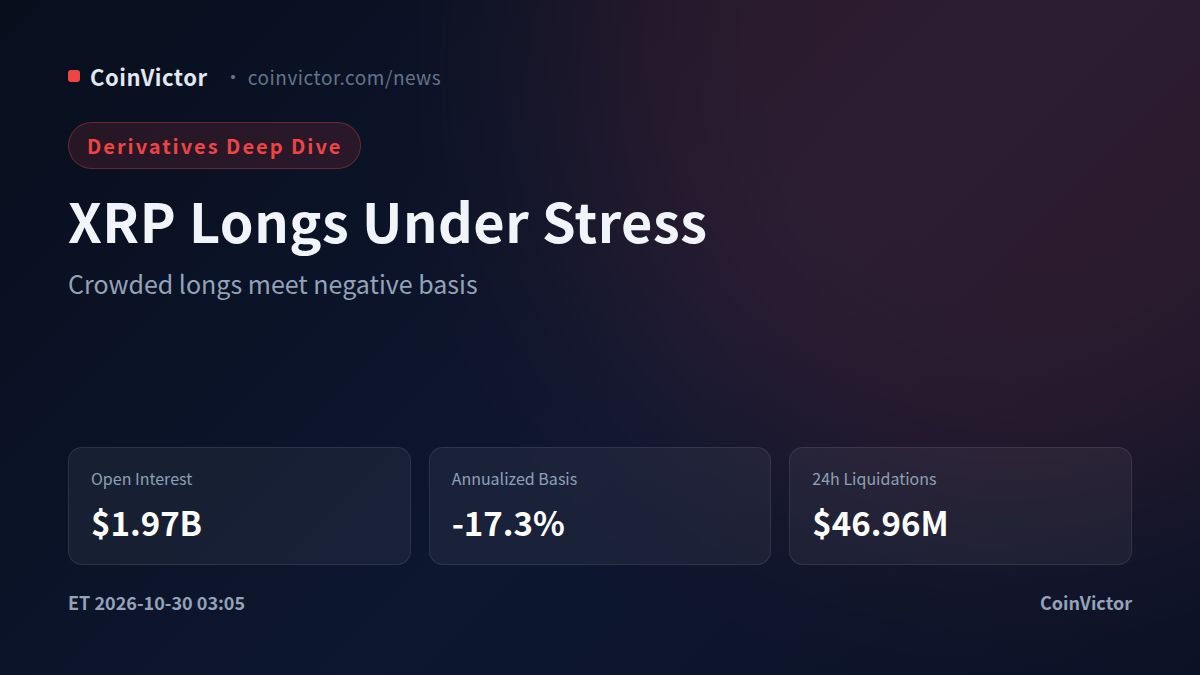
XRP is trading at $1.2638 after a 2.4% decline, but the more important signal is underneath spot: futures open interest is $1.97B, down 4.6% over 24 hours, while trading volume has risen 95.0%. That combination points to a deleveraging market rather than a clean accumulation move. The immediate structure is especially vulnerable because long exposure remains dominant even as the derivatives curve prices in a negative carry regime.
News coverage broadly portrays Ripple’s institutional access and business progress as improving, while XRP’s market performance remains under pressure. That split helps explain why dip buyers are still active even though derivatives positioning is losing resilience.
OI is falling, but not evenly
The headline open-interest number hides a meaningful exchange split. Binance holds $346.5M, or 17.6% of tracked OI, after a 12.6% 24-hour contraction. OKX holds $84.3M and fell 7.1%, while Bitget has $224.4M after a 5.8% decline. Gate remains large at $280.8M, down 3.2%. These are not small changes: the largest venues are shedding contracts while price is also lower, a classic sign that positions are being forced out or voluntarily closed.
Bybit is the exception. Its $282.7M OI is nearly unchanged over 24 hours, up 0.1%, and its four-hour change is positive at 5.4%. OKX also added 5.1% over four hours, while Bitget gained 2.8% and Gate 1.0%. This short-term rebuilding after a broader flush creates a fragile handoff: some traders are reopening risk before the larger market has proven that demand is returning. The one-hour ticker change is also positive at 0.8%, but that is too brief to offset the 24-hour contraction.
The key structural point is that OI has not collapsed. At nearly $1.97B, leverage remains large enough to amplify a move through nearby liquidation clusters. A further price decline with OI holding firm would be more dangerous than the initial washout, because it would imply that stubborn positions are absorbing losses rather than being fully cleared.
Funding and positioning favor a squeeze against longs
The funding rate picture is mixed, but the cross-venue distribution is revealing. Current readings range from -0.025359% on Bybit and -0.013915% on OKX to 0.013797% on Bitunix and 0.007211% on Binance. The average eight-hour funding input is slightly negative, so the market is not paying a broad premium for long exposure. Instead, the most active venues disagree, which usually reflects unstable positioning rather than a settled directional trend.
That unstable funding sits beside a heavily long long/short ratio by account count. Binance shows 73.8% long accounts, Bybit 81.0%, Bitget 86.7%, and Gate 69.3%. The taker data is less one-sided but still important: Binance takers are 61.4% long, while OKX is slightly short at 51.6% and Gate is extremely long at 90.2%. In other words, passive account positioning is crowded long, while aggressive flow is fragmented. Gate’s combination of heavy long accounts and strong long takers is particularly exposed if support breaks.
This is why the vulnerable side is the long side, even though negative funding can sometimes support a rebound. Negative funding reduces the cost of holding longs, but it does not erase the liquidation risk created by crowded accounts. If price falls while Bybit and OKX funding remain negative and OI rebuilds, that would signal fresh shorts pressing into a market still carrying too many longs. If price rises while funding turns broadly positive and OI expands, the squeeze risk would shift toward shorts.
Liquidations define the near-term map
The liquidation tape confirms that longs have already taken the larger hit. Twenty-four-hour liquidations total $46.96M, including $44.54M in longs versus $2.41M in shorts. Over 12 hours, long liquidations reach $43.06M, while shorts account for $1.92M. The shorter windows are even more asymmetric: four-hour long liquidations are $56,219 against $1.13M in shorts, and one-hour long liquidations are $53,242 against $615,675 in shorts. The most recent short-side burst therefore does not overturn the broader long-side damage.
Several large long liquidations cluster below the current market. Recorded levels include $1.2286, $1.2082, $1.2061, $1.2056 and $1.2008, with individual values from $1.16M to $1.82M. That makes the $1.20-$1.23 area the main stress band. A move into it could trigger another mechanical wave, particularly if OI stops declining. Conversely, a clean recovery above $1.2286 would show that the first liquidation shelf has been absorbed, but it would not by itself prove a trend reversal.
The basis supplies the macro confirmation. Current basis is about -0.0%, while annualized basis is -17.3%, a deeply defensive reading. Spot is therefore not being supported by a healthy futures premium. Daily RSI is 39.6, with four-hour RSI at 42.4 and one-hour RSI at 49.8: momentum is weak on the larger horizons, but not yet at an extreme that guarantees a rebound.
Verdict: The medium-term structure remains bearish-to-fragile, with longs more vulnerable than shorts. The critical downside zone is $1.20-$1.23, while $1.2638 is the current recovery pivot; the key OI reference is $1.97B. A break into that liquidation band with OI holding near $1.97B would favor another long flush. This view is invalidated if XRP reclaims $1.2638, OI expands from $1.97B, and funding turns broadly positive without a renewed rise in long liquidations; that combination would signal genuine demand rather than a temporary squeeze. Data as of 15:05 Beijing time on Oct 30, covering Binance, OKX, Bybit and other major venues.