XRP Deep Dive: $1.21B OI Reveals Where the Longs Are Fragile
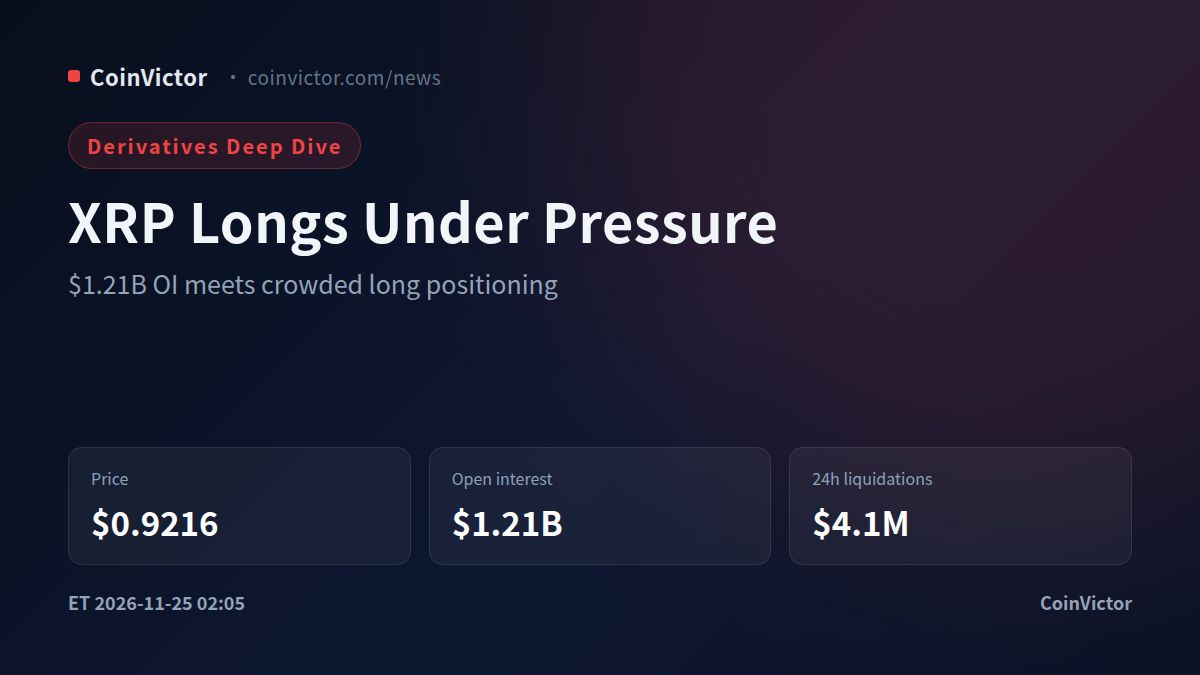
XRP is trading at $0.9216 after a 3.0% decline, but the more important signal is in the derivatives plumbing: open interest stands at $1.21B after falling 4.1% over 24 hours, while the futures basis is negative at -0.1%. That combination says leverage has been reduced into weakness, yet the remaining positioning is still heavily skewed toward longs. The result is a market where downside liquidation risk is more immediate than a clean bullish continuation.
Recent market coverage has highlighted a bearish technical cross alongside signs of recovering activity, but the derivatives data gives a more specific question: are longs being flushed into a durable base, or are they merely being compressed before another leg lower?
OI is falling, but not evenly
The aggregate OI contraction looks defensive rather than orderly. Binance holds $257.0M, or 21.2% of tracked OI, and its position base is down 1.2% over 24 hours while rising 0.7% over the latest four-hour window. Bybit carries $183.2M, or 15.1%, after a sharper 4.7% daily decline, and Gate holds $179.6M, or 14.8%, after dropping 5.0%. Bitget contributes $151.0M, or 12.4%, and is down 3.0%. These are meaningful reductions across venues with substantial exposure, not just a single-exchange anomaly.
At the same time, the short-term changes are turning positive on several major books: OKX OI is up 3.2% over four hours, Binance is up 0.7%, Bybit is up 0.5%, and Bitget is up 0.4%. That pattern suggests fresh leverage is returning after the broader unwind. The danger is that the new positions are entering while price remains below the nearest visible long-liquidation cluster. If OI rises without price reclaiming resistance, the market is likely rebuilding two-sided leverage inside a fragile range rather than confirming accumulation.
The $1.21B total is therefore the key structural reference. A continued decline would show that forced or voluntary deleveraging is still dominating. A rebound in OI can be constructive only if it is paired with price strength; otherwise, it increases the fuel available for another liquidation wave.
Positioning says longs are crowded, flow says sellers are active
Account positioning is unusually one-sided. The aggregate ticker reading shows 74.1% of accounts long, while venue-level long shares reach 79.7% on Bybit and 85.1% on Bitget. Binance is also long-heavy at 74.4%, and OKX stands at 66.6%. This is not proof that price must fall, but it means a downside move can travel quickly because many traders are positioned on the same side of the market.
Taker data provides the counterweight. Binance takers are 57.4% short, and OKX takers are 56.5% short. Gate is even more extreme, with 92.9% of taker flow short. Bitget is the exception, with 55.9% long takers. The divergence matters: passive account inventories are long, while aggressive execution is predominantly selling. That can represent hedging against existing longs, short-term downside conviction, or both. In each case, it reduces the quality of a bounce unless aggressive buyers begin to dominate.
Funding is not pricing a broad long squeeze at extreme rates, but it is also not uniformly supportive of longs. The average eight-hour funding rate is 0.0% when rounded to one decimal place. Venue readings range from 0.0% on several books to 0.0% negative on others, with HTX at 0.0% positive and WhiteBIT at 0.0% negative at the stated precision. The important message is dispersion rather than a single directional subsidy: longs are crowded by account count, yet funding is too mixed to validate a confident bullish consensus.
Liquidations identify the pressure zone
Liquidation data confirms that longs are carrying the immediate vulnerability. Total liquidations reached $4.1M over 24 hours, of which $3.6M were long liquidations and $514.7K were short liquidations. The imbalance is even clearer over 12 hours: $366.2K of longs were liquidated versus $140.5K of shorts. Over four hours, long liquidations were $64.6K against $95.3K for shorts, showing that a short-term rebound can still punish late sellers, but the broader session has already favored long-side damage.
The largest recorded event was a $234.8K OKX long liquidation at $0.9393. Other notable long liquidations appeared at $0.9291, $0.9190, $0.9120 and $0.9103. These prices form a practical map of the current leverage. The zone around $0.9393 is overhead supply and a test of whether the market can absorb previously trapped longs. The band from $0.9190 to $0.9103 is the more important downside stress area: losing it would expose remaining longs to renewed forced selling, especially if OI is rising rather than falling.
The negative basis of -0.1% reinforces this interpretation. Futures are trading below spot expectations, which is consistent with defensive positioning and short-term demand for downside protection. It is not, by itself, a capitulation signal; it becomes constructive only if the discount narrows while price and OI recover together.
Verdict: The medium-term structure remains bearish-to-fragile, with longs more vulnerable than shorts. XRP needs to hold the $0.9103-$0.9190 pressure band and reclaim $0.9393 while total OI rebuilds above the current $1.21B without another surge in long liquidations. A sustained move above $0.9393 accompanied by rising OI and a narrowing negative basis would invalidate the downside view; a break below $0.9103 with OI expanding would confirm that the long squeeze is still active. Data as of 15:05 Beijing time on Nov 25, covering Binance, OKX, Bybit and other major venues.